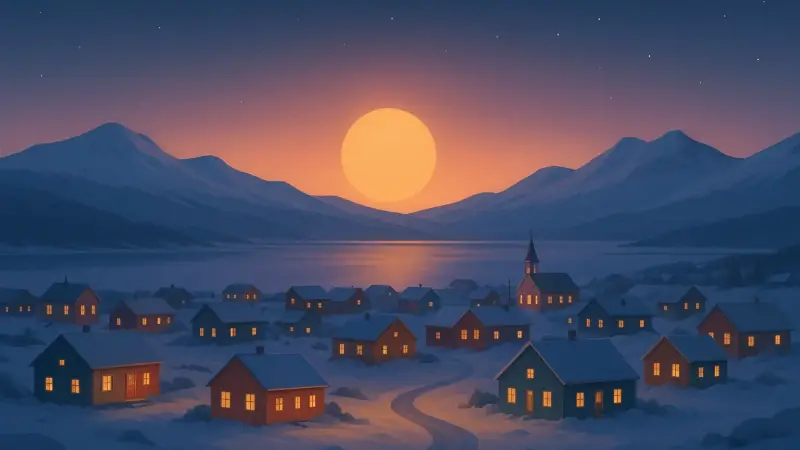
How can a town go 65 days without night?
It’s a strange thing to watch a kid walk to school under a bright sky at 11 p.m., then see the same light still hanging around at 2 a.m. In Utqiaġvik (formerly Barrow), Alaska, that can be normal. Around late May, the Sun stops setting above the horizon and stays up until late July. People often call it the “midnight sun,” and the number “65 days” is a rough shorthand that varies a bit year to year. The basic mechanism is simple: Earth’s tilt aims the Arctic toward the Sun in summer, and places far enough north end up with continuous daylight for weeks.
Why it happens there, and why the number isn’t exact
Utqiaġvik sits well above the Arctic Circle, so the geometry gets extreme. In summer, the Sun’s daily circle stays entirely above the horizon. In winter, it swings the other way and never rises. When people quote exact day counts, they’re usually blending a few definitions. “Sun above the horizon” is one thing. “It’s still light enough to read” is another. The overlooked detail is that even the strict definition depends on where you measure from. A town spreads over miles, and a flat horizon is rare. A small ridge, a building, or a bit of sea haze can change the first and last visible sliver.
There’s also the atmosphere. Refraction bends sunlight, which can make the Sun appear a little higher than it “should” be near the horizon. That matters most at the edges of the season, when everyone is watching for the first dip or the first reappearance. It can shift what people perceive by minutes, and in the Arctic those minutes feel meaningful because the change happens slowly. By the time the Sun is clearly circling high, nobody is debating definitions anymore. It’s just day, all the time.
What “night” means during the midnight sun
Even without a sunset, the light still changes. The Sun gets lower and higher in a gentle loop, so there’s usually a daily “soft” period when shadows stretch and the sky looks warmer. But it may never get dark enough to trigger the cues most people rely on. Streetlights can stay off. Porch lights feel pointless. Bedrooms need blackout curtains or improvised covers because the body still responds to light through eyelids. A detail people miss is how confusing it can be for newcomers to judge time outdoors. The sky stops being a clock.
Photography and ordinary errands get odd, too. The “golden hour” can linger, and then come back, without ever turning into full night. Work schedules may stay the same, but the outside world looks like it’s ignoring them. That mismatch is part of why residents talk about feeling wired or restless in early summer. It’s not just mood. It’s physiology getting a different signal than usual.
Why sunrise parties still make sense
If the Sun doesn’t set for weeks, “sunrise” becomes less about the daily event and more about the season turning. Communities in the far north tend to treat the first sunset after continuous daylight, or the first sunrise after the long winter darkness, as a moment worth gathering for. The timing and emphasis vary by place and by year, and it’s not always a formal, city-run thing. But the social logic is clear: after months where light feels stuck, any noticeable change becomes a shared marker. It’s one of the few outdoor signals everyone experiences at the same time.
In Utqiaġvik, people describe celebrations that look like normal parties, just anchored to an astronomical threshold instead of a calendar holiday. Someone brings food. Someone brings music. People stand around in jackets because summer in the Arctic doesn’t mean warm. And when the Sun finally behaves “normally” again, the first real dip toward the horizon can draw a crowd the way a fireworks show does elsewhere.
The practical side: daily life under a sky that won’t turn off
Continuous daylight changes routines in small, constant ways. Kids want to keep playing because it looks like afternoon. Dogs stay alert longer. People who work outside can stretch tasks late into the “evening” because visibility isn’t the limiting factor. But there’s a flip side: sleep becomes something you have to defend. Blackout curtains aren’t a luxury item. They’re part of the basic kit, like a winter coat. Another overlooked piece is that even when it’s bright, the temperature can drop fast with wind off the water, so the light can trick visitors into dressing wrong.
And then, without much warning, the arc shifts and the town starts getting true night back. The first dark hours can feel heavy because eyes have adjusted to constant brightness. People notice how loud indoor lights feel. Headlights suddenly matter again. It’s the same sky, the same place, just tilted a little differently in space.