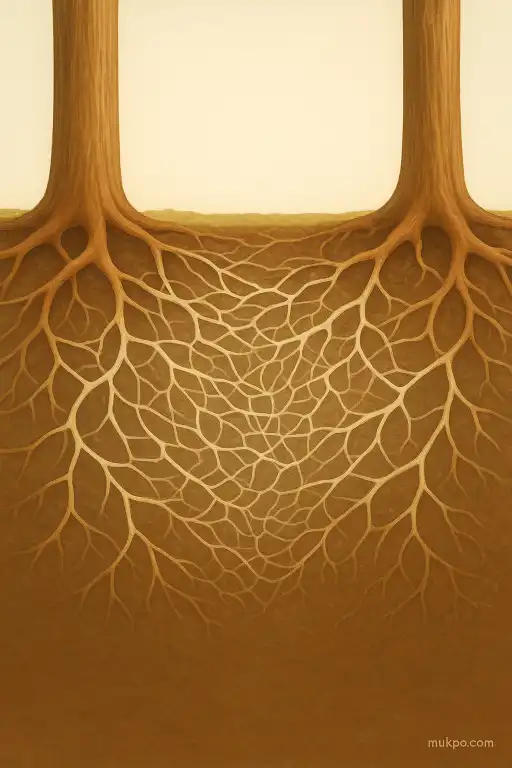
Underground trade is normal in forests
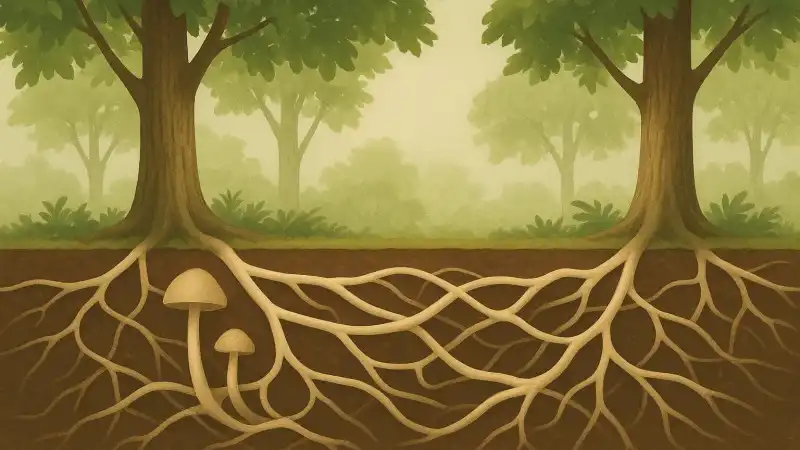
If you walk through an old forest, it’s easy to picture each tree living on its own. But it isn’t one single place or one single “network.” The same basic setup shows up in very different forests, like Douglas-fir stands in British Columbia, birch and pine forests in Scandinavia, and ectomycorrhizal woodlands across the northeastern United States. The mechanism is simple: fungi grow threadlike filaments in soil, attach to roots, and move nutrients and water in exchange for sugars made by photosynthesis. Those filaments can link multiple plants at once, so what one root can reach may not be the limit anymore.
The overlooked detail is scale. A single fungal individual can spread for meters to kilometers, and the “connections” are often many thin contacts rather than one obvious cord. That makes the whole system hard to see, easy to overinterpret, and still very real as a pathway for materials moving through soil.
How a fungus plugs into a tree
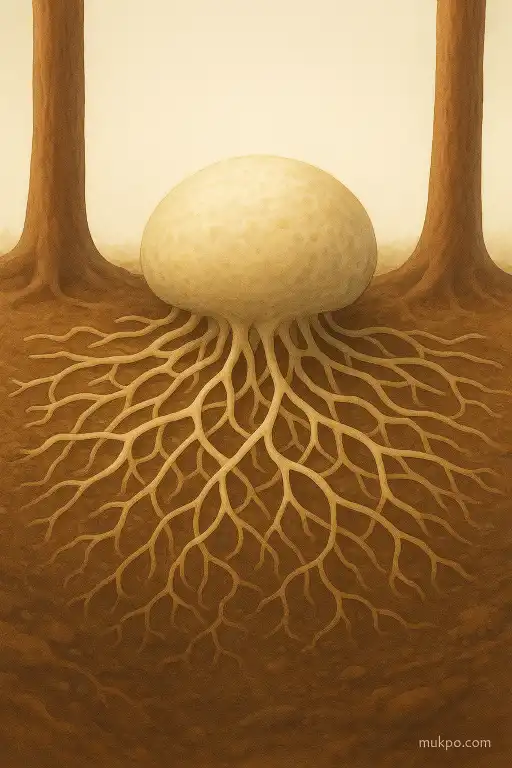
Most nutrient shuttling starts with mycorrhizae, the root–fungus partnership found in most land plants. In ectomycorrhizae (common in pines, oaks, birches, and many temperate trees), the fungus wraps the fine root tips in a sheath and threads between root cells without entering them. In arbuscular mycorrhizae (common in many grasses and tropical trees), the fungus goes into root cells and forms tiny branching structures that act as exchange surfaces. Either way, the plant “pays” with carbon-rich sugars and fats, because fungi can’t photosynthesize.
What the fungus sells back is reach. Fungal hyphae are much thinner than roots, so they explore tiny soil pores roots can’t enter. They are especially good at scavenging phosphorus and nitrogen that are patchy or bound up in organic matter. Many fungi also move water, and the extra access can matter during dry periods, even if the exact benefit varies by species, soil, and season.
What “sharing” nutrients can mean
When several plants are linked to the same fungus, materials can travel between them, but it isn’t charity and it isn’t automatic. Carbon can move from one plant into a fungus and later show up in another plant’s tissues. Nitrogen and phosphorus can also move along fungal networks, sometimes from nutrient-rich patches toward nutrient-poor roots. Researchers often track this with isotope labels (for example, carbon-13 or nitrogen-15) to see where atoms end up after a controlled pulse.
A concrete example that’s been discussed widely is carbon moving between paper birch and Douglas-fir seedlings in British Columbia experiments, depending on light conditions and which plant was shaded. But even in well-run studies, the size and direction of transfers can be unclear outside the setup. Soil microbes, root exudates, and multiple fungal species can scramble the accounting. A labeled atom arriving in a neighbor doesn’t always mean the neighbor “needed” it, or that it changed growth in a meaningful way.
Networks have rules, and they aren’t fair
Fungi don’t connect trees evenly. Some tree species host certain fungi better than others, and fungi themselves compete. A root tip might be colonized by one fungus this month and a different one next month. Connections also depend on distance and root density. Seedlings clustered near a mature tree may tap into a web of hyphae in that soil, while a seedling just a few meters away might be linked to a different set of fungi or none at all.
The currency can shift too. If a tree is photosynthesizing strongly, it can send more carbon belowground and “buy” more fungal foraging. If it’s shaded, drought-stressed, or defoliated, that carbon supply can drop fast. Fungi can respond by reallocating effort to other host plants or to parts of the soil with better returns. That’s one reason nutrient movement through these systems often looks dynamic and context-dependent instead of steady and predictable.
What these networks change in the soil
Even when nutrient transfer between trees is small, fungal networks can still reshape how a forest runs. Hyphae help build soil structure by binding particles into aggregates and by producing sticky compounds that persist after hyphae die. That changes water infiltration and oxygen availability around roots. Fungi also influence which bacteria thrive nearby, because they leak sugars and other compounds as they grow, creating hotspots of activity around hyphal surfaces.
There’s also a less noticed pathway: fungi can move signals and microbes along the same physical routes. Some plant defense responses appear to prime faster when neighbors are linked through shared mycorrhizal fungi, although the strength of that effect varies and the mechanisms are still being studied. In a real forest, what matters is that roots are rarely interacting with “soil” in general. They’re interacting with a living, changing mesh that decides—moment by moment—where nutrients and water get picked up and where they get delivered.