

How can something stay alive on bare rock?
Walk across a desert lava field and you’ll see it: little crusty patches that look like old paint stuck to stone. This isn’t one single place or one famous event. You can find similar rock-hugging lichens in the Atacama Desert in Chile, the Mojave in the U.S., and parts of the Negev in Israel. They survive where rain is rare by using a strange water source that isn’t a puddle or a cloud. They take up moisture that moves as vapor through tiny spaces in rock, then hold onto it long enough to briefly switch their biology back on.
What a lichen actually is, day to day
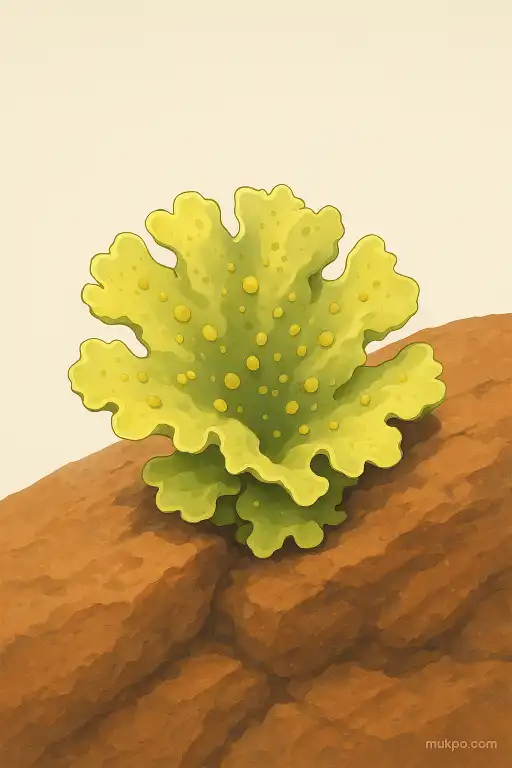
A lichen isn’t a single organism. It’s a partnership, usually a fungus plus an alga or cyanobacterium. The fungus builds the structure and does most of the water management. The photosynthetic partner makes sugars when light and moisture line up. In deserts, that “when” can be short. The lichen spends long stretches essentially paused, then becomes active for minutes or hours when it gets even a thin film of water.
The overlooked detail is scale. Lichens don’t need a droplet you can see. For some species, humidity changes and microscopic wetting at the surface can be enough to start metabolism. That’s why they can live where a weather station might report “no rain” for months, yet the rock surface still experiences brief, local wetting from fog, dew, or vapor moving out of the stone.
Where the “rock vapor” comes from
Rocks aren’t always dry inside. Porous stone, fractured basalt, weathered granite, and salt-cemented soils can hold moisture in tiny pores and cracks. Even when the surface looks bone-dry, water can exist as thin films on mineral grains below. Temperature swings drive movement. When the surface cools at night, water vapor can migrate toward that cooler zone. When the sun returns, the gradient flips again. The result is a slow breathing of moisture through the rock’s micro-spaces.
In some deserts, fog is a major feeder of this hidden reservoir. Along the coastal Atacama, fog can wet rock faces and seep into pores, then evaporate later as vapor. In inland deserts, the source may be older moisture stored deeper, or rare rain that sinks in and lingers. Exactly how much comes from each source varies by site and rock type, and it isn’t always straightforward to measure in the field.
How lichens capture that moisture without losing it immediately
The fungal part of the lichen is built for interception. Its outer layers can absorb water quickly, including from humid air. Some lichens also produce sticky polysaccharides that hold onto water as a thin layer. If the lichen sits in a crack or a shallow depression, it gets a tiny advantage: wind is reduced, and vapor can accumulate. Those micro-shelters matter more than the broader climate map suggests.
Once water is available, the lichen has to use it fast. Photosynthesis and repair processes switch on, and then shut back down when it dries. Many lichens tolerate this stop-start routine because their cells can survive extreme dehydration. They also include protective pigments and antioxidants that help with intense UV and heat. Without those, “getting wet” would be risky, because sudden light plus water can create damaging reactive oxygen inside cells.
What it looks like on a real rock surface
On a sunlit boulder, the active window often happens at odd times. A lichen might do most of its work early morning after a cool night, or during a fog pulse, then go dormant before noon heat peaks. In the Mojave, researchers often focus on north-facing slopes and shaded crevices because they hold moisture longer. In the Atacama, fog-facing rock surfaces can host thin lichen crusts where the surrounding ground looks almost sterile.
These patches also change the rock itself. Lichens trap dust, hold salts, and release acids that slowly weather minerals. Over years, that can create slightly rougher micro-texture, which then holds a bit more moisture, which favors more growth. It’s subtle and slow. If you only look for green plants or obvious wetness, you miss the whole system happening at the scale of pores, films, and nighttime cooling.
Related reads
- How a single brief apology can dissolve social tension
- The plankton that weaves glass armor from seawater silica
- Why a familiar name sometimes won’t come to mind
- A town that kept a cat as an honorary mayor for decades
- The skin bacterium that converts body odor into floral notes
- Why dreams steal mundane details and make them strange