
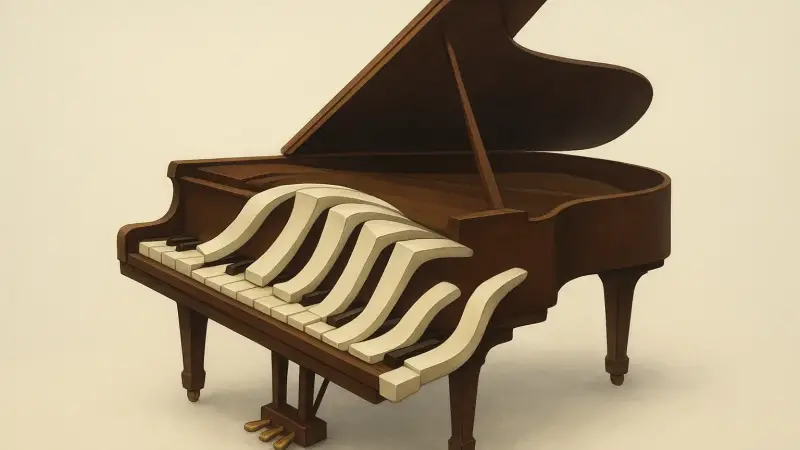
People expect a piano to be the one object in a room that stays put. The bench might shift. A sheet of music might curl. But the keys should look the same in the morning as they did at closing. Stories about keyboards “rearranging themselves” don’t point to one famous incident in one town. They show up as smaller reports, usually in old houses, schools, or closed venues in places like the UK and the US, where someone swears the pattern was wrong after a night with the room locked. The core mechanism, when there is one, is almost never the keys moving on their own. It’s the thin balance between friction, humidity, tiny fasteners, and what caretakers overlook when they do a last walk-through.
What “rearranged keys” usually means
On a standard piano, the black and white keys aren’t loose tiles you can shuffle. Each key is a long lever pinned and guided so it can only travel up and down. When people describe rearrangement, they often mean something else: keytops missing or shifted, odd spacing where a front edge no longer lines up, or a section where the black keys seem “off” because one is tilted or sitting lower. In dim light, a couple of displaced keytops can make the whole octave look scrambled.
There’s also language drift. “Ivory keys” is still how many people talk about white keys, even when the piano has plastic keytops. That matters because modern keytops tend to fail differently than old ivory. Ivory can shrink and cup with humidity changes. Plastic can de-bond in one clean piece if an adhesive layer gives up.
How the keytops can shift without anyone playing

The white surface you touch is usually a separate cap glued to the wooden key. On older instruments it may be two pieces: a “head” at the front and a thinner “tail” behind it. If glue becomes brittle, a keytop can creep forward a millimeter at a time, then finally let go. A caretaker comes in and sees a bright strip of bare wood, or a keytop sitting slightly to the side, and it reads as a deliberate swap rather than a failure.
Humidity swings can speed this up. Wood expands across the grain and shrinks back. Ivory reacts too, and it can curl just enough to break its bond. One overlooked detail is that keytops don’t have to fall off to look wrong. If the front “head” shifts, the visible seam line changes. Under certain overhead lights, that seam makes a straight keyboard suddenly look staggered.
Why caretakers notice it after sleep
Night is when the room changes fastest. Heating systems cycle down. A dehumidifier reservoir fills and stops. Exterior doors cool the air near the instrument. If the piano is near a draft, a radiator, or a window, the keyboard end can see a sharper swing than the case. That can create small stresses that aren’t obvious while someone is in the space, because bodies and lights add warmth and keep airflow different.
Caretakers also tend to be the first person back in after hours, and they see the piano in a “reset” state. The fallboard might be closed. The lid is down. The room is quiet. That makes any tiny physical change stand out. A missing keytop or a key sitting proud by a few millimeters looks like the whole keyboard has been tampered with, especially if yesterday ended with a quick tidy rather than a close inspection.
What can actually move in the key action
Even if the keytops are fine, parts of the action can shift enough to change the look and feel of the keys. Keys are guided by pins through felt bushings. If felt swells from moisture, a key can bind and not return fully. That leaves a key sitting lower, and its neighbors suddenly look “out of order.” If felt dries and shrinks, keys can develop side-to-side wobble. That wobble can make the front edges look uneven when the fallboard is opened.
On upright pianos, the keybed and keyframe can also respond to seasonal movement. It’s subtle, but a small twist can change key height across a section. People often overlook the simplest visual clue: the gaps between keys. When those gaps change, it’s rarely because keys migrated. It’s usually because a few keys are sticking, or because the keyframe isn’t sitting exactly as it did before.
A concrete night-shift scenario
Picture a piano in a school hall. The last event ends late. The room cools overnight. A cleaning crew shuts the fallboard and wipes the front of the keys. If one white keytop is already loose at the front edge, that wipe can nudge it forward. The next morning, it has slid just enough that the front lip catches when the fallboard is lifted. It can even pop off and land behind the keys, out of sight. The caretaker opens up and sees a strange bright line and a key that “isn’t right,” with no obvious missing piece on the floor.
The small detail people miss is where loose pieces go. A keytop can fall into the narrow space between keys and keyslip, or ride back under the fallboard line. It’s not always visible unless someone removes the keyslip or looks with a light from the side. From a standing position in a dim room, it can honestly look like the keyboard changed overnight.

Related reads
- Bronze statue that seems to sweat during heat waves and spooks tourists
- Why the word sits on the tip of your tongue and won’t come out
- The phantom call: why you sometimes swear someone called your name
- Why you unconsciously mimic strangers’ gestures
- Why morning fog hugs river valleys
- The hotel that rewards the loudest snorers with free breakfast