
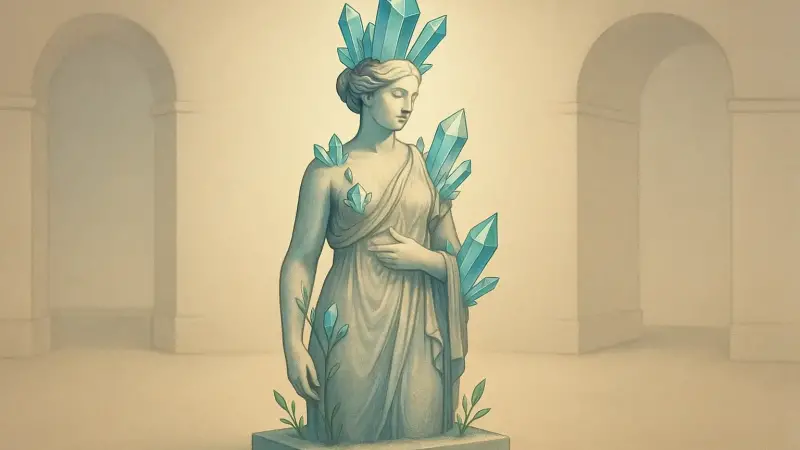
Some mornings a museum guard will spot something that wasn’t there at closing time: tiny white “needles” on a statue’s base, a sparkly crust along a fold of drapery, a dusting that looks like sugar. This isn’t one single famous statue with one confirmed cause. It’s a pattern that turns up wherever old stone or plaster meets humid air—especially in places like Venice, New Orleans, and Singapore. After a damp night, moisture condenses on a cool surface, then dissolves salts inside the material. When the air dries again, the water leaves and the salts crystallize on the surface.
What people actually see on the surface
The crystals usually show up where water lingers: in carved creases, under an overhang, at the join between statue and plinth, or along hairline cracks. They can look feathery, powdery, or glassy. Sometimes they wipe away like chalk. Sometimes they feel gritty. Museums might notice that the growth is patchy rather than uniform, because condensation and airflow aren’t even across a sculpture.
One overlooked detail is timing. The change can happen fast. It’s often tied to the moment the building switches from closed, cooler overnight conditions to morning warmth and drier air. The surface can “sweat” briefly, then the crystals appear as that thin film evaporates.
Where the salts come from
The statue isn’t making minerals from nothing. The raw ingredients are usually already inside it. Plaster and some stones contain soluble salts from their original materials, from earlier repairs, or from storage conditions. Older casts made with gypsum plaster can shed sulfate salts. Porous limestone and sandstone can hold salts from groundwater or past exposure to dirty air.
Salt can also arrive from outside and get pulled in. Coastal cities are the obvious example. Sea spray adds chlorides that can migrate into stone over time. Urban pollution can contribute nitrates and sulfates. Even old cleaning products can leave residues that later re-dissolve when humidity spikes.
Humid nights make a slow chemical loop
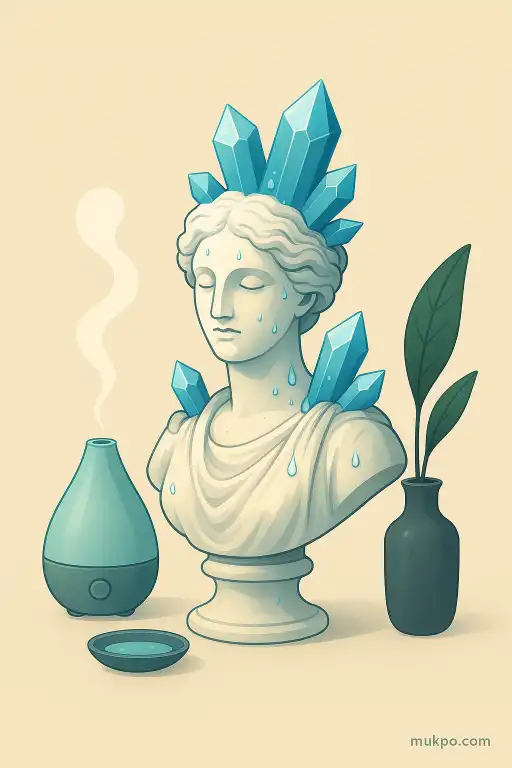
Humidity matters because many salts are hygroscopic. They attract water from the air. If the relative humidity crosses a salt’s “deliquescence point,” the crystals don’t stay solid. They dissolve into a thin brine right on the surface or just beneath it. On a humid night, that brine can spread and pull more dissolved salts along pores and microcracks.
Then conditions swing back. As the air dries—sometimes just because the HVAC changes—water evaporates. The dissolved salts re-form as crystals. That’s why it can feel like the statue “sprouts” growth overnight. It’s less a growth process than a dissolve-and-recrystallize cycle that repeats whenever humidity rises and falls.
Why it keeps returning in the same spots
Crystals often come back in the same places because those are the easiest pathways for moisture. A crack acts like a tiny channel. A seam between materials—say, a stone figure attached to a different stone base—can create a boundary where water collects. If a statue sits on a pedestal that wicks moisture from a floor, salts can migrate upward and appear as a band near the bottom, even when the rest looks fine.
Temperature differences also steer the pattern. A statue near an exterior wall or under an air vent can get cooler than the room air at night. Cooler surfaces hit the dew point first, so they collect the moisture that starts the whole process. That’s why two identical pieces in the same gallery can behave differently.
What museum staff tend to notice over time
At first the deposits may seem harmless, because they can look like a light dusting. But repeated crystallization can exert pressure in pores and along fragile edges. Fine details can start to soften. A surface can become more powdery. On metal elements attached to stone, salty moisture can accelerate corrosion, which then stains nearby areas.
Staff also notice how sensitive the cycle is to the building’s rhythm. A gallery that’s stable all day can still have trouble if nights are unconditioned, or if doors are opened for evening events during humid weather. It’s the swing—wetting, then drying—that sets up the familiar morning surprise on the same cool corner of the same statue.

Related reads
- Microscopic glass spherules hidden in Antarctic snow
- Mondegreen mechanics: why your brain insists on wrong song words
- The conman who sold the Eiffel Tower to scrap dealers in 1925 Paris
- The beach where footsteps sound like xylophone notes
- Stalin’s Lysenko campaign that turned Soviet genetics into political theater and reshaped farms
- The fungus that carpets rainforest floors in blue light