

Snow feels like the cleanest thing on Earth. That’s why it’s a little jarring to learn that some Antarctic snow holds tiny glass beads you can’t see without a microscope. Researchers have reported these spherules in different places around the continent, including near McMurdo Station and in ice-core sites further inland. They’re not “dirt” in the usual sense. They form when something melts rock or metal so completely that it turns into droplets, then those droplets cool in midair and freeze into near-perfect spheres before they land on the ice.
What the spherules are like up close
Under a microscope, they tend to look unnaturally round. Many are smaller than a grain of sand. Some are clear or pale, others are darker, and the color often comes from what they’re made of. Their surfaces can be smooth, but some have tiny pits, cracks, or a frosted texture from rapid cooling. Size matters because it hints at how long they stayed airborne. Smaller ones can drift much farther before falling out of the sky.
A detail people usually overlook is that “glass” here doesn’t necessarily mean window-glass chemistry. It often means an amorphous, quickly cooled melt. In lab work, scientists look for things like a glassy internal structure, bubbles trapped inside, or specific minerals that only form under fast heating and cooling. Those small clues help separate true melt droplets from ordinary mineral grains that just happen to be rounded.
How glass droplets get made in the first place
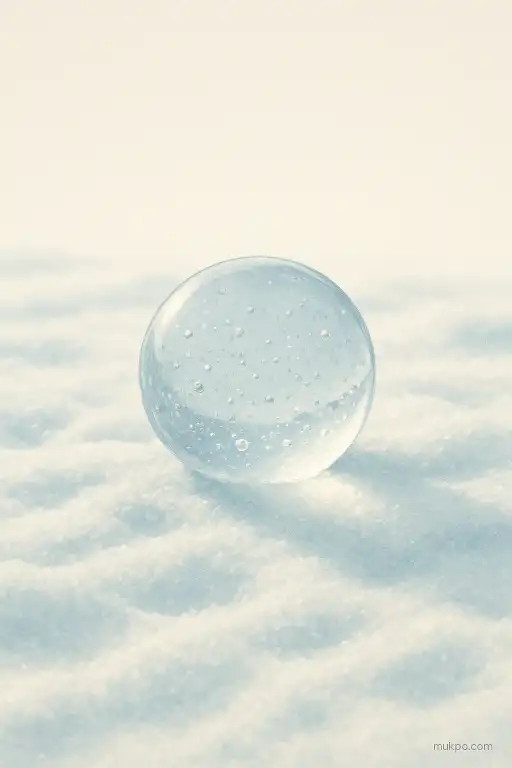
One common route is an impact. When a meteoroid hits the atmosphere at high speed, it can heat up and shed molten material. In some cases, the shock and heat can melt bits of the incoming object or target rock, creating droplets that round up as they fly. Those droplets cool so fast they don’t have time to grow crystals, which is why they become glassy spheres instead of jagged grains.
But not every sphere in Antarctic snow has to be cosmic. High-temperature events on Earth can also do it. Explosive volcanic eruptions can fling molten droplets into the air that cool into glassy particles, though these are often shaped more like shards than perfect spheres. Human activity can produce spherules too, from industrial combustion and metalworking. Antarctica has strict protections, but local contamination near active stations is still something researchers have to check for.
Why Antarctica is a good place to find them
Antarctica is far from most everyday dust sources, and large areas have low snowfall and low melt. That can make the surface act like a slow archive. Particles settle, get buried, and can remain trapped for a long time. When scientists drill ice cores, they can sometimes link layers to broad time windows, although the exact dating depends on the site and the methods used.
Wind is the wildcard. Strong katabatic winds can move snow, expose older layers, and redeposit particles. So a spherule found at the surface might not be “from this year” at all. That’s one reason teams often compare surface snow, shallow firn layers, and deeper ice. If the same type of spheres shows up at multiple depths, it suggests repeated input rather than a single odd event.
How scientists tell one source from another
The first pass is usually shape, texture, and what else is in the sample. Then come instruments. Scanning electron microscopes can image the surface in high detail. Chemical tests can measure elements like iron, nickel, magnesium, and silicon. A higher nickel content can hint at extraterrestrial material, but it’s not a simple stamp of origin because some industrial sources can also add nickel.
Context can matter as much as chemistry. A cluster found downwind of a station raises different questions than a sparse sprinkling in a remote inland core. Scientists also look at whether the particles are mixed with soot, ash, or corrosion products. Even the presence of tiny attached grains can be a clue: a sphere that picked up local dust while rolling across the surface is telling a different story than one locked cleanly inside undisturbed ice.
What it means when you find them in snow
Finding glass spherules doesn’t automatically point to a single dramatic event. Sometimes they reflect a steady background of micrometeorite debris drifting down over thousands of years. Sometimes they’re tied to specific high-energy episodes, like a distant eruption layer that also carries volcanic glass, acids, and ash. And sometimes the answer stays unclear because particles are few, the site has been wind-reworked, or the chemistry fits more than one origin.
What’s striking is how little it takes for the snow to stop being “empty.” A few dozen spheres in a meltwater filter can represent material that traveled across the planet, or through space, and ended up preserved in a place that looks untouched. In the lab, they’re easy to miss if you’re not looking for them, because they can hide among ordinary grains until the light hits just right.

Related reads
- Mondegreen mechanics: why your brain insists on wrong song words
- The conman who sold the Eiffel Tower to scrap dealers in 1925 Paris
- The beach where footsteps sound like xylophone notes
- Stalin’s Lysenko campaign that turned Soviet genetics into political theater and reshaped farms
- The fungus that carpets rainforest floors in blue light
- An elevator that stops for no passengers and opens to reveal a single folded note on the floor