
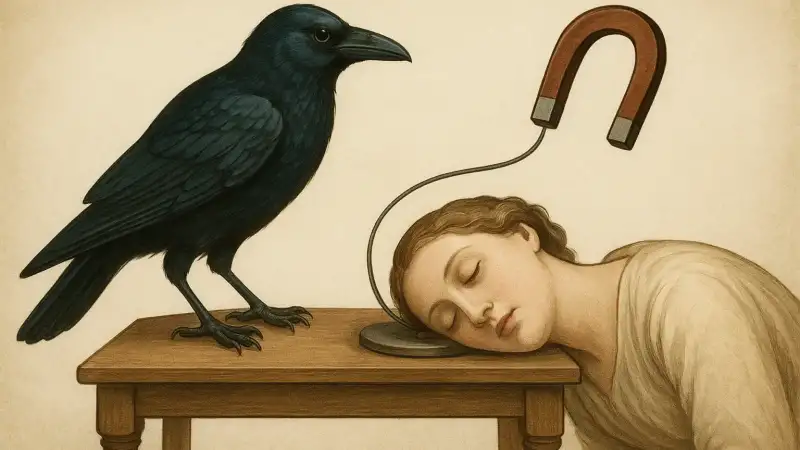
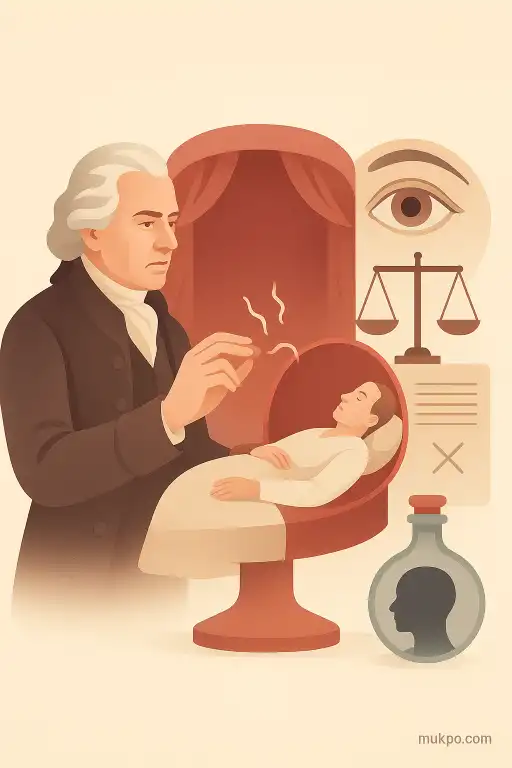
It’s easy to watch a room full of people react and assume the reaction proves the cause. In Paris in 1784, that assumption was exactly what a royal commission tried to pin down. Franz Anton Mesmer’s “animal magnetism” was supposed to be a real physical force that moved through bodies and could be directed by a practitioner. Patients gathered around a tub-like baquet, held iron rods, and waited for the current to do its work. Some felt heat, tingling, or pain. Some cried or fainted. The commission’s job was blunt: was there a measurable agent here, or was the setting itself doing the heavy lifting?
Mesmer’s Paris method looked like medicine, and like theater
Mesmer arrived in a city already hungry for new cures. His sessions were structured and repeatable, which helped them feel clinical. Patients sat close together around the baquet, a wooden container often described as filled with water and other materials, with iron rods extending out for people to touch. Rope could be used to connect bodies, and music sometimes played. Assistants helped manage the room. People weren’t just being treated; they were being staged in a shared experience.
A specific detail that’s easy to miss is how much the method depended on attention and expectation. Mesmer and his followers used fixed rituals: where people sat, what they held, when the operator approached, what they were told to notice in their bodies. That structure can make sensations feel externally caused, even when they’re self-generated or socially amplified.
Why a royal commission got involved in 1784

By 1784, animal magnetism was popular enough to be a public problem. It drew paying clients and fierce arguments, and it bypassed established medical authority. The French crown authorized an investigation through elite institutions. The commission included familiar names from the period, including Benjamin Franklin, Antoine Lavoisier, and Joseph-Ignace Guillotin, alongside other physicians and scientists. Their brief wasn’t to debate philosophy. It was to test whether “magnetism” existed as a distinct physical force.
That matters because Mesmer’s claim wasn’t just “people feel better.” It was “a transferable fluid causes these effects.” If the fluid was real, it should show up when expectation is removed, and it should fail when the supposed agent is absent. The commission leaned hard on that separation, because feelings alone can’t tell you what caused them.
The tests separated sensation from the supposed force
The commission’s approach was simple: change what the subject believes is happening while keeping the rest similar, and watch what follows. They observed that strong reactions tended to appear when people thought they were being magnetized, even if they weren’t. And when people were magnetized without being told, the dramatic effects often didn’t appear. Reports from the inquiry describe subjects responding to suggestion and context—sometimes reacting intensely to an object they believed had been “treated,” even when it had not.
There was also attention to the social setting. Group sessions are not neutral. When one person begins to tremble or cry, others notice. In a quiet room, that can spread. In a charged room, it spreads faster. The commission treated that as part of the mechanism worth explaining, not as noise to be ignored.
What the commission concluded, and what it did not
The key conclusion was that they could not detect animal magnetism as a physical agent. They attributed the observed effects to imagination, imitation, and touch—words that sound dismissive now, but were meant as causal explanations. If a person expects a powerful intervention, focuses on bodily sensations, and sits in a room designed to heighten attention, sensations can intensify. Some people will have real physical reactions. The commission did not claim the patients were lying.
They also took the episodes seriously as events with risks. Contemporary accounts mention “crises,” the convulsive fits that could occur during sessions. Part of the worry was that the practice could provoke harmful distress, especially when the room encouraged escalation. That’s a different kind of critique than “it doesn’t work.” It’s “the mechanism you claim isn’t there, and the one that is there can be dangerous.”
Why it lingered after being called spectacle
Even with an official debunking, the attraction didn’t evaporate. Mesmer’s style offered something established medicine often lacked: time, attention, and an explanation that made sufferers feel seen. A session gave a person a story about their symptoms and a setting where change felt possible. That can create genuine relief without proving a new physical force.
It also left a useful template behind. Later practices—some medical, some not—borrowed the idea that expectation and setting shape the body’s response. The 1784 inquiry is remembered partly because it treated that template as testable. It didn’t need to argue about charisma. It just had to notice when the reaction followed belief rather than the supposed magnetism.
Related reads
- The island that vanished from maps and reappeared decades later
- How deep-sea worms cultivate sulfur bacteria on hydrothermal vents
- How the brain completes muffled conversations with confident fake words
- The Prague defenestration of 1618 that hurled regents and ignited the Thirty Years’ War
- Why consistent pre sleep behaviors lower nighttime anxiety
- How being ignored for a moment lights up the brain like a physical sting