
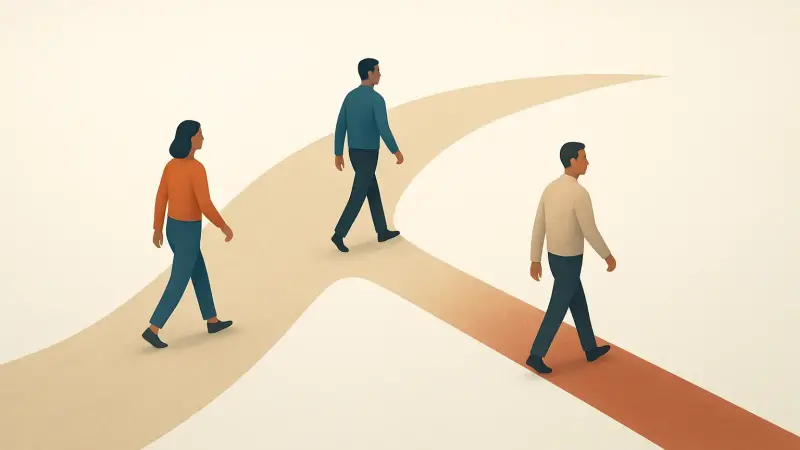
You can watch this happen at almost any big transit hub. At London’s King’s Cross, people will walk the long curve around the concourse and still miss a shorter cut that’s open and clearly marked. This isn’t one single “place where it happens.” You see it on sidewalks in New York, in office corridors, and in parking lots at suburban malls. The basic mechanism is simple. Familiar routes feel lower-risk. They cost less attention. A shortcut, even an obvious one, asks for a tiny bet: “Will this really work the way I think?” That question is enough to keep feet moving along the path that already has proof.
Familiar routes are cheaper for the brain
Once a route is repeated, it becomes partly automatic. People stop “navigating” and start executing. Corners, doorways, and crossings turn into cues. That matters because attention is limited and usually spent on something else: a text message, a conversation, a deadline, a crowded platform.
A shortcut looks like a simple swap, but it forces active tracking. It needs ongoing confirmation that you’re still going the right way. That extra monitoring is a real cost, even if the distance is shorter. The overlooked detail is that the brain often treats attention like a scarce budget. Saving 20 seconds of walking can feel less valuable than saving 20 seconds of focus.
Shortcuts carry uncertainty, even when they look obvious
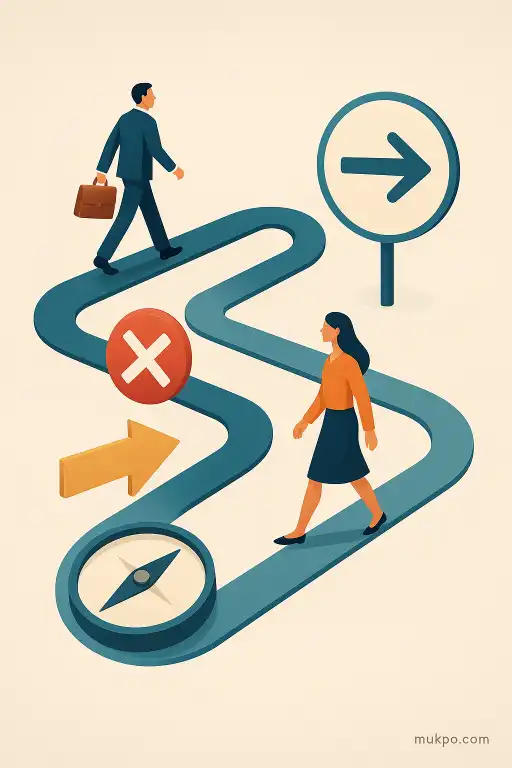
People weigh time against reliability. The usual route has a known travel time and known obstacles. The “obvious” cut may hide small unknowns: a door that sometimes locks, a corridor that narrows into a bottleneck, a crosswalk that misses a signal cycle, a security checkpoint that appears at certain hours. Even when a shortcut is open right now, many people behave as if the conditions might change mid-walk.
This is why a shortcut that involves a single point of failure gets ignored. One closed gate can wipe out all the saved time. A longer route with multiple options feels safer because it fails gracefully. If one staircase is blocked, there’s usually another. People don’t always articulate this. They just stick to the route that has fewer surprises.
Habit and timing beat geometry
Routes are often chained to routines. Someone exits a train, turns left, buys coffee, then heads to the office. The “shorter” path might skip the coffee corner or require crossing the flow of people at an awkward point. What looks like a pure distance problem is tied to a sequence of micro-goals.
Timing also shapes what “short” means. A direct hallway that’s crowded can be slower than a longer, emptier loop. People learn this through experience and then generalize it. Later, even when the hallway is clear, they keep the old choice. The geometry stays the same, but the time memory sticks. They’re not choosing the shortest line on a map. They’re choosing the route that has historically behaved well.
Social cues quietly steer the feet
When a space is unfamiliar, people copy what others do. A stream of walkers acts like a sign. At a station concourse, one person cutting across open floor can look like they’re breaking a rule, even if no rule exists. Following the crowd avoids the social risk of being the only one doing the “wrong” thing.
Design amplifies this. Barriers, railings, planters, and the angle of signage can make one route feel official and another feel improvised. Even floor wear matters. A slightly shinier strip of tile or a faint desire line across grass tells people where “people like us” go. That signal can outweigh the obviousness of the shortcut, because it answers a different question: not “Is it shorter?” but “Is it normal?”
Small frictions decide the winner
A shortcut often has hidden frictions that don’t show up in a quick glance. A heavier door. A narrow turn that forces slowing down. A set of stairs that adds effort. A sharp curb that’s annoying with luggage. These tiny costs can dominate choices because people feel them immediately, while saved distance is abstract until the end.
Even the first step matters. If the shortcut begins with an awkward diagonal, people hesitate for a moment, then default to the straight, practiced line. That initial hesitation is easy to miss when you’re thinking in maps. But it’s the moment where the familiar route wins, because it starts cleanly and demands almost nothing.
Related reads
- How sleep inertia turns you into a slow thinker after naps
- Storms that have actually dropped fish from the sky
- How biological soil crusts glue desert sand into living mats
- Why spinning ice slabs can flip and launch during a thaw
- Why speaking feelings out loud can calm the body
- Why sidewalk puddles vanish faster under leafy trees