
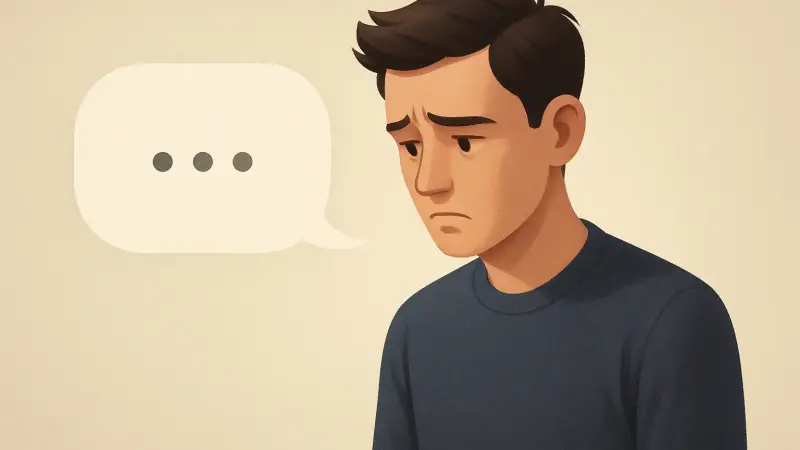
You say “Hey, can you hop on a quick call?” in Slack, and the other person starts typing… then stops. Three seconds pass. Then five. Nothing. It isn’t one single famous event; it’s a pattern that shows up everywhere, from Zoom meetings in the US to WhatsApp chats in India to WeChat threads in China. The pause is tiny, but it lands like a decision. The core mechanism is simple: when information drops out, the brain fills the gap fast, and it prefers meanings that protect you from social risk. Silence becomes data, even when it’s just a thumb hovering over a keyboard.
The brain treats missing signals as signals
Conversation usually runs on prediction. A nod is expected after a point. A quick “mm-hmm” is expected after a story beat. When that expected piece doesn’t arrive, attention spikes. People often experience it as a small jolt of uncertainty, because the mind is built to notice breaks in a pattern more than the pattern itself.
That uncertainty isn’t neutral for long. Social situations have stakes, even when nothing “important” is happening. A short delay can be read as rejection, irritation, or judgment because those interpretations are safer to prepare for than the alternative. If the pause turns out to be harmless, fine. If it’s actually disapproval, you noticed early.
Negativity fills the gap because it’s faster
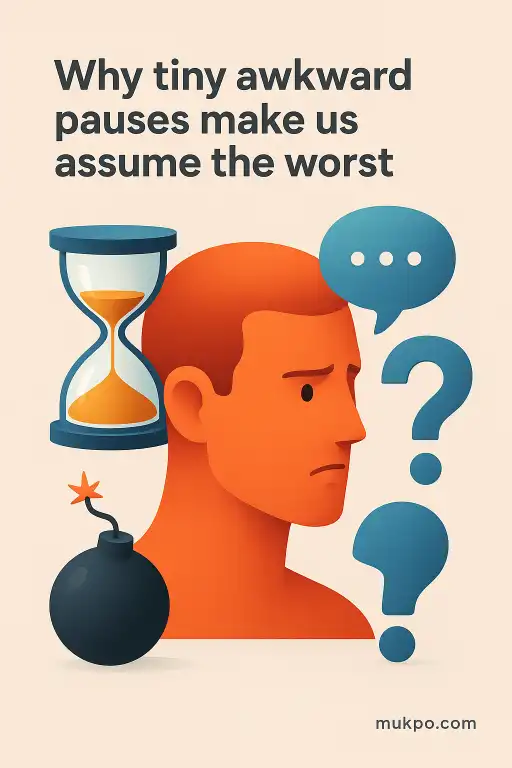
When people don’t know why something happened, they don’t sit in the unknown for very long. The mind tends to grab the first explanation that fits the feeling of threat. Negative explanations are “complete” in a way vague ones aren’t. “They’re mad at me” is a full story with motives and next steps. “Maybe they’re in the elevator” is incomplete until more evidence arrives.
This is why awkward pauses hit harder in fragile situations. A new job. A new friend group. A manager’s message. When the relationship or status feels uncertain, the cost of misreading things feels higher, so the brain spends less time waiting for context.
We overread pauses because we undercount normal friction
Most pauses have boring causes that don’t show up on the screen. Someone’s face unlock fails. A call connects but the microphone permission pops up. A person rereads a message three times because they’re trying not to sound rude. Those extra seconds are real, but they are invisible to the observer, so they don’t get included in the explanation.
A specific overlooked detail is how typing indicators distort time. “…” suggests a response is imminent, so each second feels longer. When the indicator disappears, the mind treats it like a reversal: not just “they’re busy,” but “they changed their mind.” The same delay without the indicator would often feel less personal.
Pauses get interpreted as evaluation, not delay
People aren’t only waiting for words. They’re waiting for a sign of stance: warmth, agreement, interest. In person, a pause is buffered by small cues—eye contact, posture shifts, breathing, a half-smile. On audio-only calls and text, those cues are missing, so the pause gets assigned the job of carrying meaning.
This is also why the same silence can feel different depending on who is silent. A friend pausing can read as distraction. A supervisor pausing can read as judgment. The status difference changes which interpretation feels most urgent, even if the pause length is identical.
Context decides whether the pause feels hostile
The mind uses whatever is most available to decide what a pause “means.” If the last interaction had tension, the pause gets attached to that. If there’s already a worry—about being liked, about competence, about being ignored—the pause becomes proof-shaped. It’s less about the seconds and more about the open question those seconds leave hanging.
There’s also a timing quirk people miss: pauses are judged relative to the rhythm that was just established. If replies were instant for ten minutes and then stop, the stop feels loaded. If replies were slow the whole time, the same stop is easier to file under “normal.” The brain isn’t measuring time like a clock. It’s measuring deviation.
Related reads
- How spiders use zigzag silk bands in their webs
- Why confident speakers change our beliefs even without evidence
- How repeating a word until it sounds meaningless tricks your brain
- The hotel room guests say rearranges itself at night
- Why background conversation wrecks your concentration when reading
- The lake that appears overnight and vanishes by morning