
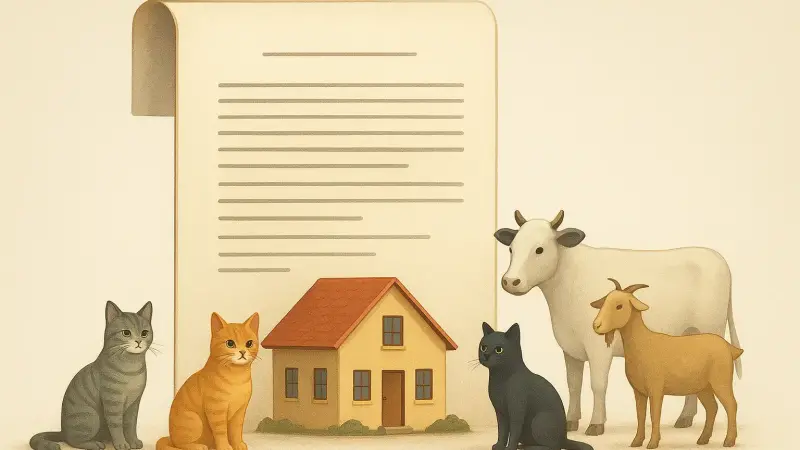
How a house cat ends up on a farm list
People think “livestock” means cows, pigs, and sheep. Then you bump into an old rule that quietly disagrees. In the United States, some state statutes and local ordinances have treated cats as “livestock” or folded them into “domestic animals” lists that function like livestock rules. The point usually wasn’t to claim cats are farm animals. It was administrative. A legal category decides who pays when an animal is killed, which cases a court can hear, and what kind of proof is required. A house cat can land in that box because lawmakers needed one bucket for owned animals, and they reused the bucket they already had.
This isn’t one single famous law from one single town. It shows up in scattered places and different eras. You can see the flavor of it in older U.S. code language, in some “stock laws” that were written for roaming animals, and in municipal animal-control codes that treat cats like property to be registered, impounded, and assessed for damages.
What lawmakers were trying to solve
Historically, the legal system needed clean categories for animals people owned. “Livestock” was often the working label because it connected to commerce. Livestock could be taxed, insured, stolen, or seized. If a law already spelled out how to value a dead sheep, it was tempting to reuse the same structure for a dead cat, rather than invent a new category with new procedures.
Another driver was roaming. Many animal rules started as “stock at large” rules: don’t let your animals wander onto someone else’s land. Cats don’t herd like cattle, but they do roam. When officials wanted an enforceable way to impound nuisance animals, they sometimes grabbed the nearest existing framework. The category did not need to match biology. It needed to match the enforcement tool.
The money question: valuation and compensation
The moment “livestock” is in play, the next thing is often a dollar figure. Older statutes about animals commonly assume a market value. That works neatly for a hog. It is awkward for a cat that has little resale market but enormous personal value to an owner. Some legal systems solved that by forcing the cat into the same valuation logic anyway, which usually meant very low damages unless the owner could show special value.
A concrete situation where this mattered: a neighbor shoots an animal they claim was bothering poultry, or a dog kills an animal on someone’s property, and the owner wants compensation. If the only ready-made damages scheme is written for “stock” or “livestock,” cats sometimes get pulled into it. The overlooked detail is that the label can quietly limit what can be recovered, because the statute may default to “fair market value” rather than replacement cost, veterinary bills, or anything tied to companionship.
Control tools: licensing, impound, and quarantine
Public health rules also pushed cats toward farm-style handling. Rabies control, bite quarantines, and stray-animal impound procedures were built for owned animals that might be loose. The question for an ordinance writer is practical: can the city hold the animal, notify an owner, charge fees, and adopt it out or euthanize it if unclaimed? If the existing template was a livestock or “domestic animals” ordinance, cats could end up listed alongside goats and chickens simply because that template already had the machinery.
One specific thing people miss is how much of this turns on definition sections. A code will often define “livestock” once, early on, and then dozens of later provisions inherit that definition. A single line—sometimes written decades earlier—can decide whether a cat is covered by an impound-fee schedule, a running-at-large fine, or a quarantine requirement, even if the later sections never mention cats directly.
Why the wording lingers long after the idea is gone
Legal language is sticky. Once a category is used in a damages statute, a taxation rule, or an enforcement ordinance, changing it can have side effects. If you remove cats from a definition, you might accidentally remove the city’s authority to impound them, or you might break a cross-reference that prosecutors and judges rely on. So older terms can hang around long after everyone agrees a house cat is not “livestock” in everyday speech.
It also varies by place because animal law is local by nature. State legislatures write broad definitions. Counties and cities write detailed control rules. Courts interpret both. That’s why one jurisdiction might list cats explicitly, another might tuck them under “domestic animals,” and another might avoid the issue by creating a separate “companion animal” category. The odd part is that the outcomes can look similar—impound, valuation, liability—while the labels stay mismatched.
Related reads
- How background chatter quietly drains your focus
- Australia’s 1932 emu war where soldiers and machine guns were outmaneuvered by birds
- The town where the river runs backward once a year
- Why tiny awkward pauses make us assume the worst
- How spiders use zigzag silk bands in their webs
- Why confident speakers change our beliefs even without evidence