

It sounds like a trick until you see it on a tide chart. In places where a river meets a big tide, the ocean can briefly win and push upriver. One well-known example is the Qiantang River in China, near Hangzhou, where a powerful tidal bore surges inland and can reverse the surface flow for a short time. Other places get a gentler version, sometimes on a predictable day each year depending on local tides and river levels. The mechanism isn’t magic. It’s a timing problem between a rising sea and a river that’s not pushing hard enough to hold its direction.
Where “backward” happens
This isn’t one single town with one universal date. It’s a pattern that shows up in a few river mouths around the world. The Qiantang is the dramatic one people film. Another famous case is the Amazon River’s “pororoca,” a tidal bore that can travel far upstream during certain strong tides. In North America, the Petitcodiac River in New Brunswick has a tidal bore too, though its size has changed over time as the river was altered and later partially restored.
Whether locals say it happens “once a year” depends on what they count. Some places might only notice it at the biggest tides, when the reversal is obvious even from shore. Smaller reversals can happen more often but look like a slowdown unless you’re watching floating debris or a current meter.
The core mechanism: tide versus discharge
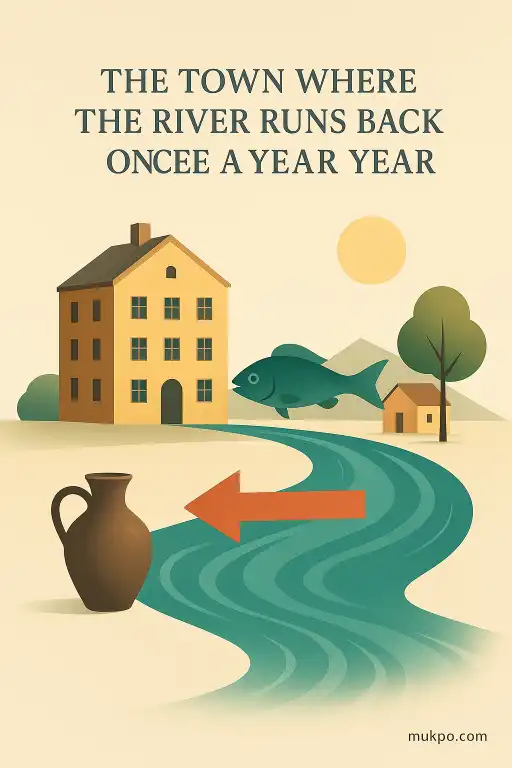
Rivers flow downhill because gravity pulls water from higher elevations to lower ones. Near the coast, though, the “lower end” is the sea surface, and that surface is not fixed. When the tide rises, the sea level at the river mouth rises with it. That reduces the river’s slope, sometimes to nearly flat. If the rising tide creates a higher water level at the mouth than the water level upstream, the pressure gradient can point inland. For a while, the easiest direction for water to move is upstream.
How far the reversal reaches depends on the tide range and the river’s discharge. After heavy rain or snowmelt, a river can overpower the tide and keep flowing seaward. During drier periods, the tide has an easier job pushing in. That’s why the “same” tide can look different month to month, even at the same spot.
Why it can feel like an annual event
Tides are predictable, but they aren’t all the same size. The biggest ones arrive around new and full moons, when the Sun and Moon line up to pull on the oceans together. Those are spring tides. If a river only reverses noticeably during the very largest spring tides, people can end up remembering one standout day: the day the current clearly turned, boats strained at their lines, and the river’s surface texture flipped direction.
Some rivers also have seasonal patterns that line up with those extreme tides. If the river tends to be lowest at a certain time of year, that’s when a strong tide is most likely to produce a visible reversal or a bore. The calendar date can vary, because the largest tides shift with lunar cycles and because river flow depends on weather.
What a tidal bore adds to the story
A reversal doesn’t have to arrive as a wave. Sometimes the flow just slows, pauses, and then starts creeping inland. A tidal bore is different. It’s a moving wall or rolling hump of water that forms when the incoming tide is forced into a narrowing, shallow channel. The geometry matters. A wide mouth that funnels into a tighter river, plus a big tide range and a shallow bed, makes the incoming tide steepen until it behaves like a wave front.
That’s why the Qiantang’s surge is so well known. The river mouth and nearby bay shape amplify the incoming tide. The bore doesn’t just reverse the surface current. It can race upriver faster than a person expects water to move in a “normal” river, with noisy turbulence behind it.
The overlooked detail: the bottom may not reverse
One thing people often miss is that “the river is running backward” can describe only part of the water column. In an estuary, salt water is denser than fresh water. During an incoming tide, denser seawater can slide in along the bottom while fresher river water still drifts seaward on top. From a bridge, you might see foam and floating leaves move inland and assume everything reversed. A sensor near the bed could show a different story, with a wedge of salt water advancing upstream under the surface.
That layering also helps explain why the water can look strangely calm for a moment. The apparent pause can be the point where the surface slope is nearly flat, even while water is still moving below. Then the tide keeps rising, the pressure pushes farther inland, and the surface finally follows.

Related reads
- Why tiny awkward pauses make us assume the worst
- How spiders use zigzag silk bands in their webs
- Why confident speakers change our beliefs even without evidence
- How repeating a word until it sounds meaningless tricks your brain
- The hotel room guests say rearranges itself at night
- Why background conversation wrecks your concentration when reading