
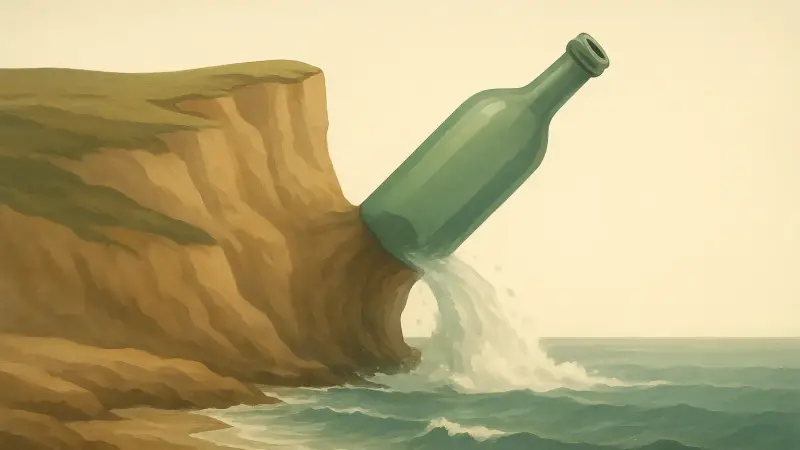
If you stand at the base of a sea cliff after a high tide, the weird part isn’t the waves. It’s the glass. People have reported bottles and shards turning up again and again in places like Glass Beach in Fort Bragg, California, where old dumps and rough surf left a long afterlife in the shoreline. It isn’t one single cliff, and it isn’t always the same kind of bottle. The basic mechanism is consistent, though: the sea stores debris in pockets, then a high tide and the right wave angle “unpacks” it and drops it back on the beach.
Where the bottles were hiding
A cliff doesn’t have to be hollow like a cave to hold onto bottles. The hiding places are usually small and messy. Rockfall rubble at the cliff base can form a loose sieve. Gaps between boulders trap glass the way a storm drain traps leaves. In some areas there’s also a narrow bench at the foot of the cliff that only gets wet on bigger tides, so it can collect debris quietly for weeks.
The overlooked detail is how much sand matters. A thin layer of sand can “cap” a patch of rubble and keep objects from moving. When the sand is scoured out during a rough tide, the same spot suddenly starts shedding bottles again. From above, it looks like the cliff is producing them, but it’s often the beach surface changing by a few inches.
Why high tide is the trigger
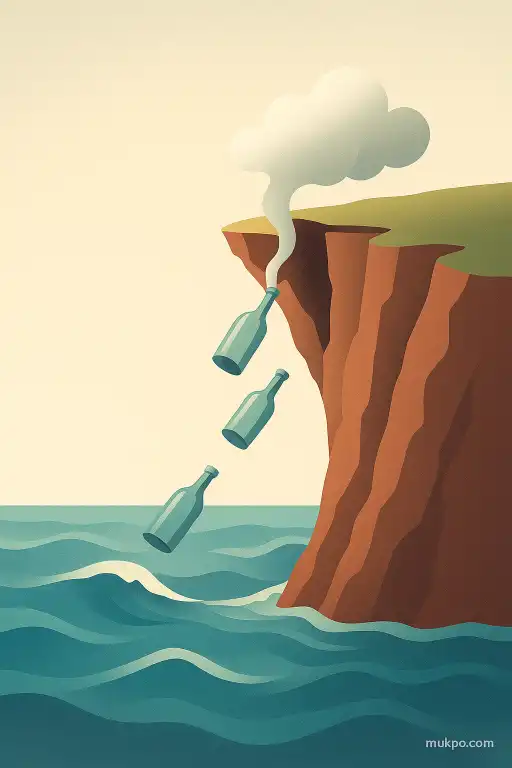
High tide isn’t just “more water.” It changes where the waves break. When the waterline reaches the cliff base, waves can slam directly into the rock and the boulder pile instead of dissipating across a wider beach. That impact works like a short, repeated shove. Items that sat stable at mid-tide start to roll, lift, and then tumble out.
The timing also depends on wave period, not just wave height. Long-period swell carries energy deeper and tends to surge farther up the beach. That’s why a modest-looking day can still produce a fresh scatter of glass if the swell is long and the tide is high. It’s a specific combination, and it varies from coast to coast.
The cliff face is a conveyor belt
Even without waves, sea cliffs are always dropping material. Salt spray gets into cracks and speeds up weathering. Rainwater seeps through softer layers and undermines harder ones. Small rockfalls are common, and each one rearranges the trap at the bottom. A new fall can bury debris, or it can expose an older pocket and suddenly release what was sealed in.
This is why the same stretch of shore can cycle between “nothing here” and “how is there so much glass.” The cliff isn’t creating bottles. It’s remixing storage. When the geometry of the boulders changes, the beach’s sorting system changes with it.
How bottles get there in the first place
Some beaches have a known history of dumping nearby, like the mid-20th-century dumping that contributed to Fort Bragg’s famous glass deposits. Other places get bottles from ship traffic, river outflows, illegal shoreline dumping, or stormwater that carries litter from inland. Which source dominates is often unclear unless there’s local history or monitoring to back it up.
Once glass enters the surf zone, it doesn’t travel like a straight line down the coast. It gets caught in small circulation patterns: behind headlands, inside pocket coves, or in the calm water that forms behind a cluster of rocks. Those are the same places that later “cough up” a sudden batch when a big tide re-energizes the area.
Why it comes back in bursts, not steadily
A steady trickle would require steady conditions. Coasts don’t work that way. Beaches breathe: sand builds up in calmer seasons and gets stripped away in stormier ones. That changes the slope of the shore, which changes how waves reflect off the cliff base. A slightly steeper beach can increase the backwash that pulls objects out from under rocks, and a slightly flatter one can do the opposite.
So the “after every high tide” feeling usually comes from clustering. A run of high tides, or a high tide lined up with a swell event, produces visible releases several times in a row. Then conditions shift and the beach goes quiet again, even though the pockets at the cliff base are still there, holding whatever hasn’t been shaken loose yet.
Related reads
- Why the perfect word finally pops into your head hours later
- How whale carcasses create island ecosystems on the seafloor
- The law that once listed house cats as livestock
- How background chatter quietly drains your focus
- Australia’s 1932 emu war where soldiers and machine guns were outmaneuvered by birds
- The town where the river runs backward once a year