
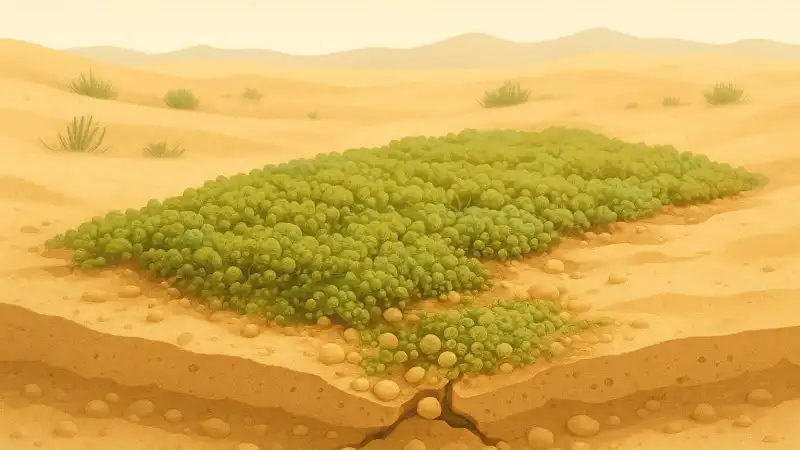
If you walk across a desert wash after a light rain, some patches of “sand” don’t behave like sand. They hold together. They crack in plates. That’s biological soil crust, often called biocrust. It isn’t one single place or event. It shows up across the Colorado Plateau in the southwestern United States, in parts of the Sahel, and in Australia’s arid interior. The basic mechanism is simple: tiny organisms live on and just under the surface and bind loose grains into a thin, living skin. They do it with sticky secretions, tangled filaments, and a lot of slow, repeated wetting and drying that tightens everything up over time.
What the “crust” is made of
Biocrust is a community, not a single organism. Early on, cyanobacteria often dominate. Later, you can see lichens and mosses mixed in, depending on temperature and how often the surface gets moisture. The structure sits right at the boundary where air meets mineral soil, so it’s exposed to sun and wind but also gets the first sip of dew or brief rain.
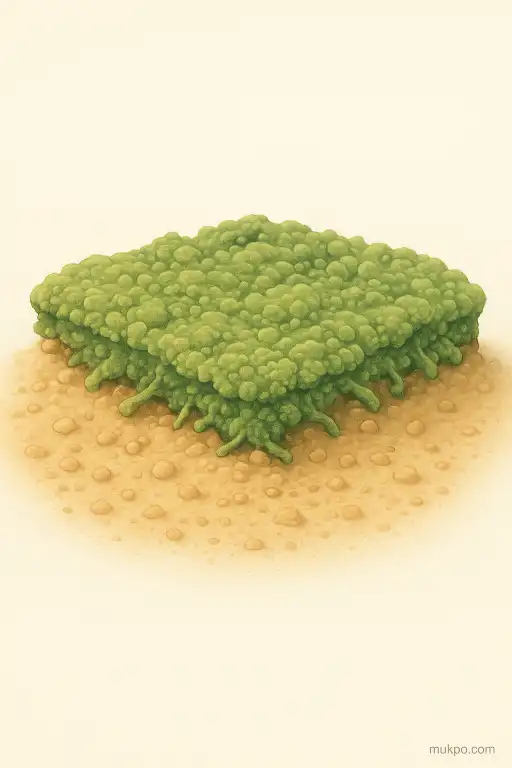
A detail people overlook is how thin it can be. The visibly darker, roughened surface might be only a few millimeters thick, but it can influence the movement of sand several centimeters down. That’s because the “living part” doesn’t stop where the color stops. Filaments and sticky residues can extend below what the eye reads as crust.
How it actually glues sand grains together
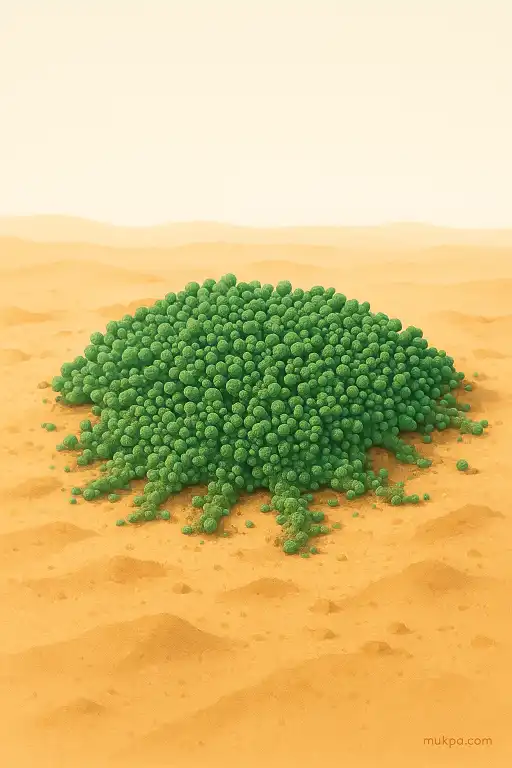
The glue is partly chemical and partly physical. Many cyanobacteria secrete extracellular polymeric substances, often shortened to EPS. It’s a mix of sugar-based gels and other compounds that stay tacky when damp and leave behind a binding film when dry. As the surface cycles from wet to dry, that film tightens around grains and makes them harder to lift by wind.
There’s also a mesh effect. Filamentous cyanobacteria thread between grains as they move and grow. That creates a kind of rebar for sand. Lichens add another layer by growing a close-fitting crust that can trap fine particles, and mosses can knit the topmost layer together when they’re present. Which group does most of the binding varies by site, season, and how stable the ground stays.
Why wetting, drying, and dew matter so much
These organisms don’t need long, soaking storms to function. Brief wetting is often enough to wake them up. Dew, fog, and short showers can trigger photosynthesis and growth, then everything dries back down. Each cycle can add a little more EPS, shift a few grains into tighter contact, and leave behind new micro-texture that catches dust the next time the wind blows.
That micro-texture changes the surface physics. A rougher surface slows airflow right at ground level, which reduces the force available to pop grains loose. It also creates tiny pockets where fine sediment can settle. Those fines help fill gaps and increase contact points between grains, which makes the binding stronger even without “more crust.”
What it changes about a desert surface
Once a crust forms, the ground behaves differently. Wind erosion often drops because grains are harder to detach. Water erosion can also change, but not always in the same direction. Some crusts increase infiltration by holding the surface stable and porous. Others reduce infiltration by sealing the top layer, so more water runs off in a thin sheet. The outcome depends on crust type, soil texture, and how intense the rainfall is.
Biocrust also affects nutrients. Cyanobacteria and some lichen-associated microbes can fix nitrogen, adding a key nutrient to otherwise poor soils. Dust trapped in the rough surface can bring in phosphorus and micronutrients. Over time, that can shift which plants manage to establish nearby, especially in the small safe spots where seeds aren’t blown away or buried too deep.
A concrete scene you can picture
On the Colorado Plateau, it’s common to see a mosaic: pale, loose sand next to darker, slightly bumpy patches. After a rain, the darker patches hold together under a light touch and dry into a firm skin. In the loose sand, a gust can kick grains into motion quickly. On the crusted patch, the same gust may only move a bit of dust, because the grains are locked into a thin composite of mineral particles and living material.
Up close, the overlooked part is how much of the “glue” is invisible. Even when the surface looks dry and dead, the binding matrix is still there, and many of the organisms are simply dormant. When moisture returns, the surface can become biologically active within minutes, without any obvious change except a slight darkening and a faint softening of the top film.
Related reads
- Why spinning ice slabs can flip and launch during a thaw
- Why speaking feelings out loud can calm the body
- Why sidewalk puddles vanish faster under leafy trees
- The rainforest fungus that secretes tiny antibiotic molecules
- How confident voices make doubtful facts feel true
- A village that bakes bread using volcanic steam