
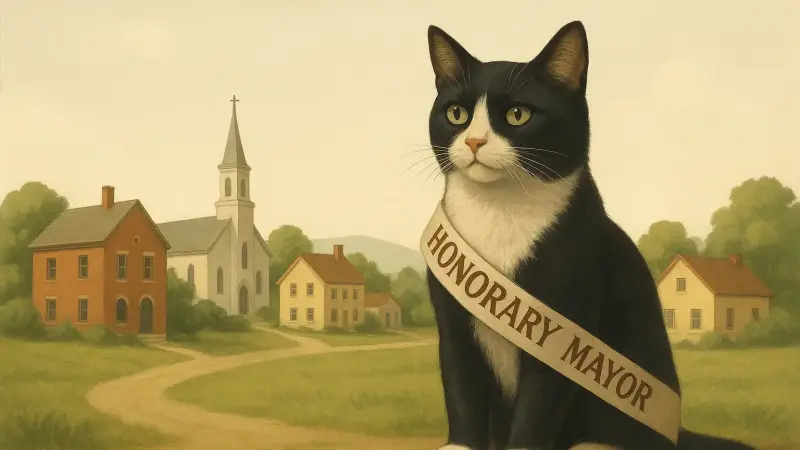
It sounds like a joke until you see how it works on the ground. In Talkeetna, Alaska, a cat named Stubbs was treated as an “honorary mayor” for years, showing up in photos with visitors and “holding office” in a way that didn’t require any real authority. The mechanism is simple: the animal becomes a mascot for a place, and the title becomes a local story people enjoy repeating. Sometimes it’s tied to a shop that cares for the cat. Sometimes it’s tied to a loose, unofficial vote. The details vary depending on who’s telling it, but the effect is consistent: people start acting like the cat is part of the town’s civic identity.
What “honorary mayor” actually means
These animal “mayors” usually aren’t part of government. A real mayor is created by a legal process: an election, an appointment, a charter, a set of powers. An honorary mayor is created by community agreement and repetition. It’s a title with no legal force, but it can still feel official because it gets printed on postcards, mentioned in visitor guides, and repeated by staff at local businesses.
That difference is the easy-to-miss detail. People hear “mayor” and assume city hall is involved. In places like Talkeetna, the role sits outside formal governance. The town still has normal services and decision-making. The cat is there to be recognized, not to sign anything.
How a cat ends up “in office” for decades
Longevity comes from routine. A cat that lives in a central, public-facing spot becomes familiar in a way people can rely on. In Talkeetna’s case, visitors commonly associated Stubbs with a local store, which meant there was a stable place to “find the mayor.” That physical predictability matters more than any origin story. If the cat disappears from view, the legend fades.
Decades also depends on succession. Sometimes the same animal holds the title for its whole life. Sometimes the town quietly passes the “office” to another animal without making a big deal about it, because the point is the continuity of the character, not the bureaucracy of replacement. Not every town does this, and accounts can get fuzzy when stories get retold.
Why towns lean into it
The appeal isn’t just cuteness. A non-human “mayor” is a low-stakes way to express local personality without triggering political arguments. It creates a shared reference point. Someone can like the “mayor” without picking sides on anything. That makes it unusually durable in small communities where everyone knows each other and disagreements can linger.
It also gives visitors a script. People arrive, ask about the cat, take a photo, and leave with a story that sounds specific and personal. That’s valuable for a place that sees tourism, because the story travels. Even when it’s clearly unofficial, it still feels like an encounter with the town’s “insider” culture.
The overlooked infrastructure behind the “mayor”
A cat can’t be a public figure without care. The unglamorous parts are what keep the tradition going: someone feeds the animal on a schedule, someone pays vet bills, someone decides what happens if the cat gets sick or stressed by crowds. That support often comes from a particular business or a small group of locals, which quietly shapes how “public” the mayor can be.
Another thing people overlook is access. A famous town cat can end up spending its days in one building, which means the “mayor’s office” is effectively private property. Visitors might imagine a civic institution, but it can actually be a store counter, a porch, or a back room where the cat retreats when it’s had enough attention.
How the story changes as it spreads
Once an honorary mayor becomes known outside town, the story tends to get simplified. Online posts turn “unofficial mascot” into “elected mayor.” A long span becomes “decades” even when the exact start date isn’t consistently reported. The cat’s daily life gets edited into a set of repeatable highlights: the favorite nap spot, the “campaign,” the ceremonial photos.
Locals often play along because the exaggeration is part of the fun, and because it keeps attention on the place itself. The result is a strange blend of fact and performance. A visitor can be told something with a straight face, sense that it’s a bit, and still walk away feeling like they learned something true about how the town likes to present itself.
Related reads
- The skin bacterium that converts body odor into floral notes
- Why dreams steal mundane details and make them strange
- Frozen methane bubbles on a lake that can be set alight
- The fungus that turns beetles metallic green with a secret pigment
- The poplar at the Korean DMZ that nearly sparked a Cold War firefight
- Why icebergs sing: how trapped air shapes underwater sound