
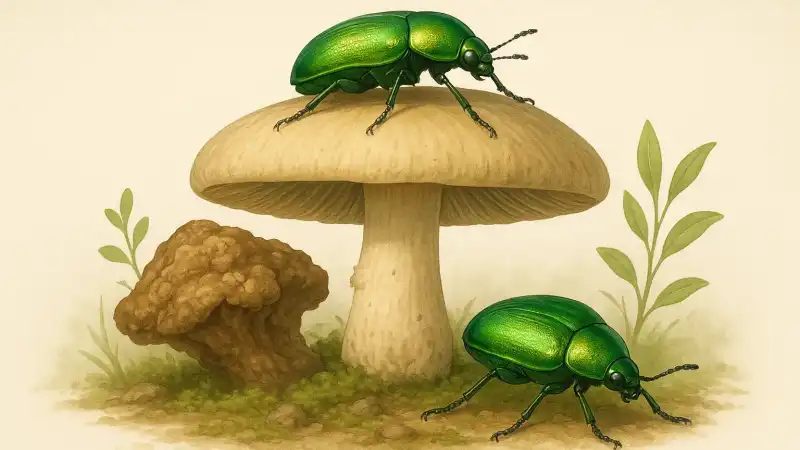
Why a dead beetle can look like jewelry
Pick up a beetle that died in a damp corner of a forest and it might flash an odd, metallic green. Not because it was born that way. In places as far apart as temperate forests in Europe, North America, and parts of East Asia, a handful of insects take on that color after they’re killed by a fungus. The basic mechanism is simple: the fungus grows through the insect’s body, then lays down a pigment in the outer layers as it finishes. That pigment is the “secret” part. It is not the beetle’s own shell color showing through. It’s fungal chemistry added after death.
The fungus is using the beetle as a platform
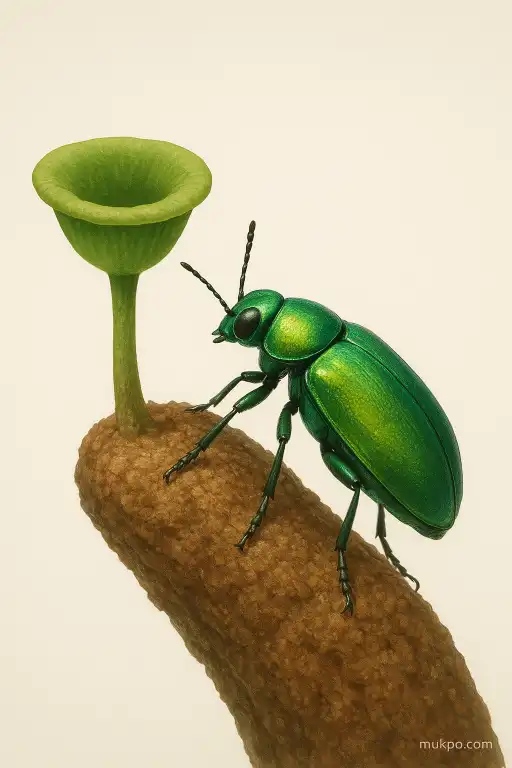
Entomopathogenic fungi infect insects from the outside. Spores land, germinate, and push hyphae through the cuticle. Inside, the fungus spreads and consumes tissues. After the host dies, the fungus often breaks back out through softer seams to produce more spores. With these metallic-green cases, the outside can look strangely polished even when the insect is otherwise clearly dead and rigid.
One detail people usually overlook is where the color is strongest. It tends to show up along creases, joints, and the undersides, not evenly across the back like a natural iridescent beetle. That patchiness is a clue. It matches where fungal growth and drying films accumulate, rather than where the beetle’s original structural color would be built into the exoskeleton.
It’s not the same as natural beetle iridescence
Many living beetles look metallic because of structure, not pigment. Their cuticle is layered like a tiny optical device. Light interference produces greens and blues that shift with angle. A fungal “metallic” look is different. It is usually more matte up close, and the hue can be less angle-dependent. If it does shift, it’s often because the fungal layer is uneven or cracked, not because it’s a finely tuned optical surface.
That matters because it changes what the color means. A natural green beetle is advertising something about itself: species identity, mate quality, or camouflage. A fungus-painted beetle is advertising the fungus. The insect’s body is basically a scaffold that lets the pathogen build a visible coating and a spore factory above the ground litter.
What the “secret pigment” might be doing
The exact compounds can vary by fungus, and the chemistry is not equally well mapped for every insect-fungus pairing. But fungi commonly make families of pigments like melanins, quinones, carotenoid-like molecules, and polyketide-derived dyes. Some of these absorb UV, some act as antioxidants, and some deter microbes that would otherwise compete for the same corpse.
A green coating can be useful even if it’s not meant to be “seen” by people. Many insects, mites, and microbes respond to chemical cues on a surface. A pigment layer can change how quickly the body dries, how easily bacteria colonize it, and how stable fungal spores are under sunlight. Even the slickness matters. A slightly different surface film can help spores shed when raindrops hit or when a scavenger brushes past.
Where you actually encounter it, and why it’s easy to miss
You tend to see these metallic-green “mummies” in places that stay humid but still get airflow: leaf litter, rotting logs, the base of mossy trunks, and shaded trail edges. A concrete situation is a springtime walk after rain, when last year’s beetle bodies are still intact but damp enough for fungal growth to finish and harden into a skin. The color is often most obvious when you tilt the insect in flat light, not in direct sun.
It’s easy to miss because it looks like a normal shiny beetle at first glance, and because the coating can vanish if the body is handled. Rubbing, drying too fast, or being washed by heavy rain can remove or dull the film. That’s part of why reports feel scattered. The phenomenon isn’t tied to one famous location or one single outbreak. It appears wherever the right fungus, the right insect host, and the right humidity line up for a few days.
Related reads
- The poplar at the Korean DMZ that nearly sparked a Cold War firefight
- Why icebergs sing: how trapped air shapes underwater sound
- Why favourite songs suddenly sound different
- Shortwave number stations that still broadcast coded messages
- The 1970 Oregon operation that detonated a beached whale and scattered blubber across the beach
- Why people scramble to break awkward silence