
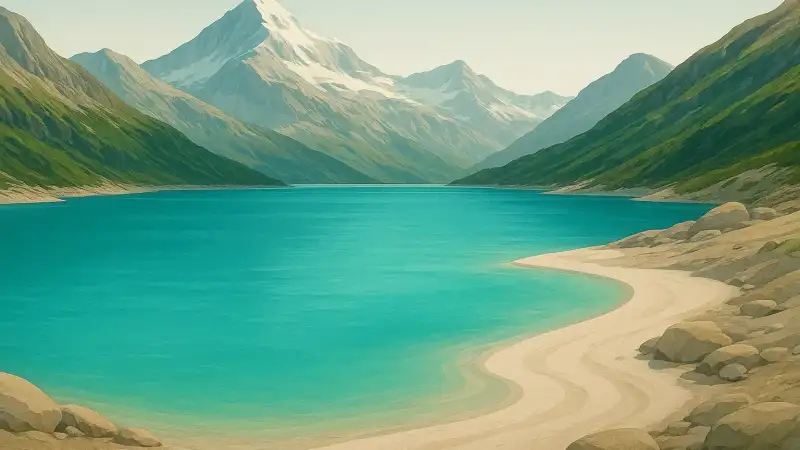
A color that looks too bright to be real
Some alpine lakes look like they were dyed on purpose. Lake Louise in Alberta is a classic example. So is Peyto Lake nearby, and Lake Pukaki in New Zealand. This isn’t one single place or one special chemical recipe. It’s a repeatable pattern that shows up wherever glaciers are grinding rock and meltwater is carrying the powder downhill. The core mechanism is simple: extremely fine mineral particles stay suspended in the water and scatter sunlight in a way that makes the lake look turquoise from shore and from above.
What glacial flour actually is
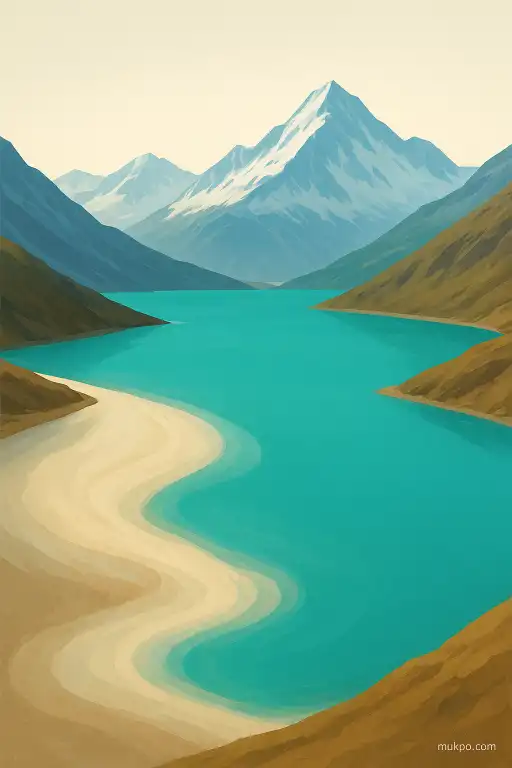
Glacial flour is rock that has been crushed so finely it can behave like silt smoke in water. A glacier moves like slow, heavy sandpaper. At its base, rocks embedded in the ice scrape across bedrock, breaking it down into tiny grains. Meltwater streams pick those grains up and deliver them to lakes. The particles are mostly minerals you’d expect from local bedrock, often including quartz and feldspar, but the exact mix varies by geology.
The usually overlooked detail is size. The grains can be so small—down into the “micron” range—that they don’t settle quickly. That long suspension time matters as much as how much flour is present. A lake can receive plenty of sediment and still look dull if the grains are larger and drop out fast. The bright lakes tend to be the ones fed by water carrying lots of extremely fine material.
Why turquoise wins over other colors
Sunlight is a mix of wavelengths. Water by itself tends to absorb red light more strongly than blue, which already nudges deep, clean water toward blue. Glacial flour adds a second effect: scattering. Those tiny particles scatter shorter wavelengths efficiently. The mix of natural water absorption and particle scattering pushes what returns to your eye toward blue-green.
The angle and the sky matter. Under bright sun, the scattering is strong and the lake can look almost opaque and milky. Under overcast skies, it can shift toward gray-green because there’s less direct light to scatter. The same lake can look different hour to hour, even if nothing in the water has changed.
Why it’s not always the same shade, even in the same valley
Concentration changes fast. During peak melt in summer afternoons, more sediment can enter the lake, and streams can deliver pulses that spread as visible plumes. After a cold night or an early-season freeze, meltwater slows and the lake can clear slightly. Wind also rearranges the suspended flour. A breezy day can mix the upper layer and keep particles aloft longer, while calm conditions let some of them settle into quieter bays.
Lake shape plays a role too. A deep lake with a broad basin can keep a milky turquoise look because the suspended particles are distributed through a large volume of illuminated water. A small, shallow lake might turn a flatter, chalkier color because light bounces back quickly from a sediment-laden bottom. That difference is easy to miss when people focus only on the glacier feeding the lake.
What happens when the flour stops arriving
If glacial input shrinks or a meltwater channel shifts away, the color can fade. The flour slowly settles out, building thin layers on the lakebed. Over time the water can become clearer and darker, revealing more of the lake’s true depth and any dissolved organic color coming from surrounding soils and plants. That change can be gradual, and the timing varies because it depends on local hydrology, storms, and how much sediment is already in circulation.
In some places, the turquoise look is seasonal rather than permanent. The lake can be brightest when meltwater is high and the particle load is fresh, then look more transparent later in the year. The rock powder itself hasn’t “turned” the water a new color. It’s acting like a moving optical filter that only works as long as the glacier keeps feeding the system.
Related reads
- Why ordinary coincidences feel like meaningful signs
- A village where fish rain down after storms
- The urge to check your phone when nothing new has arrived
- The fish that uses sand like a file to reshape its jaws
- Why imagined confrontations can feel physically exhausting
- The man who survived seven lightning strikes