

Most people treat lightning like a single bad roll of the dice. You step outside at the wrong moment, and that’s it. But there are a few documented cases where the same person was struck again and again. The best-known is Roy Sullivan, a U.S. National Park Service ranger in Shenandoah National Park in Virginia, who was recorded as being struck seven times. Other repeat-strike stories turn up too, including golfers and outdoor workers in places like Florida and Queensland, though the exact counts can be unclear. The mechanism isn’t mystical. It’s a mix of exposure, timing, and how lightning “chooses” the easiest path through the air and through a body.
Who the seven-strike story is about
Roy Sullivan’s seven strikes are unusual partly because they’re attached to a specific job and a paper trail. He worked outdoors for years, often on ridgelines and near tall trees, in a park that gets frequent summer thunderstorms. That combination matters. Lightning injuries are heavily shaped by where someone is, what they’re doing, and how often they’re exposed to storm conditions.
It’s also why “survived seven lightning strikes” isn’t one single global event with one universally agreed record-keeper. Stories spread easily, and not every strike gets documented the same way. In Sullivan’s case, the seven-strike figure is the number most often cited in accounts tied to his ranger career, with descriptions of separate incidents rather than one prolonged episode.
Why a person can be struck more than once
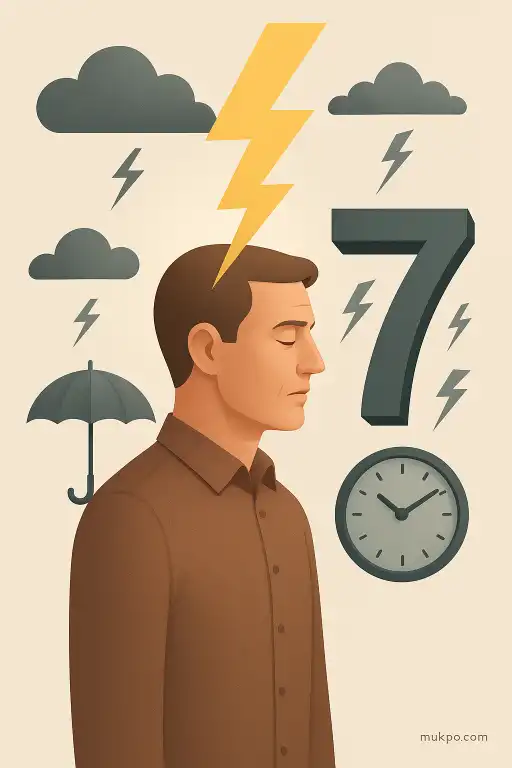
A lightning strike isn’t usually a bolt picking a person at random. It’s a fast electrical breakdown along a path that becomes favorable second by second. Tall objects help launch upward streamers. Open ground reduces competing paths. Wet surfaces lower resistance. A person who is repeatedly in exposed places during storms is repeatedly in the set of “available routes.”
There’s also a situational detail people overlook: the same storm can produce multiple separate cloud-to-ground strikes minutes apart, and the risk can stay high even when the rain slackens. That matters for people working outside who have to keep moving through changing terrain, especially near isolated trees, ridge tops, fire towers, or open overlooks.
What a lightning strike does to the body
Survival is more common than people assume, but “survived” can still mean major injury. Lightning can stop the heart or breathing, cause burns, rupture eardrums from the blast wave, and trigger neurological problems that linger. A lot of the damage comes from electricity spreading over the skin’s surface in a flashover, from heat, or from the shock of being thrown.
One reason outcomes vary is that lightning doesn’t always travel the same way through the body. It can enter and exit at different points, or it can partly travel over clothing and sweat. Even small details like being soaked, holding metal tools, or standing in shallow water can change where the current concentrates. That’s part of why repeat strikes don’t necessarily look like repeat injuries.
The overlooked routes: side flash and ground current
Many “struck by lightning” cases are not a direct hit from cloud to person. A common route is side flash, where lightning hits a tree or another tall object and then jumps to a nearby person because that new path is easier in that instant. Another is ground current. Lightning hits the ground and the electrical energy spreads outward, and a person becomes part of that spread, especially if their feet are apart on wet soil.
This helps explain why proximity can be as important as height. Someone can be hit while standing next to the thing that takes the main strike, or while moving across ground that has just been energized. It also explains why a repeat-strike story doesn’t require a person to be the tallest thing around every time.
What makes the seven-strike story stick
Part of the grip is the contradiction. Lightning feels like a once-in-a-lifetime event, yet documented repeat strikes exist. A park ranger in Shenandoah National Park is also a concrete mental picture: long days outside, storms rolling across ridges, and a job that doesn’t happen under a roof. That context makes the number feel less like pure fate and more like repeated exposure to a specific kind of risk.
And even with a name attached, the details people remember tend to be the count, not the mechanism. The mechanisms are mundane and fast: developing channels in the air, a sudden preference for a certain route, and energy spreading through nearby ground. The human part is that the same person can find themselves in that narrow slice of timing again, years later, in another storm.
Related reads
- The cramped shipboard trial that made citrus the Royal Navy’s cure for scurvy
- The lichen that drinks rock vapor to survive deserts
- How a single brief apology can dissolve social tension
- The plankton that weaves glass armor from seawater silica
- Why a familiar name sometimes won’t come to mind
- A town that kept a cat as an honorary mayor for decades