
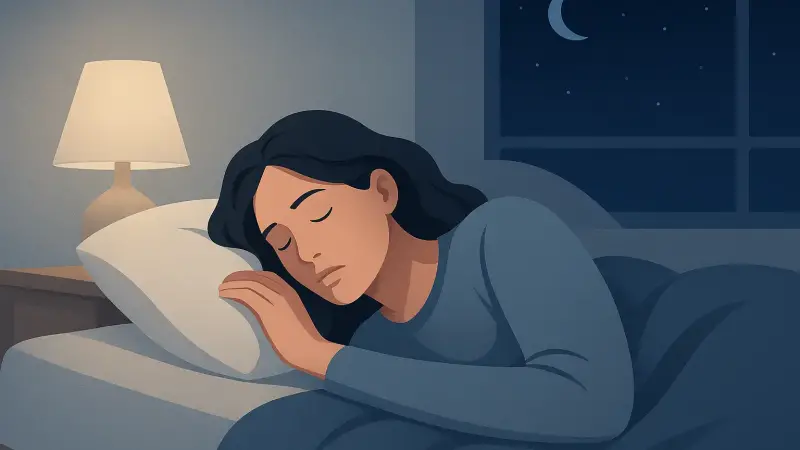
Some nights, the lights go out and the body still acts like it’s waiting for an email. There isn’t one single place or famous incident behind this. It shows up in everyday bedrooms in New York, Tokyo, and São Paulo, and it varies a lot by person. One thing that tends to change the feel of the night is how consistent the lead‑in to sleep is. The basic mechanism is simple: repeated pre‑sleep behaviors reduce uncertainty, and uncertainty is one of the easiest ways to keep the threat system online. When the brain can predict what happens next, it spends less energy scanning for problems.
Nighttime anxiety feeds on uncertainty
Night anxiety often isn’t about a single fear. It’s the brain noticing reduced input and trying to make sense of it. In the dark, there are fewer cues to anchor attention. That leaves more room for internal signals: a slightly faster heartbeat, a warm face, a random muscle twitch. If the mind can’t quickly categorize those signals as normal, it keeps checking them.
This is why two people can have the same quiet room and very different nights. One person’s brain treats the silence as “safe and done.” Another treats it as “something is missing.” Consistent pre‑sleep behaviors don’t erase worries, but they narrow the range of possibilities the brain has to evaluate.
Predictability lowers the brain’s monitoring load

Repeated sequences become easy for the brain to run. They turn into a kind of script: wash up, dim the room, get into bed, lights off. The details can differ, but the key is that the order and timing stop being negotiable. When that happens, there are fewer “decision points,” and decision points are where anxious thinking likes to wedge itself.
A specific detail people often overlook is the micro‑moment after getting into bed. If the usual pattern is immediately lying still, but tonight includes checking the phone, walking to the kitchen, or turning lights back on, the brain gets mixed signals about whether sleep is actually the next state. That ambiguity can keep the system in monitoring mode for longer than people expect.
Consistency becomes a cue for safety
The nervous system learns by association. When the same set of behaviors reliably leads to sleep, those behaviors start to predict a safe outcome. Over time, the body can begin downshifting earlier, sometimes before a person consciously “feels sleepy.” It’s not magical. It’s conditioning and expectation working together.
This also explains why novelty at night can feel louder than it is. A hotel room, a different pillow, an unfamiliar hallway light, or even a new detergent smell can disrupt learned cues. The brain treats “new” as “needs checking,” and checking is incompatible with drifting off.
Routines reduce internal negotiation
Bedtime is one of the few times the day stops demanding action. That can be a relief, but it also opens a gap where unfinished tasks and social tensions rush in. When pre‑sleep behavior is consistent, there’s less room for the mind to bargain with itself: one more video, one more message, one more mental review of tomorrow. The sequence is already chosen.
A concrete example is someone who tends to replay work conversations at night. If their pre‑sleep period varies—sometimes scrolling, sometimes tidying, sometimes lying down early—the mind keeps searching for the “right” off‑ramp. If the same pattern happens each night, the brain gets fewer chances to reopen the debate, even if the content of the worries hasn’t changed.
Timing and light create stronger signals than people notice
Some parts of pre‑sleep behavior matter because they shape the body’s clock. Light exposure, especially bright overhead light and phone light close to the face, is a strong signal for alertness. So is doing stimulating tasks right up to the moment of lying down. When those signals vary night to night, the brain has a harder time predicting when sleep is supposed to happen.
What’s easy to miss is that it isn’t only “screen time.” It’s the whole pattern of cues: the same lamp, the same brightness, the same sequence of movements, the same sounds in the home. When those cues are stable, the brain spends less of the night asking, quietly and repeatedly, whether it should still be on duty.
Related reads
- How being ignored for a moment lights up the brain like a physical sting
- The neighborhood that woke up to a constant low hum
- The town that made dying a crime
- How a space rock’s water may have kickstarted Earth’s oceans
- Why time feels shorter as decades pile up
- When an Ottoman sultan shut down Constantinople’s cafés and made coffee a crime