
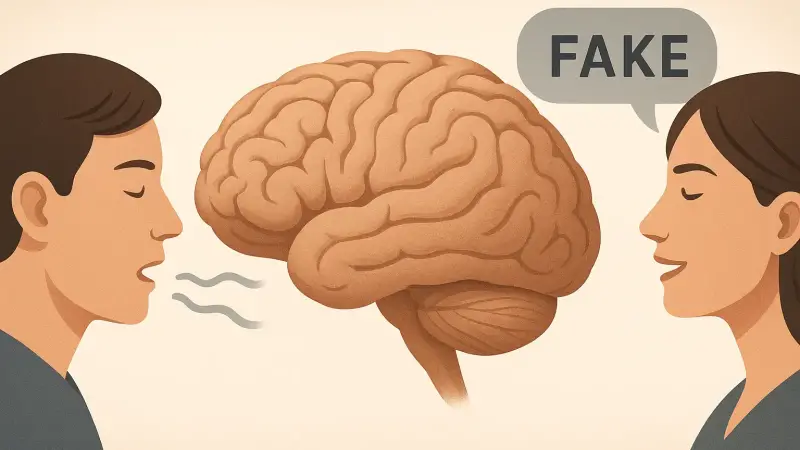
That moment you swear you heard a word
On a crowded New York City subway platform, someone says something through a scarf, a mask, or just the roar of the train. You nod because you’re almost sure you caught it. Later you replay it and realize you might have invented a whole syllable. This isn’t one single place or event. It happens in a London pub, a Tokyo station, a busy call center anywhere. The brain doesn’t wait for perfect audio. It predicts what should be there and fills the gaps fast. The weird part is how confident that fill-in can feel, even when the actual sound never arrived.
Speech is a prediction problem, not a decoding problem
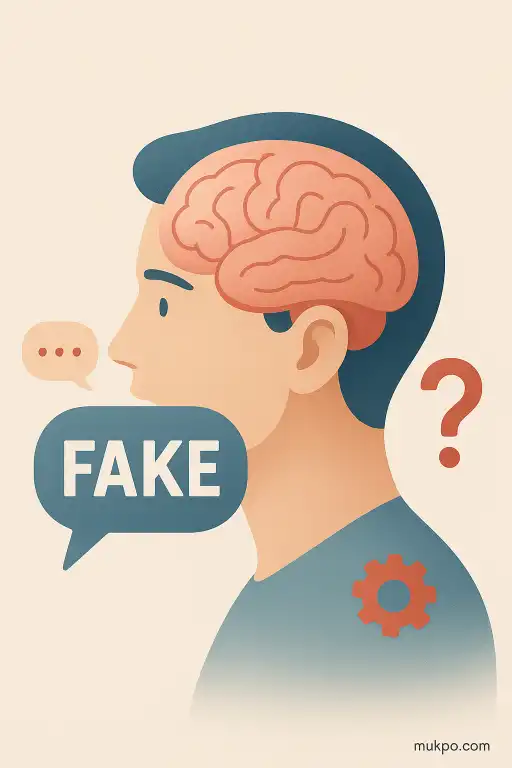
Speech hits the ear as messy, overlapping sound. Consonants get clipped. Vowels smear into background noise. The brain leans on expectations: the topic, the setting, the speaker’s accent, and what usually comes next in a sentence. That top-down guesswork isn’t optional. It’s built into normal understanding. If a friend starts with “Can you pass the…,” the brain is already preparing a short list of likely endings before the last word finishes arriving.
When the signal is muffled, the balance shifts. The sound provides fewer constraints, so the prediction engine gets more freedom. That’s when “confident fake words” show up. It can feel like hearing, but it’s closer to rapid inference. The system chooses the best-fitting candidate and commits, because conversation can’t pause for forensic audio analysis.
Why the fake word feels real
Part of the confidence comes from timing. The brain’s guess lands at the same moment the real word would have landed, so it has the right rhythm. Another part comes from how speech is represented. People don’t store every sound as a raw recording. They store patterns: phonemes, common word shapes, and familiar sequences. If the beginning of a word and the sentence frame are clear, the middle can be “completed” with very little data.
A detail people often overlook is that loudness isn’t the whole story. A loud room can still be easy if the sound is clean. A quieter room can be hard if the sound is distorted. Masks, scarves, a hand over the mouth, phone compression, and reverberant spaces like stairwells all remove the crisp high-frequency cues that carry consonants. Without those cues, different words collapse into the same blur, and the brain has to pick one.
Context can overpower the actual sound
The chosen word is usually the one that fits the situation, not the one that matches the acoustics best. Picture a barista behind an espresso machine saying something that starts with “oat…” or “out…”. If the order on the counter is a latte, the brain tends to settle on “oat milk” instead of “out back,” even if the sound could support either. The same thing happens with names. If someone in an office says, “Did you email Brian?” a listener who works with “Ryan” may genuinely “hear” Ryan, because that’s the more available person-shaped prediction.
This also explains why two people can hear different things from the same muffled phrase. They bring different priors. One knows the topic. One expects a joke. One is used to a particular accent. The audio is the same, but the internal shortlist of likely words is not.
Why the brain doesn’t flag it as a guess
There isn’t a neat “certainty label” attached to everyday perception. Most of the time, the system treats its best hypothesis as the world. That’s efficient, and it usually works. The cost shows up in muffled moments, where the best hypothesis can be wrong but still feel identical to a real perception. The confidence comes from coherence: the filled-in word makes the sentence grammatical and sensible, so it passes an internal plausibility check.
When the guess is wrong, people often notice only later, when a follow-up question doesn’t match what they thought they heard. The earlier word wasn’t “misheard” in the usual sense. It was never fully heard. It was completed. And the completion was good enough to keep the conversation moving at full speed.
Related reads
- The Prague defenestration of 1618 that hurled regents and ignited the Thirty Years’ War
- Why consistent pre sleep behaviors lower nighttime anxiety
- How being ignored for a moment lights up the brain like a physical sting
- The neighborhood that woke up to a constant low hum
- The town that made dying a crime
- How a space rock’s water may have kickstarted Earth’s oceans