
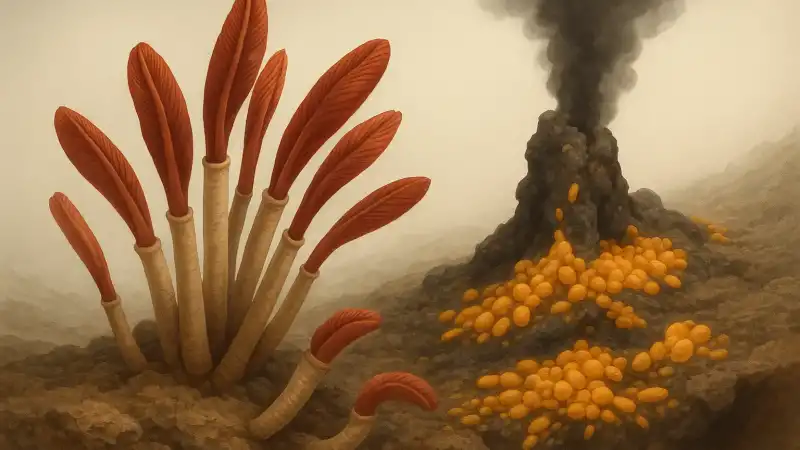
Meeting a worm that farms in the dark
People rarely ask how an animal can “eat” a chemical. But that’s the everyday problem down at hydrothermal vents, where food doesn’t start with sunlight. These vents aren’t one place. They show up along ocean ridges in places like the East Pacific Rise, the Mid-Atlantic Ridge, and the Lau Basin. In those fields, some deep-sea worms live inside tubes and rely on bacteria that use sulfur compounds leaking from the seafloor. The basic mechanism is simple: the worm positions itself where vent water and oxygenated seawater mix, and it supplies the bacteria with both ingredients so the bacteria can make organic carbon.
The overlooked detail is how narrow that sweet spot can be. A few centimeters can mean the difference between “enough sulfide to power chemistry” and “so much sulfide it becomes toxic.” The worm’s whole life is shaped around staying in that thin boundary layer.
What the bacteria are doing with sulfur
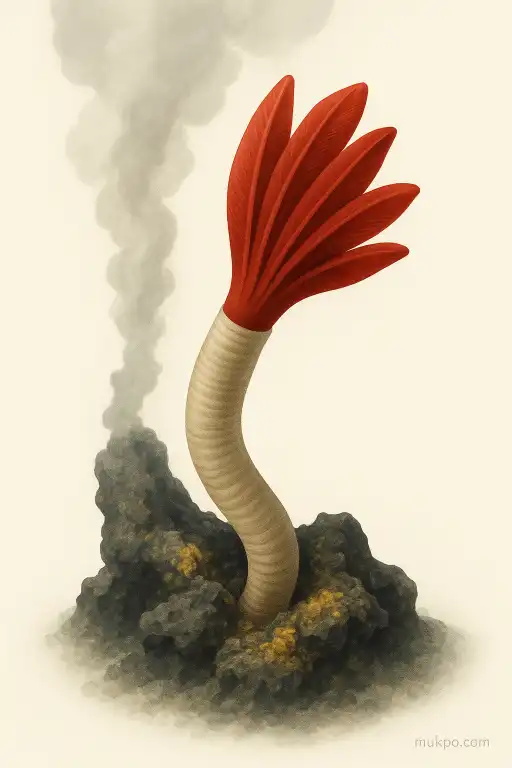
The bacteria involved are usually sulfur-oxidizers. They take reduced sulfur chemicals such as hydrogen sulfide from vent fluids and combine them with oxygen (or sometimes nitrate) from seawater. That chemical reaction releases energy. The bacteria spend that energy fixing carbon dioxide into sugars and other organic molecules, basically building biomass without photosynthesis.
This only works if two things arrive at once: an electron donor (sulfide) and an electron acceptor (often oxygen). Vents tend to supply the first, and the surrounding ocean supplies the second. The worms don’t create the chemistry, but they make the mixing reliable by living right where those flows meet.
How worms “cultivate” microbes instead of just hosting them
Different vent worms do this in different ways, and the details vary by species. Some tube worms (like the famous Riftia pachyptila from the East Pacific Rise) don’t have a mouth or gut as adults. They keep their bacteria inside a special internal organ called a trophosome. In that setup, “cultivation” is mostly about farming conditions: the worm collects chemicals from the water and delivers them to the bacteria through its blood.
Other worms and vent animals carry dense bacterial mats on their surface or within cavities, closer to the water itself. That can look more like a literal garden. The animal’s movement and posture keep fresh vent fluid passing over the microbes, while also preventing the bacteria from getting smothered by minerals that precipitate out of vent water. That mineral rain is easy to miss, but it can coat surfaces fast near some chimneys.
The plumbing: delivering sulfide without poisoning yourself
Hydrogen sulfide is useful fuel for bacteria and a problem for animal tissues. Vent worms deal with this using specialized physiology. In some tube worms, the blood contains hemoglobin that can bind and transport both oxygen and sulfide at the same time. That combination is unusual. It lets the worm move sulfide around internally in a controlled way instead of letting it shut down basic cellular processes.
The worm also has to keep the bacteria productive, not just alive. That means steady delivery rather than spikes. Vent flow is patchy and can shift when a chimney cracks, collapses, or gets sealed by new mineral deposits. So the animal’s “farming” includes constant small adjustments—how far it extends from its tube, which side faces the flow, and how much body surface is exposed to oxygen-rich water.
A vent farm is always in danger of being erased
Hydrothermal vents are unstable habitats. Temperatures can swing quickly, and the chemistry can flip from oxygenated to anoxic over short distances. When the balance shifts, the bacteria can stop fixing carbon efficiently, or a different microbial community can take over. That means the worm’s success depends on staying in the right microhabitat, not just finding a vent field once.
There’s also the risk of the “farm” getting physically buried. Vent fluids carry dissolved metals that precipitate into sulfide minerals as they cool. Those minerals build chimneys, but they also dust nearby surfaces. If bacterial layers get coated too heavily, exchange with the water slows. That’s one reason many vent animals cluster on edges of flow, where chemistry is strong enough to feed microbes but not so intense that minerals and heat overwhelm everything.
Related reads
- How the brain completes muffled conversations with confident fake words
- The Prague defenestration of 1618 that hurled regents and ignited the Thirty Years’ War
- Why consistent pre sleep behaviors lower nighttime anxiety
- How being ignored for a moment lights up the brain like a physical sting
- The neighborhood that woke up to a constant low hum
- The town that made dying a crime