

Seeing a comet do two different things at once
A comet can look like it’s carrying two tails, and they don’t always agree on direction. That isn’t one single event tied to one place or year. It’s a pattern observers have seen across comets like Hale–Bopp (1997), McNaught (2007), and NEOWISE (2020). One tail can be narrow and bluish. Another can look whiter or more yellow. That yellowish tint often points to sodium, a common element that’s surprisingly easy for sunlight to pick up and push around once it’s free.
The core mechanism is simple: the comet warms as it nears the Sun, material leaves the nucleus, and sunlight plus the solar wind sort that material by what it is. Sodium atoms end up in their own category because they interact with sunlight in a very specific way.
Where the sodium comes from
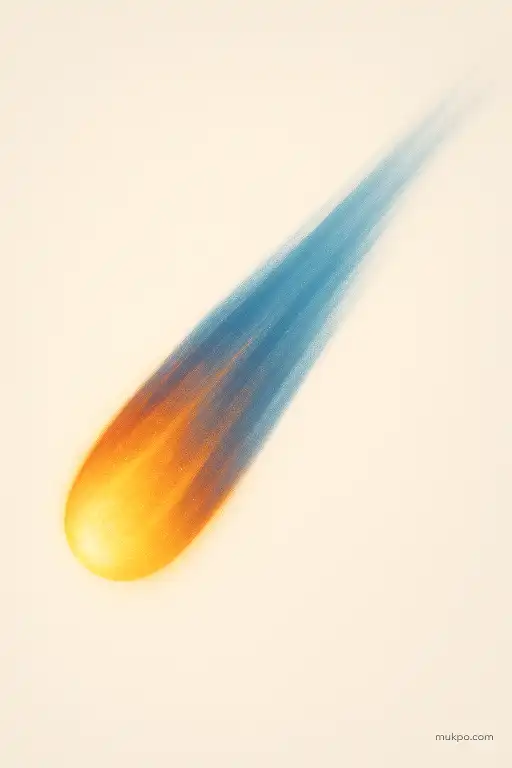
Comets are mixtures of ices, dust, and rocky grains. Sodium is usually locked up inside minerals in the dust, not sitting around as free metal. As the comet heats, gas drags dust away from the nucleus. Then the Sun’s ultraviolet light and energetic particles start altering those grains. Some sodium can be knocked out of mineral structures by photon-stimulated desorption or by sputtering, where fast particles physically kick atoms off a surface. Exactly which process dominates can vary with the comet and with distance from the Sun, and it isn’t always clear from Earth-based images alone.
There’s an overlooked detail here: sodium doesn’t need to be abundant to be obvious. The yellow sodium D-lines around 589 nanometers are strong, and they sit in a part of the spectrum detectors and human eyes are pretty good at noticing. A small amount of free sodium can draw attention that a larger amount of other neutral atoms wouldn’t.
Why sunlight can shove sodium so efficiently
Once sodium is in the coma as individual neutral atoms, it becomes easy to push. The push comes from radiation pressure: photons carry momentum, and when an atom absorbs and re-emits light, it takes a tiny kick. Sodium is special because it resonates with sunlight at those D-line wavelengths. That makes it absorb photons there very effectively, which increases the net outward force from the Sun compared with many other neutral species.
This is not the same force that shapes the ion tail. The ion tail is steered mainly by the solar wind and magnetic fields. Neutral sodium starts out not caring much about magnetic fields. It mostly cares about how many resonant photons it sees and how fast it gets ionized after it leaves the dust.
How the tail gets sculpted into a narrow feature
A sodium tail tends to be long and relatively thin because the atoms are accelerated outward while still staying close to the comet’s orbital plane. The geometry matters. Dust grains feel radiation pressure too, but they also have a wide range of sizes and velocities, so the dust tail spreads out and curves. Sodium atoms are more uniform. They can be “sorted” into a narrower stream as radiation pressure pushes them onto slightly different trajectories than the dust and as the comet continues moving along its orbit.
The Sun also sets a time limit. Neutral sodium doesn’t stay neutral forever. It can be photoionized by ultraviolet light, and then it stops behaving like a neutral tail particle and starts behaving like an ion, which means the solar wind can grab it. That turnover helps keep the sodium feature from becoming a big diffuse cloud. The balance between outward push and ionization rate changes with solar activity, and it can change quickly.
What you can and can’t tell from a photo
When a comet shows a yellowish, straight-looking component, it’s tempting to label it “sodium” immediately. Sometimes that’s right, and sometimes it’s mixed with dust-scattered sunlight and other emissions. Confirming sodium usually takes spectroscopy that resolves the D-lines, not just a color image. That’s why reports can disagree: cameras have different filters, processing methods vary, and the comet can change night to night.
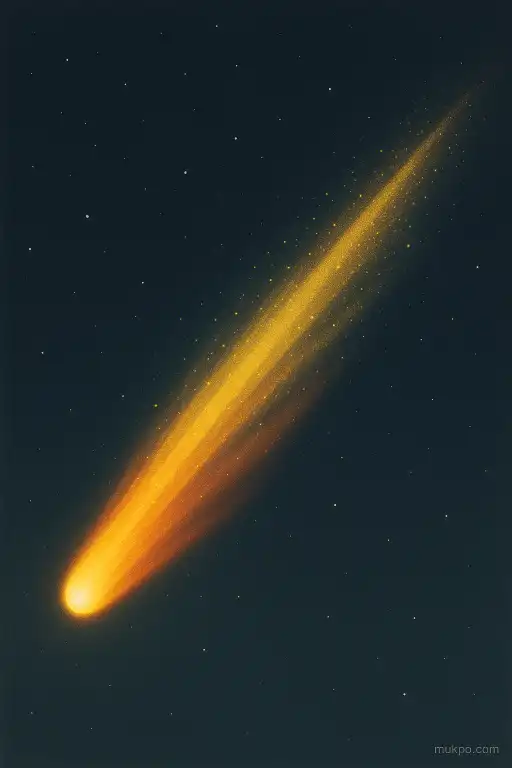
A concrete example people forget is that the same comet can show different tail structures depending on viewing angle. During Comet NEOWISE in 2020, the dust tail’s curvature was obvious in many wide-field photos, while narrower features looked straighter in some orientations than others. That doesn’t mean the physics changed instantly. It often means the line of sight changed, while sunlight kept doing the same basic job of freeing atoms and pushing the ones, like sodium, that catch the Sun’s light most efficiently.
Related reads
- The Christmas truce and the impromptu football match along the 1914 Western Front
- When a 1784 Paris commission exposed Mesmer’s animal magnetism as spectacle rather than science
- The island that vanished from maps and reappeared decades later
- How deep-sea worms cultivate sulfur bacteria on hydrothermal vents
- How the brain completes muffled conversations with confident fake words
- The Prague defenestration of 1618 that hurled regents and ignited the Thirty Years’ War