
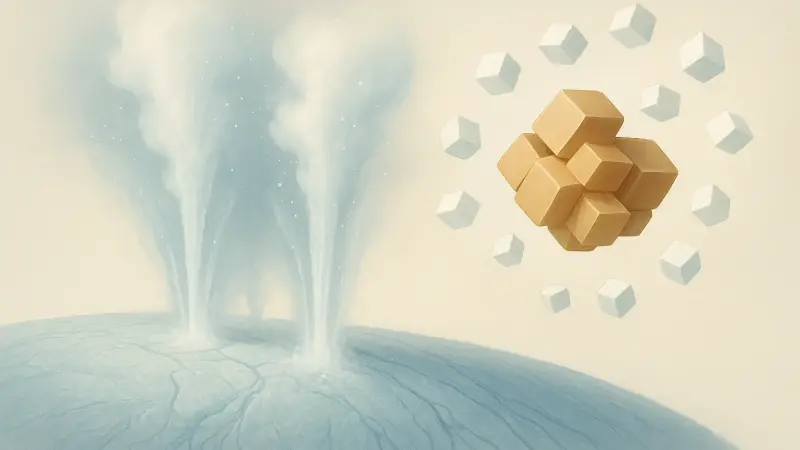
If you shake a bottle of fizzy mineral water and crack the cap, you don’t just get water. You get clues about what was dissolved inside it. Enceladus works a bit like that. In 2005, NASA’s Cassini spacecraft flew through jets spraying from fractures near Enceladus’s south pole and found that the plume isn’t “just ice.” It carries salts and other chemicals. Those salts matter because they don’t form easily in a vacuum. They usually come from water that has spent time touching rock, picking up ions, and then getting launched into space as tiny grains.
What Cassini actually sampled
Cassini didn’t drill or land. It tasted the plume by flying through it at high speed. Two instruments did most of the chemistry work: the Cosmic Dust Analyzer, which caught ice grains and read their composition from impact, and the Ion and Neutral Mass Spectrometer, which measured gases. A concrete example is Cassini’s close passes in 2008 and 2009, when it flew through denser parts of the plume and returned clearer mass spectra for both dust and vapor.
A detail people often overlook is what those “salt” detections are made of in practice. The clearest signals were not piles of table salt. They were sodium- and potassium-bearing compounds inside ice grains, often as salts of chloride, bicarbonate, or carbonate. That distinction matters because the grain chemistry depends on how droplets froze, how they boiled, and how they were altered by radiation after leaving Enceladus. The plume is a messy sampler, not a clean beaker.
Why salt points to liquid water and rock contact

Pure water ice can erupt from many processes, including surface sublimation. Salts are harder to explain without liquid water somewhere below. Dissolved ions need time in solution. They also need a source. For sodium, potassium, and chloride, the most straightforward source is rocky material leaching into water, the way groundwater on Earth picks up minerals as it moves through cracks.
Salt chemistry also hints at how long water and rock have been interacting. Short contact can still dissolve some ions, but higher concentrations and a wider mix of ions tend to come from ongoing circulation. That’s why researchers talk about an ocean communicating with a rocky interior rather than a one-off melt pocket. It doesn’t prove a single plumbing layout. It supports a system where liquid is repeatedly produced and moved.
What the mix of salts suggests about ocean conditions
The plume grains that look “salty” have been interpreted as coming from water that is not extremely acidic. Carbonate and bicarbonate signals fit better with neutral to mildly alkaline conditions than with strongly acidic water. That matters because pH changes what minerals dissolve, what gases get produced, and what kinds of chemical energy are available.
There’s also the question of concentration. Some models infer an ocean with salinity in the ballpark of Earth’s seas, while others allow lower or higher values depending on how the plume fractionates salts during freezing and venting. It’s unclear because the plume is selective. Tiny droplets can freeze in ways that concentrate salts into certain grains, and the instruments mostly sampled what was easiest to loft into space.
How salty water gets turned into a plume
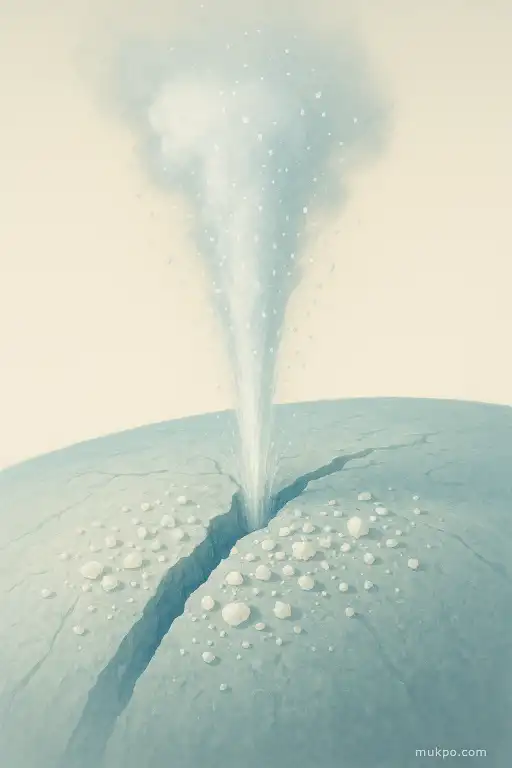
Enceladus’s plume likely starts as liquid water under pressure, rising through cracks and cavities. As it ascends, it can partially boil in the near-vacuum, breaking into droplets. Those droplets freeze into ice grains. Some grains trap dissolved salts. Others are closer to pure ice, depending on where they formed and how fast they froze.
That pathway creates a bias that complicates interpretation. If most salts end up in fewer, denser grains, Cassini’s dust measurements might overemphasize salty material compared with the average ocean. If salts stay mostly in brine pockets that don’t get lofted, Cassini might under-sample them. The vent geometry near the south polar “tiger stripe” fractures also likely varies over time, changing which reservoirs get tapped on different flybys.
What salts can’t tell us yet, and what would help
Salts can narrow down broad conditions, but they don’t uniquely identify the ocean’s full recipe. A sodium and chloride signal doesn’t reveal whether the dominant anion is chloride or bicarbonate without context. It also doesn’t tell you the full inventory of trace metals, organics, or how layered the ocean might be. Radiation processing after ejection can also tweak grain surfaces, and high-speed impacts in the instrument can fragment molecules in ways that blur exact identities.
What would sharpen the picture is cleaner sampling at lower relative speeds, repeated measurements across seasons, and better separation of grain types. A future mission that can analyze individual particles with higher mass resolution, and compare plume composition when activity is stronger versus weaker, could tell whether the salts track a stable ocean chemistry or a shifting set of subsurface pockets. That difference changes how people picture the hidden ocean’s circulation and its contact with rock.
Related reads
- Why the word you need vanishes in the middle of a sentence
- The mirror in a thrift shop that reflects rooms nobody recognizes
- How seagrass meadows bury carbon and reshape coastlines
- The Antarctic brine pocket where microbes breathe metal instead of oxygen
- How a cold rewires your sense of taste and flavor
- The mushroom that glows to attract spring beetles