
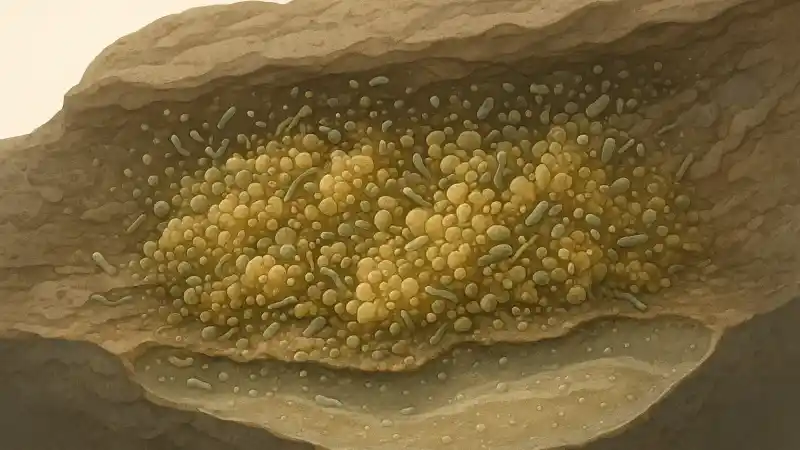
It feels obvious that life needs oxygen, because that’s what we breathe. But in parts of Antarctica, there are wet pockets of water so salty and so starved of air that oxygen is basically off the menu. One well-known example is Blood Falls at Taylor Glacier in the McMurdo Dry Valleys, where iron-rich brine oozes out and stains the ice. Inside briny, sealed-off water like this, some microbes can keep going by using metals as part of their chemistry. Instead of oxygen taking electrons at the end of respiration, compounds of iron can do that job.
Where the brine pockets are
When people say “brine pocket,” they’re talking about salty water trapped within ice, under ice, or in sediments that stay below freezing most of the year. Antarctica has several versions of that setup. The McMurdo Dry Valleys are a common reference point because they have cold desert conditions, glaciers, and salty groundwater all in close contact. Blood Falls is tied to a subglacial brine system feeding out through cracks in the ice.
These brines can stay liquid because salt pushes the freezing point down. The exact chemistry varies by location. Some brines are rich in chloride, some in sulfate, and some carry lots of dissolved iron. What they share is isolation. When water is sealed away from the atmosphere for long stretches, oxygen gets used up and not replaced.
How “breathing metal” works

Microbes still need a way to harvest energy. A simple way to think about respiration is electron flow: cells pull electrons from a fuel source and pass them to an electron acceptor. Humans mostly use oxygen as that final acceptor. In oxygen-poor brines, certain microbes can use oxidized metals instead, especially iron. Ferric iron, written as Fe(III), can accept electrons and get reduced to ferrous iron, Fe(II).
This isn’t a rare trick confined to Antarctica. Similar “metal-reducing” metabolisms show up in lake sediments, deep soils, mines, and seafloor mud. The Antarctic version gets attention because the environment is so cold and so salty. It’s a reminder that the chemistry of a place can matter as much as temperature when it comes to what life can do.
Why the brine is anoxic in the first place
Oxygen disappears fast in a closed system. Any microbes present will consume it. Chemical reactions can also remove it, especially when minerals and dissolved compounds are reactive. Once the supply is gone, the system doesn’t “reset” unless fresh oxygenated water mixes in. Under ice, mixing can be limited. Even tiny barriers matter when everything is cold and slow.
One detail people often overlook is that cold water can hold more dissolved gases than warm water, but it doesn’t help much if the water never gets exposed to air. A brine pocket can be both very cold and effectively airless. High salinity also changes how gases dissolve and move, which can make oxygen transport even less straightforward than in ordinary freshwater.
What iron does to the scene you can actually see
At Blood Falls, the bright red color isn’t because the brine is full of oxygen. It’s largely a surface effect. When the iron-rich brine reaches air, iron can oxidize and form iron oxides, which look like rust. That’s why the stain is most dramatic where the brine emerges and spreads across ice.
Below the surface, conditions can favor reduced iron, which stays dissolved more easily. That dissolved iron can act as a usable electron acceptor for certain microbes. Then, as brine moves and conditions shift, the chemistry can flip again. The same iron can cycle between forms depending on what’s available, including tiny amounts of oxidants, minerals in the sediment, and whatever the microbial community is doing.
Why scientists care about these pockets
Brine pockets are natural laboratories for life under multiple stresses at once: cold, salt, darkness, and low oxygen. Researchers look at them to understand how microbial ecosystems function when the “normal” rules—like oxygen being plentiful—don’t apply. In Antarctica, that also means learning how subglacial and periglacial systems exchange water and chemicals over time.
They also matter because the microbes aren’t just surviving; they can reshape the local chemistry. Iron reduction, sulfur chemistry, and carbon processing can all change what stays dissolved, what precipitates out, and what signals show up when brine finally reaches the surface. In places like Taylor Glacier, a small seep can carry a long underground history with it, right up into view.
Related reads
- How a cold rewires your sense of taste and flavor
- The mushroom that glows to attract spring beetles
- Why bread sometimes grows mold in perfect circular patches
- An elevator that refuses to open on floors with odd birthdays
- How volcanic ash shapes global weather patterns
- How a tiny meteorite impact changes local soil chemistry