
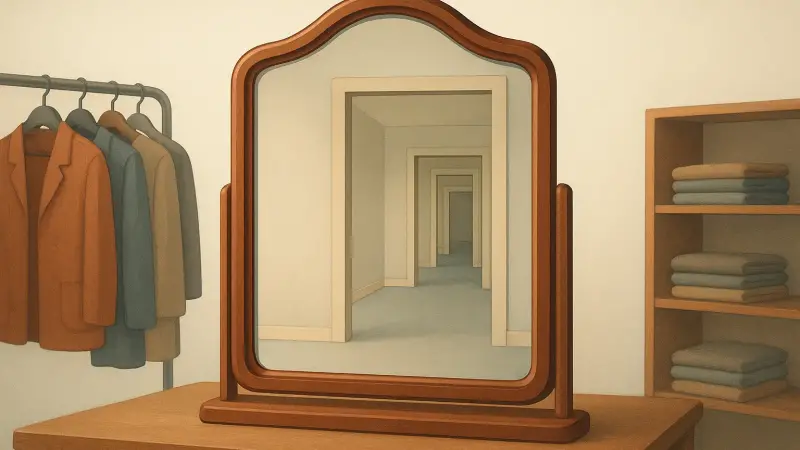
A normal mirror that doesn’t behave normally
People don’t usually look closely at thrift-store mirrors. They check for chips, they check the frame, and they hold it up to see if it makes the room feel bigger. Then sometimes a mirror does the one thing a mirror isn’t supposed to do. It reflects a room that isn’t there. This isn’t one single famous incident with a named shop and a confirmed paper trail. Stories like this show up as local anecdotes, forum posts, and personal accounts from places as far apart as the UK and the US, and the details vary. The core mechanism is consistent, though: a mirror that’s physically in one room but seems to be visually “tuned” to a different interior.
What people usually report seeing
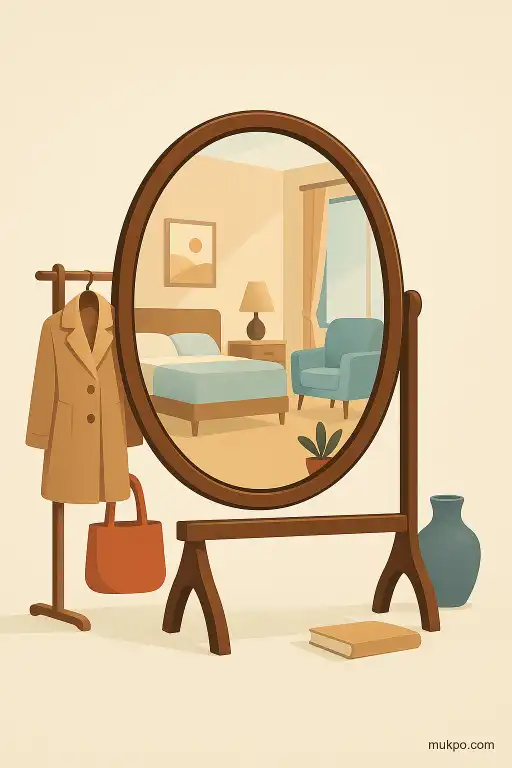
The reflection tends to be ordinary, which is part of why it sticks. Not a ghost. Just a space nobody recognizes. A narrow hallway instead of the shop aisle. A bedroom with a different window layout. A ceiling fan that isn’t in the building. The lighting is often described as slightly off—too warm, too dim, or coming from a direction that doesn’t match the actual room. People also mention that the “wrong” room keeps its geometry. If they shift left, they see more of the left side of that other room, as if they’re moving relative to it, not just watching a static picture.
A concrete situational example that comes up a lot: someone holds a full-length mirror upright in a cluttered thrift shop and, in the glass, there’s a clean, carpeted space with a closed white door behind them. They turn around and there’s no door. They look back and it’s still there. Then the employee walks past, and in the reflection the person is there but the employee isn’t, like the mirror is showing an angle that doesn’t include the aisle traffic. That missing-by-a-second detail is the part many people overlook when they retell it.
How a real mirror can “show” the wrong room
There are a few very normal ways for a mirror to appear wrong without being wrong. The simplest is that it’s not reflecting what you think it’s reflecting. Thrift stores have big windows, glass cases, and other mirrors at odd angles. Put two reflective surfaces in the same line and you can get a “borrowed” view from somewhere else in the building. A mirror can also have a slight warp. Old glass, especially in heavy frames, can bend the reflection just enough that your brain stops trusting the geometry and starts interpreting it as a different space.
Another underappreciated factor is lighting temperature. Fluorescents in stores can be harsh and greenish. A mirror that picks up warm light from a back room or a lamp in a corner can make a familiar area look like a different building. Add a dark frame that blocks peripheral cues and the reflected scene can feel detached. People focus on the center of the mirror and forget the edges. The edges often contain the giveaway: a sliver of shelf, a faint reflection of a price sign, or a second reflection nested in the first.
Why the brain insists it’s a different place
A mirror is supposed to be a perfect rule-following object. When it breaks the rule even slightly, the mind doesn’t just note “weird optics.” It tries to stabilize the scene. That means it builds a room model: where the walls must be, how far away the door is, what size the window should be. If the mirror’s cues are incomplete—cropped edges, inconsistent shadows, missing familiar objects—the brain fills in the missing structure. That filled-in structure can feel certain even when it’s wrong.
People also anchor hard to one or two “impossible” details. A door in the wrong spot is a big one. So is a window pattern that doesn’t match the building. But those are also the details most sensitive to perspective. Shift the mirror by a few degrees and a doorway can appear or disappear if it was actually a reflection of a doorway around a corner. The person holding the mirror usually watches the center of the glass, not the surrounding environment, so they don’t notice how small changes in angle can completely change what the mirror has access to reflect.
Why thrift shops are the perfect setting for it
Thrift shops pack in reflective materials. Picture frames with glass. Chrome lamp bases. Polished tables. Even matte surfaces can throw faint reflections if the lighting is strong. The stores also tend to have narrow aisles, which makes it easier to accidentally create a chain of reflections that “teleports” a view from a back corner to the front. And because items move constantly, the setup that produces the strange view can exist for five minutes and then vanish when someone rolls a rack or rotates a standing mirror.
One specific detail that gets ignored: protective films and old cleaning residue. Some mirrors have a thin layer of haze that scatters highlights and kills depth cues. Others have tiny scratches that create a subtle double image around bright edges. In a store, those defects can combine with overhead lights and glass clutter to make the reflection look like it has different dimensions. Someone will swear the mirror showed a separate room, and then it “stopped” later, simply because the mirror was moved a few feet or the lighting changed when the sun dropped behind the front windows.
Related reads
- How seagrass meadows bury carbon and reshape coastlines
- The Antarctic brine pocket where microbes breathe metal instead of oxygen
- How a cold rewires your sense of taste and flavor
- The mushroom that glows to attract spring beetles
- Why bread sometimes grows mold in perfect circular patches
- An elevator that refuses to open on floors with odd birthdays