

People tend to think of squid “flashing” as a vague shimmer, like a quick mood ring. But in the waters off Okinawa, Japan, one small species can pulse light in tidy, timed bursts that look a lot like a code. It’s not a language lesson, and nobody is claiming it’s literally Morse with dots and dashes. The mechanism is simpler and stranger. The squid controls tiny light organs and reflective skin structures with tight timing, and other squid can see the pattern. What comes out is a sequence of on-off beats that carries information because the timing is consistent.
Which squid, and where people noticed it
The animal most often linked to this “Morse-like” idea is the Hawaiian bobtail squid, Euprymna scolopes. A lot of the close-up biology work on its light organs comes from lab and field research in Hawaiʻi, where the species lives in shallow coastal sand and hides by day. Similar coded-looking flashing also shows up in other small squids and cuttlefish, but the famous case centers on bobtails because their light organ is unusually well studied and the timing of their output is easy to measure.
It’s also worth saying plainly: there isn’t one single “Morse code squid” location or one agreed headline species everywhere. Different studies and videos point to different cephalopods in places like Japan and Hawaiʻi. The common thread is controlled, repeated timing that another animal could plausibly interpret.
How a squid makes light without a flashlight
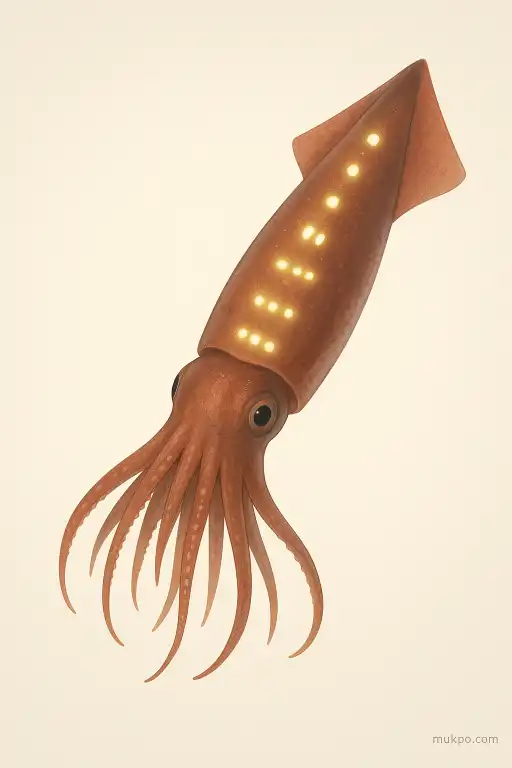
Many squid don’t glow by themselves. They host bioluminescent bacteria in a specialized light organ. In the bobtail squid, the main partner is commonly described as Vibrio fischeri (taxonomy has been revised in recent years, but the idea is the same). The bacteria produce light as a byproduct of their chemistry. The squid “farms” them by feeding and housing them, then uses muscles and tissue shutters to shape what gets out.
A detail people usually overlook is that the squid still has to manage the optics. It isn’t just a glowing pouch. The light organ includes reflective layers and a lens-like structure. Some species even have an ink sac positioned to act like a curtain. So when you see discrete flashes, you’re often seeing mechanical control over a steady glow, not the bacteria turning on and off like a switch.
Why the pattern can look like dots and dashes
<p“Morse-like” comes down to timing. If you can produce a short burst and a long burst, and you can repeat them consistently, a human observer will immediately map that onto dots and dashes. Cephalopods are good at consistent timing because their skin and muscles are wired for fast display changes. Even when the light source is bacterial, the squid’s shutters can create short and long pulses with clean edges.There’s also a practical reason for using time patterns underwater. Light intensity can be messy in the ocean. Distance, water clarity, and viewing angle change what “bright” means. Timing is more robust. A nearby squid and a farther squid can both still tell the difference between a quick flash and a longer one, even if the second animal sees both as dimmer.
What the squid might be “saying”
The safest claim is that the flashing can carry information, not that it spells words. Squid use visual signals for courtship, spacing, and conflict avoidance. A timed pattern could help with species recognition in low light, or it could signal readiness to mate without getting close enough to risk a fight. In bobtail squids, the glow is also famous for counterillumination: matching the downwelling light so the squid’s silhouette disappears from below.
That second purpose creates an interesting constraint. If the light organ is helping camouflage the animal, the squid can’t just blast light whenever it wants. It has to modulate output to match the background. So “communication” signals may need to ride on top of that camouflaging glow, using brief changes in rhythm rather than big changes in brightness.
How researchers test whether it’s code or just flicker
To treat a flash sequence as a real signal, researchers look for repeatability and context. Does the same pattern show up during the same social situation? Does it change when another squid is present? They also check whether the pattern is under the animal’s control. If the “flashes” happen at random intervals, or line up with stress movements like jetting away, it may be incidental.
The hard part is that squid are busy and hard to watch in the wild. Camera frame rate matters. So does angle. A shuttered glow can look like blinking if the squid turns slightly and the reflector stops pointing at the lens. That’s why some of the strongest evidence comes from controlled observations where researchers can separate actual on-off modulation from a simple change in orientation.
Related reads
- A fountain that changes temperature on birthdays
- A mailbox that keeps receiving postcards from a traveler who vanished decades ago
- The cocktail party trick: how your name cuts through noise
- How glowing algae pulse in sheltered bays
- Why your gut feeling can be alarmingly persuasive
- The mushroom that wires forests with electricity