
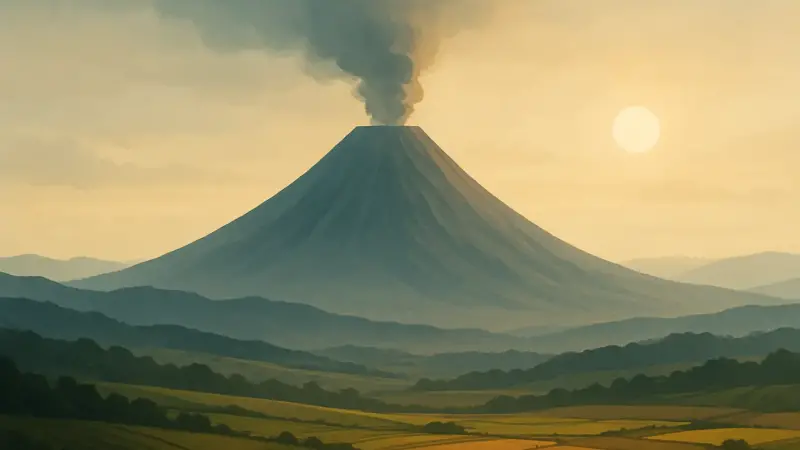
Sunlight can drop without anyone noticing
Most people think of a bad harvest as a local problem. Too much rain. Not enough rain. A late frost. But after the 1815 eruption of Mount Tambora in Indonesia, people in places thousands of miles away described a different kind of off-season: days that looked slightly washed out, summers that never fully warmed, and crops that struggled to finish. It wasn’t smoke drifting across the ocean like a campfire. It was a change to the light itself, caused by volcanic material high in the atmosphere turning some sunlight back to space and nudging weather patterns into unfamiliar shapes.
A volcano doesn’t have to be nearby to change your weather
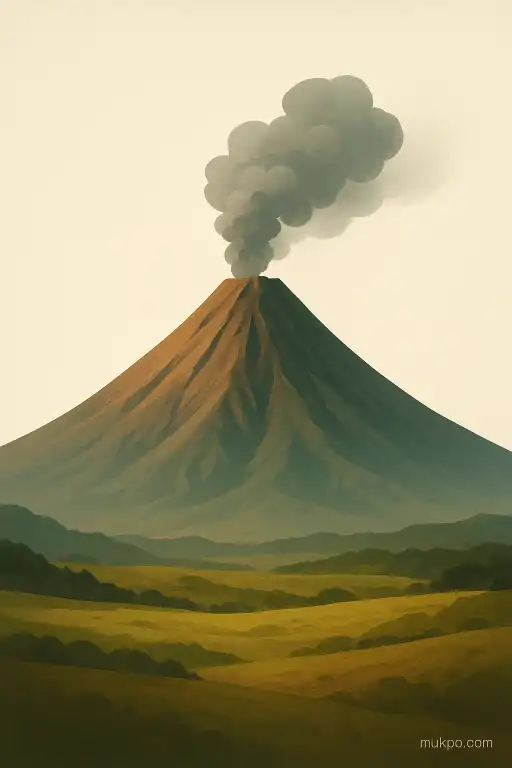
When a big eruption is strong enough, it punches gases and ash above the weather layer most of us live in. That matters because normal storms can’t easily scrub the stratosphere clean. So the eruption’s sulfur dioxide can linger up there and spread out around the globe.
Within weeks to months, that gas reacts with water vapor and forms tiny sulfate droplets. They’re small enough to float for a long time and numerous enough to matter. Instead of “blocking” the Sun like a dark cloud, they mostly brighten the sky in a way that reduces how much solar energy reaches the surface. The dimming can be subtle day to day, but it adds up across a season.
The overlooked detail: it’s not just less light, it’s different light
A detail people tend to miss is that volcanic haze changes the balance between direct sunlight and diffuse light. Direct light comes in a tight beam. Diffuse light arrives from many angles after scattering. After some eruptions, the surface can get less total sunlight, yet a larger fraction of it becomes diffuse.
That can tug plants in opposite directions. Diffuse light can penetrate deeper into a crop canopy and sometimes improve photosynthesis in shaded leaves. But the bigger effect for harvests is usually temperature. Cooler days slow growth. Cooler nights can bring frost risk earlier or later than expected. Grain filling in wheat, ripening in fruit, and simple things like pollen viability can all get thrown off by just a small shift in seasonal warmth.
Cooling is only part of it; rainfall and storms can shift too
Volcanic aerosols don’t cool every place the same way. They can also change pressure patterns and the paths storms take. One reason harvest failures feel confusing after a major eruption is that the signal isn’t uniform. One region gets persistent cold and wet. Another gets drought. A third sees repeated late frosts. The local outcome depends on where the aerosols concentrate, what time of year the eruption happens, and how the oceans respond.
Tambora’s aftermath is often linked with the “Year Without a Summer” in 1816, including unusually cold conditions reported in parts of North America and Europe. Other eruptions have had measurable global effects too, like Mount Pinatubo in 1991, which cooled average global temperatures for a time. The exact mix of dimming, cooling, and rainfall changes varies from event to event, and historical accounts can be patchy, but the basic chain is consistent: high-altitude sulfur turns into long-lived haze, and the atmosphere’s energy balance shifts.
Why harvests feel the shock so fast
A harvest is a timer. Crops are tuned to a window of heat and light that has to arrive in the right order. When a season runs cooler, plants may stay green longer but fail to mature before autumn. When spring warmth is delayed, planting shifts late and the whole schedule compresses. When rainfall patterns move around, fields can swing between waterlogged soil that slows roots and sudden dry spells that hit at flowering.
People notice the price of grain and the look of the sky, but the first break often happens quietly at the edge of the growing season: a frost that arrives a week early, or a run of cool days that never looks dramatic on its own. Those are the kinds of small mismatches a distant eruption can create, even when the volcano itself is on the other side of the world.
Related reads
- A street where every doorstep displays a broken clock set to the same minute
- A bakery that refuses to bake any recipe printed in books
- The squid that flashes in Morse code
- A fountain that changes temperature on birthdays
- A mailbox that keeps receiving postcards from a traveler who vanished decades ago
- The cocktail party trick: how your name cuts through noise