
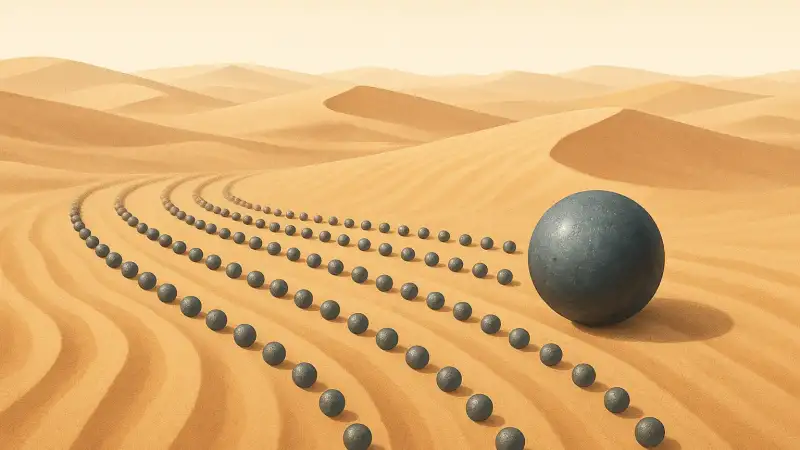
Sand dunes don’t always point downwind
Stand on a big dune field and you expect the ridges to line up with the dominant wind. Often they do. But not always, and there isn’t one single place where this happens. You can see puzzling dune orientations in parts of Namibia’s Namib Desert, in White Sands National Park in New Mexico, and in sections of the Sahara. In some of those settings, researchers have found a small extra “steering force” mixed into the sand itself: tiny grains of magnetic minerals that act like weak little magnets. They don’t move dunes by themselves. But they can bias how grains stick, roll, and settle when the wind is already doing the heavy lifting.
The basic idea is simple. A dune forms from countless tiny decisions at the grain level. Anything that slightly changes how grains clump or resist motion can change the shape that survives over time. Magnetic grains can provide that nudge, especially when the wind direction shifts from season to season.
The “tiny mineral magnets” are real minerals
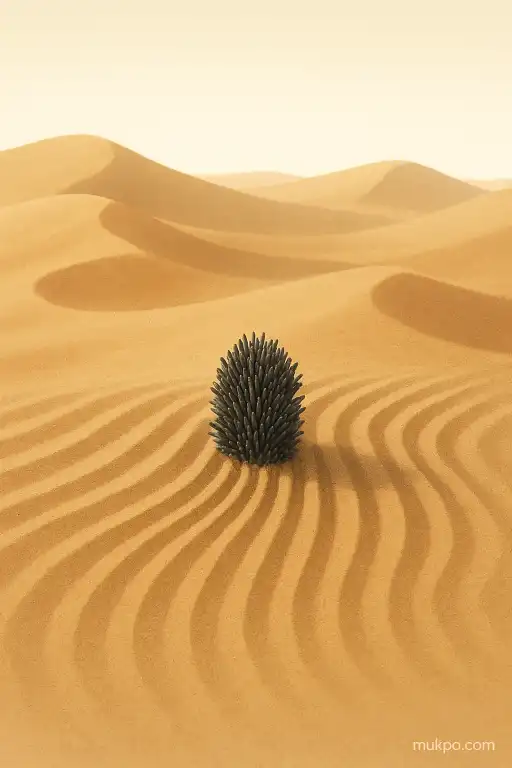
Most sand is dominated by quartz, which is not magnetic. The magnetic behavior comes from a minority component: iron-bearing minerals such as magnetite and, in some sands, hematite or other heavy minerals. These grains can be naturally magnetized, or they can become magnetized by Earth’s magnetic field and by repeated collisions and settling. The effect is small, but dunes are patient structures. They integrate small biases over long periods.
A detail people often overlook is that the magnetic fraction is usually the darker, denser “heavy mineral” part of the sand. That means it doesn’t always travel exactly like the bulk of the dune. It can concentrate in thin layers or patches, especially on certain slopes or after certain wind events, which makes its influence uneven across the same dune.
How magnetism can bias grain motion
Wind moves sand by hopping (saltation) and by creeping along the surface. For a grain to start moving, the wind has to overcome friction and the little “locks” created where grains touch. Weak magnetic attraction can slightly increase those locks when magnetite-rich grains are close together. That raises the threshold for motion in some micro-spots and lowers it in others, depending on how grains are packed and oriented.
On a dune, the difference between the windward slope and the slip face matters. If certain patches resist motion a bit more, sand transport becomes less uniform. Over many windy days, that can favor one ridge orientation over another, particularly where winds come from two main directions and the dune is constantly negotiating which way to point.
Alignment depends on more than wind direction
Dunes aren’t just wind vanes. Their orientation is also controlled by how variable the wind is, how much sand is available, moisture, vegetation, and the size distribution of grains. Magnetic effects fit into that crowded list as a “second-order” control. Where magnetite is scarce, nothing noticeable happens. Where it’s present enough to matter, it tends to matter most when the wind regime is already ambiguous—two strong seasonal directions, or frequent shifts around a dominant direction.
That’s one reason the same dune type can line up differently in different places. The Namib has abundant heavy minerals in some coastal sands, for example, while White Sands is mostly gypsum with different grain properties and different ways of sticking together. The result is that magnetism can be a big deal in one field and basically irrelevant in another, even under similar-looking winds.
What researchers look for in the field
To test whether magnetism is influencing orientation, people don’t just hold a compass to a dune. They sample the sand and measure magnetic susceptibility, look for concentrations of heavy minerals on specific parts of the dune, and compare ridge trends with wind records. They also check whether the “magnetic” layers correlate with surfaces that are harder to mobilize, like thin crusted zones or denser lag deposits that form after repeated winnowing.
One practical complication is that dune sands are mixed and re-mixed constantly. A ridge can preserve yesterday’s wind signature while burying last year’s. That makes it unclear, in many real dune fields, exactly how long magnetism has been shaping a given alignment. It can be detectable in the grain-scale physics even when the landscape-scale pattern takes decades or longer to show it.
Related reads
- How a distant volcano dimmed sunlight and chilled entire harvests
- A street where every doorstep displays a broken clock set to the same minute
- A bakery that refuses to bake any recipe printed in books
- The squid that flashes in Morse code
- A fountain that changes temperature on birthdays
- A mailbox that keeps receiving postcards from a traveler who vanished decades ago