
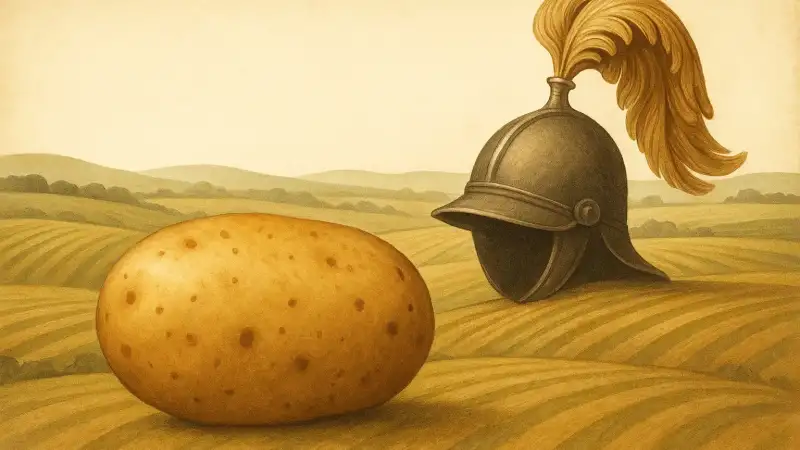
If an army sits in the same countryside long enough, it starts thinking like a hungry neighbor. That was the odd engine of the 1778–1779 War of the Bavarian Succession, fought between Austria and Prussia after the death of the Bavarian elector Maximilian III Joseph. The troops massed in Bohemia and Bavaria, but big set-piece battles never really arrived. So the war turned into something else. Columns marched to secure roads, villages, and storehouses. Patrols went out for sacks of grain and, famously, for potatoes. Soldiers still had muskets and cannon, but the daily contest was often over who ate first.
Why there was a war at all
The trigger was a dynastic problem, not a border skirmish. In early 1778, Maximilian III Joseph died without an heir. Austria’s Joseph II tried to claim chunks of Bavaria, arguing old rights and practical convenience. Prussia’s Frederick II saw that as a dangerous expansion in the German lands and moved to block it. Saxony was pulled in too, because it also had succession claims and because nothing in the Holy Roman Empire stayed tidy for long.
That kind of dispute created armies that needed to show up, occupy, and threaten. It did not automatically create a clear battlefield. The geography mattered. Bohemia and the Bavarian borderlands offered ridges, forests, and limited routes. Both sides could make an attack expensive by sitting behind bad ground and forcing the other to starve first.
How potatoes became a military objective
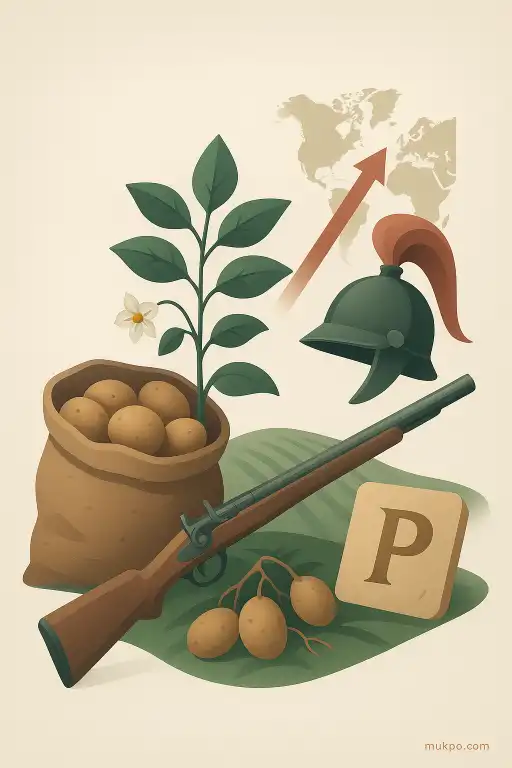
Eighteenth-century armies did not live on heroic charges. They lived on bread, fodder, and steady movement of carts. When supply lines stretched, commanders leaned on “contributions” from nearby towns and villages. That meant requisitions, purchases at set prices, or outright taking, depending on discipline and desperation. Potatoes mattered because they were bulky, common in rural diets, and could keep troops going when flour was scarce or mills were out of reach.
One overlooked detail is how awkward potatoes were for an army that wanted speed. Grain could be milled and baked into transportable bread. Potatoes were wet, heavy, and perishable if piled badly. If a unit grabbed them, it often had to cook them soon, or haul them in carts that were already needed for ammunition and forage. That pushed soldiers toward quick raids on nearby fields and cellars rather than neat, planned deliveries.
What the campaign looked like on the ground
Instead of one decisive clash, there were marches, counter-marches, and constant skirmishing by light troops. Prussian forces and Austrian forces watched each other across difficult terrain, each trying to cut the other’s supplies. A village that was quiet one week could be stripped the next, not because the locals had chosen sides, but because a road junction or a bridge suddenly mattered. Control of a valley could mean control of the carts moving through it.
A concrete pattern shows up in accounts from this kind of war: detachments sent out “to forage” become small battles. A few dozen men looking for food run into enemy patrols doing the same thing. Shots are exchanged. Someone gets captured. Then a larger unit arrives to protect the next round of foraging. The “front line” becomes a shifting patchwork around barns, gardens, and storehouses, not just around forts.
Why Europe remembered it as the “Potato War”
Nicknames stick when they explain what people actually noticed. Civilians noticed crops disappearing, not diplomatic arguments. Soldiers noticed hunger, not fine legal claims. The war’s German nickname, often rendered as the “Kartoffelkrieg,” captured the fact that so much effort went into staying fed while avoiding a battle that might wreck the army in a day. It also carried a quiet mockery: great powers mobilized, and the most visible result was men stealing or bargaining for food.
The label can mislead if it sounds like everyone was literally fighting over potatoes alone. Grain, hay, cattle, and brandy were just as important, and the exact mix varied by district and season. But potatoes were an easy symbol because they were right there in the fields and in peasant cellars, and because the war’s tempo made daily eating feel like the real campaign.
How it ended without a “winner’s battlefield”
By early 1779, neither Austria nor Prussia had gained what it wanted at a reasonable cost. Disease, exhaustion, and the sheer difficulty of feeding large forces in those regions wore down the appetite for escalation. Diplomacy did the heavy lifting. The conflict ended with the Treaty of Teschen in 1779, which settled the immediate succession dispute and transferred the Innviertel region to Austria while keeping Bavaria largely intact under a new ruler.
What lingered was the memory of a war where the decisive pressure was often logistical, not tactical. The soldiers who moved through Bavaria and Bohemia left behind stories about empty cellars, guarded granaries, and patrols that looked less like conquering heroes and more like tired men trying to find their next meal before the other side did.
Related reads
- How tiny mineral magnets make sand dunes align
- How a distant volcano dimmed sunlight and chilled entire harvests
- A street where every doorstep displays a broken clock set to the same minute
- A bakery that refuses to bake any recipe printed in books
- The squid that flashes in Morse code
- A fountain that changes temperature on birthdays