
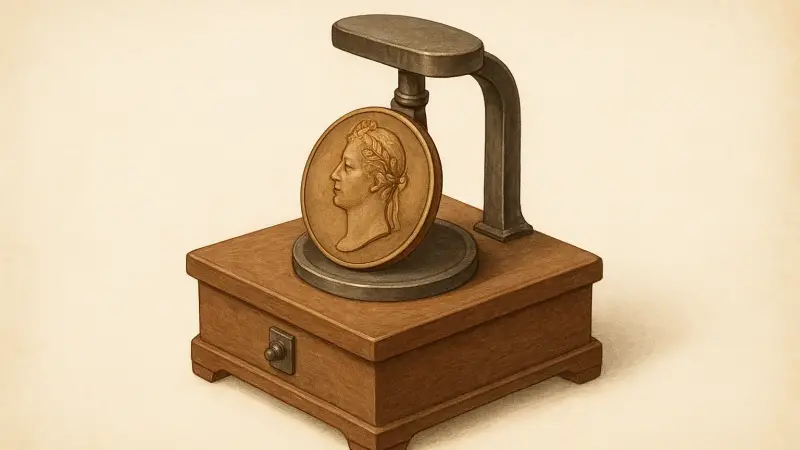
People tend to assume a coin is either “real” or “fake.” In Georgian London it was messier than that, because even a genuine coin could be quietly wrong. A shilling could be too light. Its silver could be off. Or the edges could show the neat scars of being clipped. The Royal Mint had a way to test this without trusting its own workforce, and it was old by then: the Trial of the Pyx. In 1717, after Isaac Newton’s long stint at the Mint, the process still hinged on a simple mechanism. Random coins were sealed away in a chest, then judged later in public against strict standards.
Why London needed a courtroom for coins
Georgian London ran on small payments. Wages, ale, coach fares, market stalls. That made everyday coin quality a public problem. When silver coins were clipped or sweated (shaken in bags to wear off a little metal), the loss was distributed across everyone who handled them. People reacted the only way they could. They weighed coins. They refused them. Or they discounted them in trade, which pushed good coins out of circulation because nobody wanted to spend the full-weight ones.
Counterfeiting existed too, but the bigger anxiety was often about “near enough” money. A piece could look right at a glance and still fail when measured. That mattered because the Mint’s reputation was part of state credit. If the coinage wasn’t trusted, the government’s promises weren’t either, and Georgian finance depended on trust in paper and metal at the same time.
What the Pyx was, in plain terms
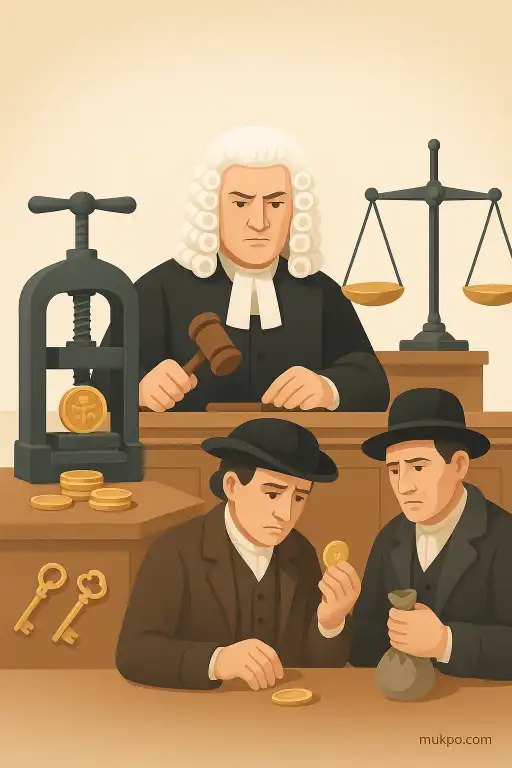
The “pyx” was literally a box, a locked chest used to store samples of newly minted coins. The routine was mechanical. From each batch of coin struck at the Mint, a set number of pieces were taken at random and dropped into the pyx. They stayed sealed until the formal trial. That delay mattered, because it stopped anyone from gaming a single day’s output once they knew the testing had begun.
At the trial, the samples were counted and tested against official standards for weight and fineness. The standards weren’t just ideas. They were embodied in reference weights and in “trial plates,” pieces of metal kept as benchmarks for how pure the gold or silver was supposed to be. One detail people overlook is how much this depended on custody and locks. The point wasn’t only chemistry. It was chain of control. If the box could be tampered with, the whole performance collapsed.
How the testing worked, and what it could prove
The trial didn’t ask whether a single coin in the street was counterfeit. It asked whether the Mint’s output, in aggregate, met the legal tolerances. That’s why it used sampling. If the sample set came out light, or low in silver content, it suggested something systematic. The testing could include weighing large groups to see if the average drifted, and assaying melted samples to check fineness. A coin could pass by weight but fail by purity, or the other way around.
This is where “coiners” came into view. If someone inside the process substituted metal, skimmed silver, or used tools that produced underweight pieces, a good sample system made that harder to hide. It also drew a line between problems created outside the Mint (clipping in circulation) and problems created at the point of manufacture. The Pyx couldn’t catch a clipper working in a tavern back room. It could catch a pattern that looked like intentional shorting at the source.
Where the exposure happened: politics, records, and blame
The Trial of the Pyx was public enough to be legible as accountability. It involved officials, jurors, and specialist assayers, and it generated records. That mattered in Georgian London because scandal traveled fast and stuck. If coins were suspected of being “bad,” the question became who had failed: the moneyers striking the pieces, the Mint leadership, or the state itself. A formal trial created a place to pin responsibility, or at least to argue about it with numbers instead of rumor.
It also created a kind of lagging indicator. The Mint could be producing coins for months before the trial examined the pyx contents. So when a batch failed, it pointed backward in time to a period of production. That time delay could expose longer-running malpractice, not just a one-off mistake. It could also make it hard to untangle intent from error, because staff might have moved on, died, or changed roles by the time the failure was announced.
A concrete London example: the guinea and the question of “right” value
Even when the metal was correct, the money could still be “wrong” in practice. In 1717, Newton helped fix the official value of the guinea at 21 shillings, responding to market pressures and the way gold and silver traded against each other. That’s not the same problem as coining, but it shows how Georgian London lived with two different tests at once. The Pyx asked if the Mint hit the technical standard. The market asked if the coin’s legal value matched what its metal could command.
That split is easy to miss because it isn’t a dramatic crime story. It’s administrative friction. A coin could be perfectly made and still behave badly in circulation if the price relationship between metals shifted. The Trial of the Pyx did not settle those arguments. It did something narrower, and more surgical. It made it harder for underweight and debased output to hide behind the general chaos of London money.

Related reads
- The piano whose ivory keys rearranged themselves while caretakers slept
- Bronze statue that seems to sweat during heat waves and spooks tourists
- Why the word sits on the tip of your tongue and won’t come out
- The phantom call: why you sometimes swear someone called your name
- Why you unconsciously mimic strangers’ gestures
- Why morning fog hugs river valleys