

A smell can drop you into a scene
Someone opens a jar of peanut butter, or a neighbor starts mowing, and you’re suddenly back in a very specific moment you didn’t know you still had. It’s not one single place or event. It happens across cultures and settings, whether the smell is chlorine at a public pool, diesel at a bus stop, or the particular soap used in a childhood bathroom. The core reason is mechanical, not mystical. Smell has a fast, privileged route into brain networks that handle emotion and memory. That routing makes certain odors feel like they “arrive” as a whole scene, not as a slow chain of thoughts.
The wiring from nose to memory is unusually direct
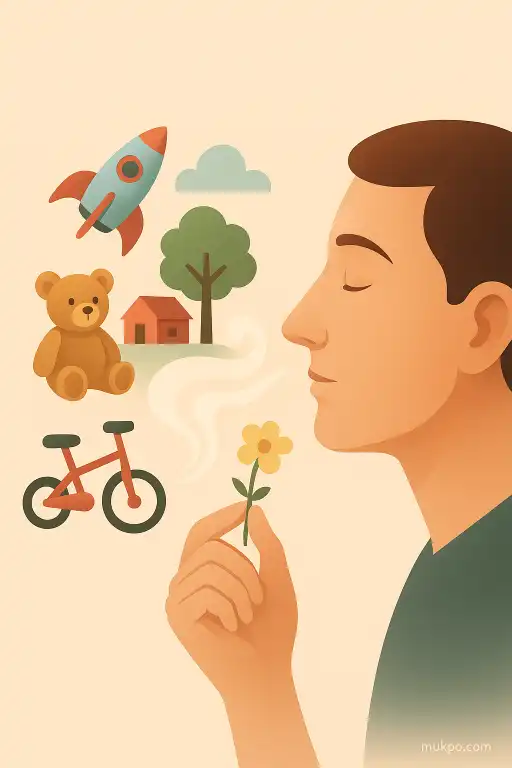
Most senses relay through the thalamus before they reach higher processing. Smell is different. Signals from odor receptors go to the olfactory bulb and then feed into areas tied closely to emotion and memory, including the amygdala and hippocampus. That short path is why an odor can bring a feeling first, before the mind can label what the smell even is. Sometimes the word for it doesn’t come at all, but the scene does.
This is also why a smell-triggered memory can feel “instant.” It’s not that the memory is stored in the nose. It’s that the cue enters the same neighborhood of the brain that binds together place, emotion, and context. When that network lights up, it tends to reactivate a whole pattern at once: the room layout, the light level, who was there, and the mood.
Odors act like powerful keys because they’re rare and distinctive
Many smells are encountered in narrow, repeated contexts. A particular laundry detergent might only exist in one household. The vinyl-and-dust smell of a school supply closet might only show up once a year. The brain is good at using distinctive cues to index a memory, and smell cues are often unusually specific. A tiny change in a mixture can make it feel like a different odor entirely.
A specific, situational example: the smell of sunscreen can bring back a whole beach day, but often it’s not “sunscreen” in general. It’s one brand mixed with salt air, hot car upholstery, and whatever snack was in the back seat. That blend becomes a fingerprint. Later, catching even part of it can call up the full setting faster than a photo would.
The “scene” feeling comes from how memory is rebuilt, not replayed
These moments feel like a recording snapping on, but memory isn’t stored as a single video file. The brain reconstructs it from fragments. Smell cues are good at triggering the emotional and contextual fragments at the same time, which makes the rebuild feel complete. That’s why the memory can include details you weren’t trying to recall, like the hallway temperature or the heaviness of a winter coat.
One detail people usually overlook is timing. Odor molecules hang around and spread unevenly. A smell can be strongest in a doorway, near fabric, or when air currents shift. That means the trigger often hits before the person knows what changed in the environment. By the time they identify the odor source, the memory is already assembled.
Why childhood shows up so often
Childhood is loaded with first-time pairings. First classroom, first hospital visit, first grandparent’s house, first time in a particular car. New experiences lay down strong associations, and the smells in those environments become part of the bundle. Adults also tend to move through more standardized spaces, so fewer odors are uniquely tied to one chapter of life.
There’s also a practical side: kids have less control over their environments, so smells can be more constant and more defining. The same home cooking, the same shampoo, the same basement dampness. Years later, one whiff of a specific spice or cleaning product can pull up not just an image, but a whole social map—who lived where in the house, which room was “allowed,” and which wasn’t.
Related reads
- Tiny rituals that calm panic and feel oddly effective
- The laundromat known for returning socks with secret notes stitched inside
- A museum statue that sprouts crystals after humid nights
- Microscopic glass spherules hidden in Antarctic snow
- Mondegreen mechanics: why your brain insists on wrong song words
- The conman who sold the Eiffel Tower to scrap dealers in 1925 Paris