

It sounds odd until you picture the scene. A crowded market day in Florence, money changing hands fast, strangers pressed close, and a guild trying to keep its members working and its reputation intact. Some 14th-century Florentine guild rules did try to control behavior in public spaces with surprising detail, including bans on joking, loud banter, and laughter in specific contexts. The mechanism wasn’t a citywide “no laughing” law. It was discipline: a guild statute, an internal court, and a fine. On paper, the aim was order and credibility. In practice, it was about keeping transactions sharp and preventing market days from turning into noisy performances.
Where this kind of rule came from
Florence in the 1300s was run through institutions that cared intensely about appearance: guilds, parish networks, and civic magistracies. The guilds weren’t just trade clubs. They wrote statutes, set standards, and punished members who embarrassed the craft. A rule aimed at laughter fits that world. Markets pulled in outsiders. They also made a craft visible. If a seller looked unserious, customers might assume the goods were unserious too, or that the weights and measures were being played with.
It’s also worth being careful with the claim. Sources that circulate online often compress or dramatize older statutes. Sometimes “laughter” is a loose translation of language aimed at rowdy talk, mockery, or disruptive joking. The exact phrasing varies by guild and by surviving copy, and it isn’t always clear how strictly it was enforced.
Market day was a performance, and guilds wanted control
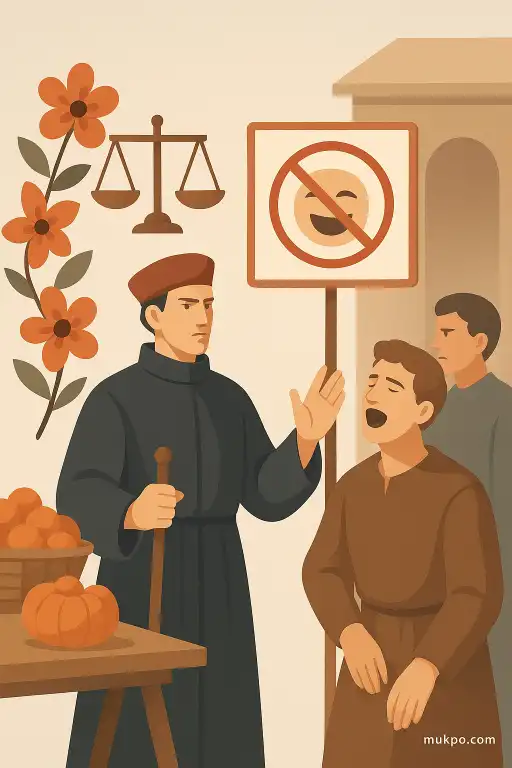
A market wasn’t quiet commerce. It was competitive selling, shouting, and reputation-building. In that environment, laughter could signal a lot at once: a private joke between insiders, ridicule of a customer, or a tactic to rattle a rival. A guild that cared about “honest dealing” had reasons to treat that as a risk. If a complaint reached the guild officers, they could frame it as damage to the craft’s honor rather than a personal insult.
One situational example helps. Picture a cloth seller at a stall near a busy street like the area around Orsanmichele, where grain and later guild presence made the neighborhood feel watched. If an apprentice laughs while measuring cloth, a buyer may think the measure is being cheated. Even if it’s harmless, the moment invites suspicion. Guild discipline was often designed to remove those moments before they turned into arguments that needed outside officials.
What “outlawed laughter” usually meant in practice
Guild prohibitions tended to be narrow. They often targeted specific places, times, and roles: at the bench, at the stall, during bargaining, while carrying goods, while representing the workshop. The point wasn’t joylessness. It was to prevent members from acting like street performers, hecklers, or gamblers while on duty. If the statute was written broadly, enforcement still tended to focus on moments that produced witnesses and complaints.
The overlooked detail is how much of this relied on being seen. Medieval discipline worked best when behavior was public, repeatable, and easy to describe to an officer later. “He laughed at me” sounds subjective. But “they were laughing and shouting, blocking the space, and people gathered” becomes a charge about disturbance, obstruction, and reputational harm. That’s the kind of description that ends up in a fine book, if a record survives.
Why guilds reached for fines instead of civic punishment
Florence had civic courts and officials who dealt with violence, fraud, and breaches of the peace. But guilds preferred to keep everyday misbehavior inside the trade. It was faster. It kept scandals local. It also reinforced hierarchy. Masters were responsible for apprentices, and workshops were responsible for their street-facing conduct. A laughter ban, if it existed in a given guild’s statute, sits comfortably beside other “conduct” rules about swearing, brawling, drunkenness, and insulting customers.
Fines mattered because they were measurable and scalable. Guilds could set a penalty low enough to be paid quickly but high enough to sting. Repeat offenses could bring higher fines or temporary exclusion from selling. That kind of threat hits hardest on market day, when missing a day’s trade could hurt more than the coin itself.
How a rule like this gets remembered as “no laughing”
Modern retellings like clean, shocking lines. “They banned laughter” sticks better than “they punished disruptive joking, mockery, and loud behavior during sales.” There’s also the problem of translation. Latin and Tuscan legal language can bundle laughter with taunting, derision, or fooling around, and a single English word flattens that. A statute aimed at a very specific kind of public ridicule can look, centuries later, like a blanket attack on happiness.
And then there’s the simple fact that markets were tense. People were hungry, indebted, and quick to suspect cheating. A guild’s job was to keep its people from triggering fights that spilled into the street and drew in the authorities. If a document tells members not to laugh at the stall, it’s likely describing that tight edge where a “joke” could become an accusation, and an accusation could become a crowd.

Related reads
- The speeding years illusion: how perception compresses with age
- When a solar storm painted auroras across low latitudes
- How squid see and signal with polarized light
- Smell triggers that pull up entire childhood scenes instantly
- Tiny rituals that calm panic and feel oddly effective
- The laundromat known for returning socks with secret notes stitched inside