
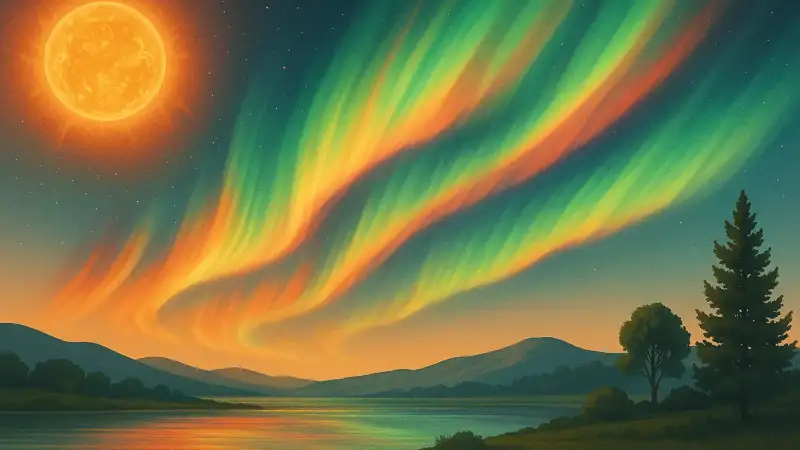
Why the sky sometimes ignores latitude
Auroras are supposed to be a high-latitude thing. People plan trips to Alaska or northern Norway, not to Havana or Rome. But it doesn’t always work that way. During big solar storms, the same basic mechanism still runs—charged particles from the Sun get guided by Earth’s magnetic field and collide with gases in the upper atmosphere—but the “aurora zone” can spread far from the poles. That’s when you get reports like the 1859 Carrington Event, when auroras were seen unusually far south, and the May 1921 storm, which also pushed displays into places that don’t normally see them. Exactly how far they reach varies from storm to storm.
What a solar storm changes in Earth’s magnetic field
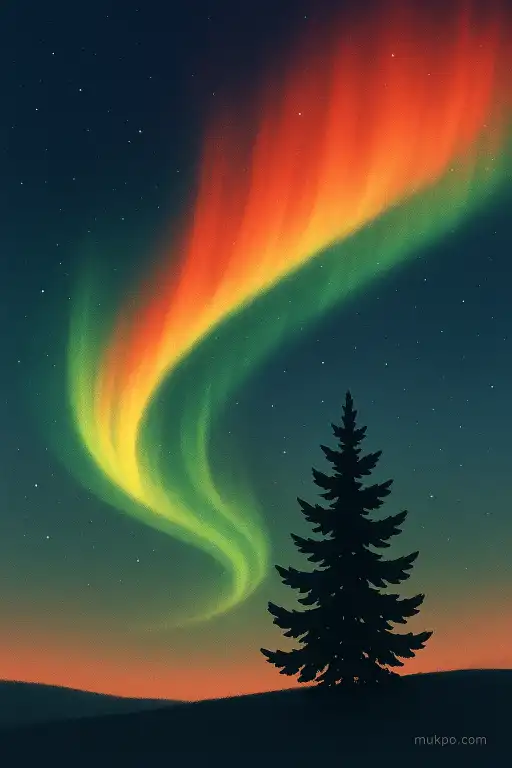
A strong solar storm is usually tied to a coronal mass ejection, a huge burst of magnetized plasma. When that cloud hits Earth, it doesn’t “blow” the atmosphere away. It mainly disturbs the magnetosphere, the region controlled by Earth’s magnetic field. If the incoming magnetic field is oriented the right way (often described as southward), it can connect with Earth’s field more efficiently. That opens a door for energy and particles to pour into the system, and the magnetosphere rearranges itself under stress.
That stress shows up as stronger electric currents high above Earth, including the ring current and the auroral electrojets. As those currents intensify, the region where particles drop into the upper atmosphere can expand toward lower latitudes. It’s not that the poles move. It’s that the boundary of where auroras can form spreads outward. Observers at mid-latitudes may suddenly be “inside” the reach of auroral precipitation for a few hours.
What people actually see at low latitudes
Low-latitude auroras often don’t look like the crisp curtains shown in travel photos. A common overlooked detail is that they can sit low on the horizon and get mistaken for distant city glow, a fire, or sunset afterglow. Color can be different too. Deep red is reported often, because emissions from atomic oxygen around 630.0 nm come from higher altitudes, and those high-altitude glows can be visible from farther away even when the more “active” green structures are staying poleward.
Another thing that trips people up is direction. In many mid-latitude sightings, the glow is toward the pole, not overhead. Someone in the southern U.S. might see a red band low to the north. Someone in southern Europe might notice a diffuse redness above the northern horizon. During extreme storms that push the auroral oval far enough, it can climb higher in the sky, but a lot of famous “low-latitude” reports are still horizon-hugging displays.
Concrete examples from big storms
The Carrington Event in 1859 is the reference point people reach for because the reports were so widespread and the technology impacts were obvious for the time. Accounts describe bright auroras at unusually low latitudes, alongside telegraph disruptions. The record is not uniform, though. Some places left detailed notes, others didn’t, and the exact latitude limit depends on which reports you trust and how you interpret old descriptions of “red skies.”
More recently, the March 1989 storm is remembered for the Hydro-Québec power outage, but it also produced auroras seen much farther south than usual in North America. The May 1921 storm is another case that comes up because it strongly affected telegraph and telephone systems and generated widespread auroral reports. These aren’t the only examples. They’re just the ones that left enough paper trail—and in 1989’s case, instrument records—to make the low-latitude reach hard to dismiss.
Why it’s hard to pin down “how far south” it went
Even with modern monitoring, the boundary isn’t a clean line. It shifts minute by minute with the solar wind and the geometry of Earth’s magnetic field. For older events, there’s also the reporting problem. People describe what they know. A farmer might write “red light in the north” without mentioning how high it reached or how long it lasted. City lighting, smoke, and haze can wash out faint structure, while dark rural skies can make a weak glow seem dramatic.
There’s also a magnetic-versus-geographic latitude mismatch that most people don’t think about. Auroras care about magnetic latitude, and Earth’s magnetic poles wander over time. So “the same town” can be slightly better or worse positioned for auroras in different decades, even if its map latitude never changes. When a big storm hits, that small difference can decide whether the display is a barely-there red smear on the horizon or something obvious enough that people start calling newspapers about it.

Related reads
- How squid see and signal with polarized light
- Smell triggers that pull up entire childhood scenes instantly
- Tiny rituals that calm panic and feel oddly effective
- The laundromat known for returning socks with secret notes stitched inside
- A museum statue that sprouts crystals after humid nights
- Microscopic glass spherules hidden in Antarctic snow