

Why a year can feel shorter at 40 than at 10
People say time “goes faster” as they get older, but it isn’t tied to one place or one historical event. You hear it in New York and Nairobi, in Tokyo and small towns, and it shows up in ordinary moments. A summer break that felt endless in elementary school can feel like it barely happened when you’re working full-time. The core mechanism is perception. The brain doesn’t store or replay time like a clock. It builds a sense of length from memory, attention, and how much new information was processed while something was happening.
A concrete example is the weeks between Thanksgiving and New Year’s. For some adults it feels like a blink, even when the calendar says it was five or six full weeks. For a child, the wait for a birthday can feel physically long. It’s the same number of days. The difference is how those days get encoded.
Memory density: fewer “bookmarks” makes time look shorter
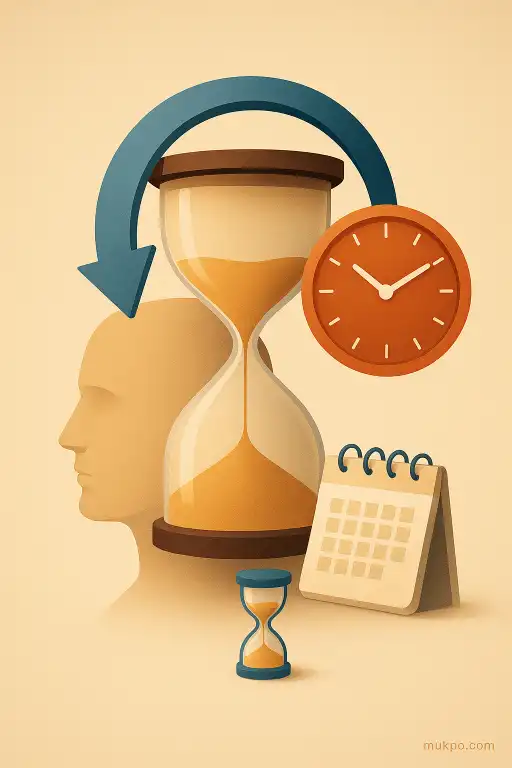
One reason years seem to compress is that adulthood often has fewer firsts. When days are similar, the brain lays down fewer distinct memory “chunks.” Looking back, that stretch has fewer internal landmarks, so it seems shorter in retrospect. Childhood has more novelty. New schools, new rules, new skills, new social worlds. More novelty usually means more unique memories to hang the period on.
A detail people often overlook is that the speeding-up effect is strongest when they’re looking backward, not while they’re living the moment. A dull week can feel slow on Wednesday but short when remembered a month later. Retrospective time and “in the moment” time can point in opposite directions, because one depends on memory structure and the other depends on attention and emotion.
Attention: routine runs on autopilot
Attention works like a gate for what gets processed deeply. When a task is familiar, the brain can predict it and fill in gaps. That saves effort, but it also reduces the amount of detail recorded. Commutes are a good example. The first time someone drives a new route, every turn is monitored. Weeks later, they can arrive with little recollection of the drive itself. The time passed, but fewer pieces of it were treated as noteworthy.
This is also why unusual days can feel long. A delayed flight, a medical appointment, or an argument can stretch subjective time because attention keeps snapping back to it. The brain is tracking and updating constantly. More tracking tends to produce a longer felt duration, even if the clock time is ordinary.
Proportion: a year becomes a smaller slice of a life
There’s a simple math angle people notice intuitively. A year is 10% of a 10-year-old’s life and 2.5% of a 40-year-old’s. That doesn’t “prove” anyone’s experience, but it matches the way minds use comparisons. The brain is always judging length relative to a reference. As the reference grows, a fixed unit can feel smaller.
This proportional effect can be hard to separate from memory and attention, because they usually change together. Adult years often have steady routines and fewer firsts at the same time the “reference life” is getting larger. People report the same calendar speeding up even when their days are busy or stressful, which suggests more than one process is feeding the impression.
Why the same year can feel fast to one person and slow to another
The illusion doesn’t hit everyone equally, and it doesn’t hit the same person equally every year. Big context shifts matter. Changing jobs, moving apartments, starting a relationship, having a child, or living through a disruptive period can create a dense chain of memories. Looking back later, that year often feels “full,” and therefore longer, even if it felt hectic at the time.
Age is part of the pattern, but it’s not the only dial. Health, sleep, stress, and how segmented days are can all change how many distinct moments get stored. Two people can share the same calendar year and remember it with completely different lengths, because the brain is not measuring days. It’s measuring change.
Related reads
- When a solar storm painted auroras across low latitudes
- How squid see and signal with polarized light
- Smell triggers that pull up entire childhood scenes instantly
- Tiny rituals that calm panic and feel oddly effective
- The laundromat known for returning socks with secret notes stitched inside
- A museum statue that sprouts crystals after humid nights