
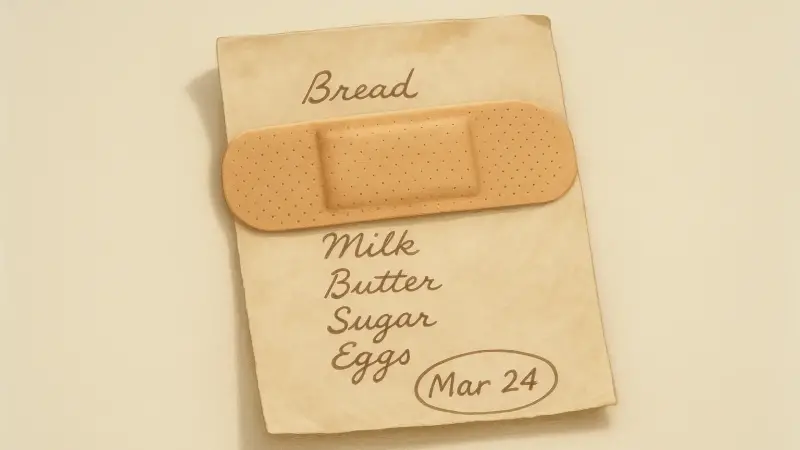
How does a slip of paper end up sealed inside a wall, and why would “tomorrow” be circled on it a hundred years later? Finds like this aren’t tied to one famous incident or one “haunted” building. They turn up during ordinary renovations in lots of places, from Victorian houses in the UK to prewar apartments in the US and older masonry buildings across Europe. The core mechanism is simple. A cavity gets plastered shut, the air inside stays dry enough, and paper that should have crumbled survives. The date problem is where people freeze, because “tomorrow” only makes sense if you know what day the writer thought it was.
How paper survives behind plaster
Plaster and lath walls, and even later plaster over masonry, are full of little voids. Some are intentional: around window frames, behind baseboards, near electrical chases added later. Others happen during repairs, where a worker patches over an old gap without fully packing it. If a shopping list slips in and the patch gets finished, the paper is suddenly protected from light, handling, and swings in humidity.
The overlooked detail is that “sealed” rarely means airtight. It means the paper isn’t getting wet. A cavity can still exchange air slowly through hairline cracks, but stay dry year-round if it’s not on an exterior wall that wicks moisture. That’s why lists and receipts sometimes come out crisp, while a page found a few feet away is a brown paste.
Why a shopping list ends up in a wall at all
Most of the time it’s not a deliberate time capsule. Paper gets used as a shim, a temporary note, a cover for a gap, or just something in a pocket that falls during work. Older plastering and carpentry created lots of moments where hands were full and debris was everywhere. A small folded list is the exact kind of thing that disappears without anyone noticing.
There’s also a social reason shopping lists show up: they were easy to write on scraps. People reused envelopes, the backs of forms, and torn ledger pages. That reuse can matter later because the scrap might carry a printed year, a shop name, or a form title. The list looks plain until you notice the letterhead or the faint lines from an account book.
The “tomorrow” circle isn’t automatically supernatural
Circling a date is normal behavior. It can mark when someone planned to shop, when wages came in, when a delivery was expected, or when a market day mattered. “Tomorrow” is a moving target, though. If the list doesn’t also say the day of week, the month, or the year, “tomorrow” can only be reconstructed from context, and that context is often missing.
Even when there is a date, it can mislead. People copy lists from an older note. They keep a list for days and circle a new date on top of old items. They write “tomorrow” while thinking about a routine schedule, not a calendar. A list with “tomorrow” circled can look like a message aimed at the future, when it’s really just a quick way to keep a plan from slipping.
What investigators look for around the note
The paper itself is only half the evidence. Where it was found matters. A cavity behind a patched section near a doorway suggests repair work. A void above a window lintel suggests construction or settling. A spot near a later-added conduit suggests the list could be newer than the building. Those small construction clues often do more to date the object than the handwriting does.
People also look for tiny material tells that get skipped in the excitement: staple rust marks, the ghost of a torn perforation, or the imprint of pencil pressed through from another sheet. Pencil stays readable in stable conditions, but it can smear if the cavity ever got damp. Ink can feather. The pattern of damage can hint at whether the space stayed consistently dry or had one brief wet event decades ago.
How “a century old” is usually established
Dating claims tend to start as a rough guess. Someone sees old cursive, old product names, or archaic spelling and calls it “about 100 years.” More careful dating comes from cross-checks: the type of paper, the presence of wood pulp versus rag content, printing styles if it’s on the back of something, and the building’s renovation timeline. Without those anchors, “century old” is often a vibe, not a measurement.
When the date is genuinely on the page, the next question is whether the page is contemporaneous with the wall. A list can be old and still get sealed later, because it was kept in a drawer and reused as scrap. That’s one reason the circled “tomorrow” can feel wrong. The paper’s age, the handwriting’s age, and the moment it got trapped behind plaster don’t always match.
Related reads
- Phantom phone buzzes: how expectation rewires your touch senses
- How the Royal Mint’s Trial of the Pyx exposed coiners in Georgian London
- The piano whose ivory keys rearranged themselves while caretakers slept
- Bronze statue that seems to sweat during heat waves and spooks tourists
- Why the word sits on the tip of your tongue and won’t come out
- The phantom call: why you sometimes swear someone called your name