
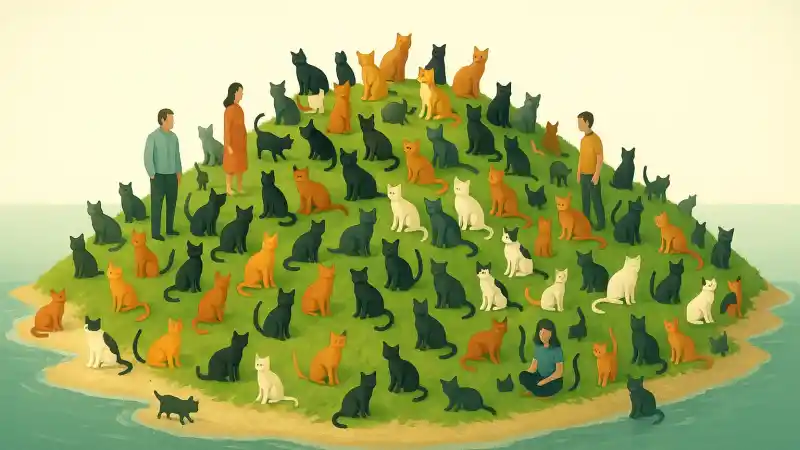
Why “cat islands” exist at all
It feels like a contradiction the first time you hear it: an island where there are far more cats than people, and everyone seems to know it’s normal. In Japan, Aoshima in Ehime Prefecture is the named example most people point to, along with Tashirojima in Miyagi Prefecture. The exact ratios are a moving target because the human population changes and the cats aren’t counted like residents. But the mechanism is pretty consistent. A small place gets a stable food source, a shrinking number of humans, and a cat population that’s good at replacing itself.
It’s also not one single island, and it’s not limited to Japan. Places like Cyprus have well-known high-density cat colonies in certain areas, though not always on “one island” in the way social media frames it. The same basic ingredients show up wherever a community stops needing working cats but keeps feeding them anyway.
How the cats get there and stay
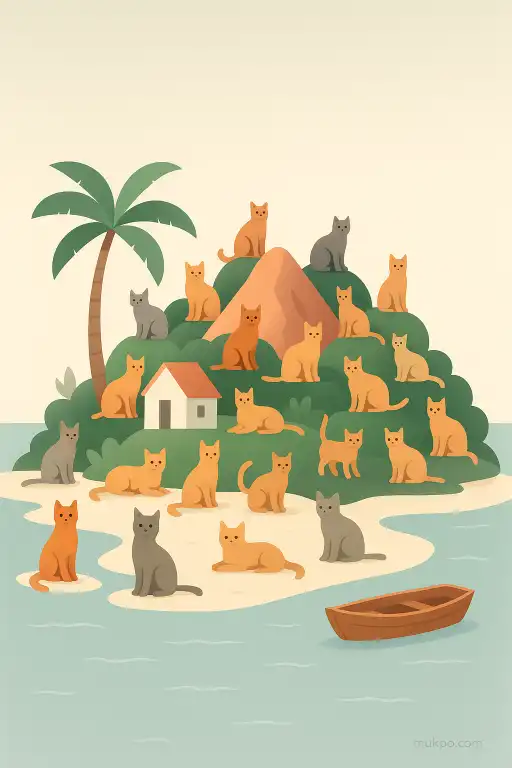
Most of these populations start with cats brought for a job. On fishing islands, cats were kept around boats and storage sheds because rodents are a real problem for nets, bait, and food. Once cats are established, they don’t need much encouragement. Even occasional feeding, plus access to sheltered spots, is enough for colonies to persist.
A detail people overlook is how “sticky” a food routine is. Cats learn timing. If a few regular feeders leave town or pass away, the cats don’t disappear. They simply concentrate around whoever still feeds them, which makes the island feel even more overrun even if the total number hasn’t exploded.
Why the people keep shrinking
The human side is usually the bigger change. Many of these islands had more residents decades ago, then lost population as schools closed, jobs moved to larger cities, and younger families relocated. That shift can be gradual and hard to notice from outside. A place can go from a few hundred residents to a few dozen without any dramatic event.
When the number of people drops, a cat population that would look ordinary in a town starts to look extreme. Ten to twenty outdoor cats might not stand out on a busy street. On a tiny island with a small, aging population, those same cats can outnumber humans quickly, especially if there are few constraints on breeding.
What daily life looks like in a high-cat place
The reality tends to be less like a theme park and more like a neighborhood with a lot of semi-owned animals. Some cats are clearly attached to certain homes. Others live around docks, breakwaters, and storage buildings, where people pass through and leave scraps. You see clusters rather than a uniform blanket of cats, because food and shelter are not evenly distributed.
Smell and noise are the parts visitors often don’t expect. Unneutered cats fight. They yowl at night. They mark territory. And because islands have limited trash infrastructure, food waste and packaging matter. A single overflowing bin near a harbor can become the center of the colony, shaping where cats gather and where conflicts happen.
Counting cats is harder than it sounds
“Cats outnumber people by the dozens” makes for a neat line, but it hides how uncertain the numbers can be. Human populations are usually recorded, even if they fluctuate seasonally. Cat populations are not. Some cats are social and visible. Some avoid people and only appear at dawn or after fishing boats return. Kittens come and go fast, and mortality can be high.
That’s why reports about specific islands can conflict without anyone necessarily lying. Aoshima, for example, has been described at different times with different cat-to-human ratios. The more important point is what drives the effect: a small, shrinking human community and a locally supported cat colony that keeps reproducing until food, space, or intervention puts a ceiling on it.
Related reads
- The Italian town that banned high heels to stop tourists chipping its ancient stones
- How short routines calm decision anxiety
- The 1814 London brewery disaster that flooded streets with porter
- The town that resurfaces from a reservoir when waters fall
- How octopus suckers taste to choose prey
- A waterfall with a natural flame burning behind it