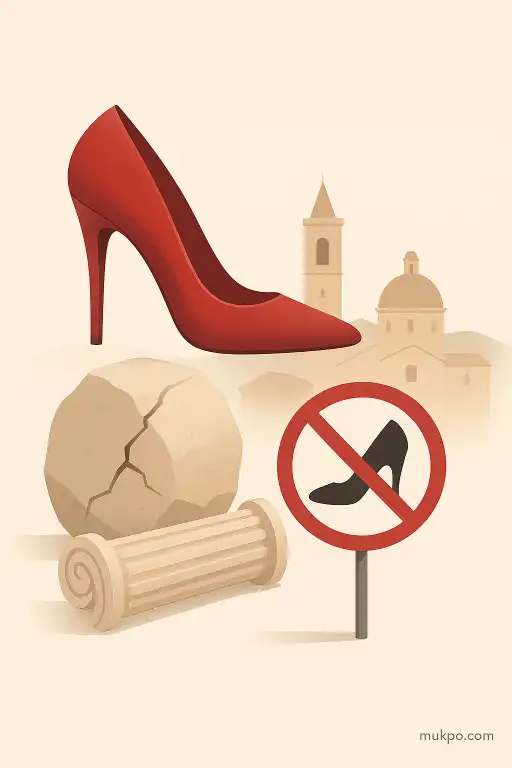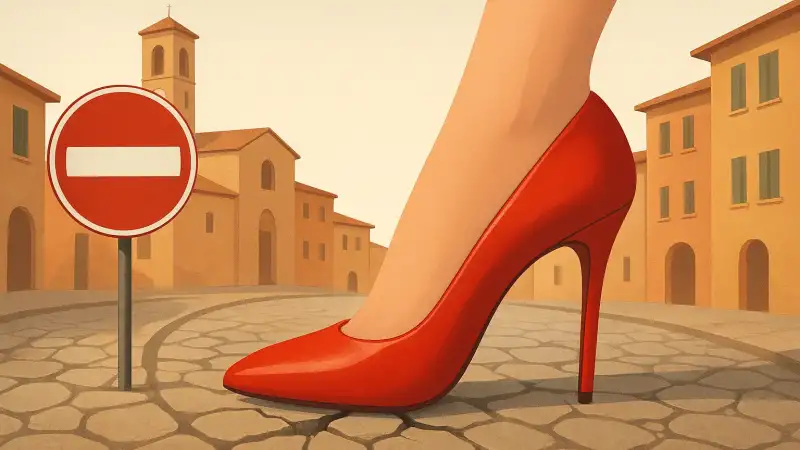
Most people don’t think about their shoes as tools that can damage a street. Then they arrive somewhere old, where the street is the attraction. In the Italian hill town of Civita di Bagnoregio, visitors walk on narrow lanes made of ancient stone, and the surface slowly loses tiny bits every time something sharp hits it. That’s the basic mechanism behind the much-shared rule about high heels: thin heel tips concentrate a lot of weight into a pinpoint. The details of enforcement can vary and aren’t always clearly documented in the stories that circulate, but the idea is straightforward—reduce the kinds of footwear most likely to chip and pit the paving.
Why one kind of shoe can leave a mark
Stone feels hard, but old paving is not uniform. It has hairline cracks, worn edges, and repaired sections where mortar or softer stone sits next to harder blocks. A stiletto-style heel can act like a small punch. The same body weight that spreads across a sneaker sole can land on a circle only a few millimeters wide. That’s why the damage often looks like scattered little pits rather than one big scrape.
A specific detail people overlook is the role of heel caps. The replaceable plastic tip at the bottom of a heel changes the contact point. When it’s worn down or missing, a narrower, harder core can hit the ground instead. Even a “not that high” heel can become a problem if the tip is small and degraded, especially on uneven steps where the heel lands at an angle.
What the ban is trying to protect in Civita di Bagnoregio
Civita di Bagnoregio is tiny, perched on a ridge, and reached by a pedestrian bridge. That setup funnels nearly all foot traffic onto the same few routes. When thousands of people take the same turn, pause at the same viewpoint, and climb the same steps, wear concentrates fast. On older stone, “fast” can still mean years, but the change is visible in the places where crowds naturally bunch up.
The surface isn’t just a road. It’s part of the site’s character, and it’s hard to replace without changing the look and feel of the place. Repairs also have limits. Matching stone can be difficult, and patches can erode differently than the original blocks. So prevention ends up being as important as restoration, even if the prevention looks like a strange rule about fashion.
How rules like this actually work on a tourist street
Most “bans” in historic centers function less like constant policing and more like a boundary-setting sign. The town signals what kinds of behavior it considers damaging, and the signage itself becomes part of crowd management. Whether fines are routinely issued is often unclear in secondhand reports, and it can depend on season, staffing, and local priorities. The practical result is usually a mix of occasional enforcement and lots of voluntary compliance.
It also helps that footwear is easy to spot. Unlike rules about touching walls or stepping off paths, a heel is visible from across the street. That visibility matters in a place where officials may only have a few people monitoring entry points or busy lanes. A rule that can be understood in two seconds has a better chance of changing behavior than one that requires explanation.
This isn’t just about heels, even when it sounds like it is
Heels get singled out because they’re a clean example of point pressure, but the underlying issue is cumulative wear from modern tourism. Rolling suitcases can rattle and chip edges on steps. Bikes and scooters can scuff corners and knock into low walls. Even the grit people track in underfoot can act like sandpaper over time, especially where foot traffic is constant and rainwater moves that grit along.
There’s also a social angle that tends to get missed. A shoe rule gives visitors a concrete way to participate in preservation without needing a lecture on geology or conservation. It turns an abstract problem—slow loss of material—into something immediate. That’s useful for towns that rely on tourism but also have to keep the physical fabric intact for residents and future visitors.
What it feels like on the ground
In a place like Civita di Bagnoregio, the vulnerable spots are the ones people don’t notice while they’re looking up: the lip of a step, the edge of a drain channel, the corner where a lane narrows. Those are the points where a heel can catch, twist, and take a tiny flake of stone with it. The effect is subtle at first, then suddenly obvious when the surface starts to look peppered.
The rule also changes the soundscape. Thin heels on stone make a sharp, repetitive tap that carries in narrow streets. When fewer people wear them, the street gets quieter, and the dominant noises become footsteps, voices, and the scrape of chairs from cafés. It’s a small shift, but it’s the kind of thing locals notice long before a tourist realizes there was a policy involved.