

How a brewery can turn into a flood
People picture beer as something that stays put in barrels and pint glasses. But in October 1814, at the Meux & Co brewery near Tottenham Court Road in London, it moved like a sudden, heavy liquid wall. The mechanism was simple and brutal. A huge wooden vat full of porter failed, the pressure released at once, and the surge smashed into other containers nearby. Within moments, thousands of gallons were no longer “stored” beer. They were a fast, street-level flood pushing through a crowded neighborhood.
The vat that failed
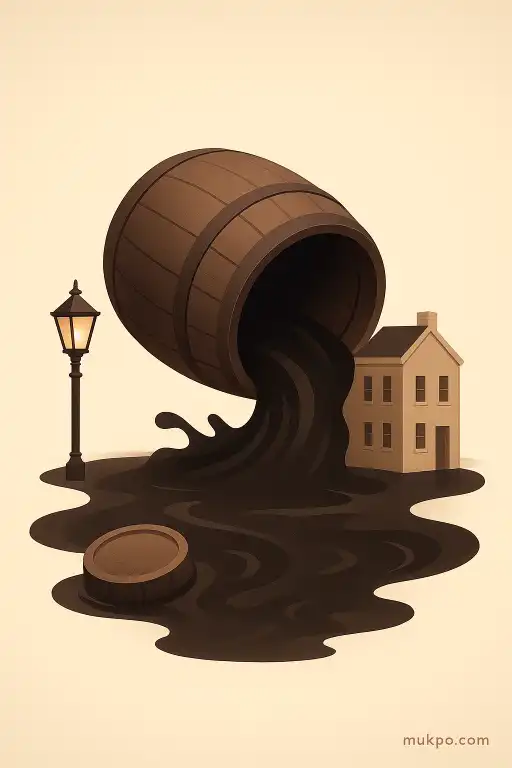
The beer was being held in an enormous fermentation and storage vat, the kind built from thick staves and held tight by iron hoops. Those hoops mattered. They were not decoration. They were the structure. Accounts from the time describe a hoop slipping off one of the giant vats earlier in the day, and the brewery treating it as something that could wait. That’s a detail people often miss. In big wooden tanks, a single hoop failing can shift loads onto the rest. The wood swells and dries. The pressure inside changes. A small-looking problem can be the start of a total rupture.
When the vat finally gave way, it didn’t just leak. It burst. The released porter struck adjacent vats and casks and set off a chain reaction inside the brewery. The building itself could not contain it. Walls and partitions were damaged, and the beer found the easiest path outward, which meant the surrounding streets and low-lying rooms.
St. Giles and the people in the way
The brewery stood close to St. Giles, an area known at the time for dense housing and poverty. That detail changes how the disaster lands. It wasn’t beer washing through empty lanes. It was beer forcing its way into basements, ground-floor rooms, and cramped courtyards where people lived and worked. Contemporary reports describe porter pouring into nearby buildings with little warning. A flood like that doesn’t behave like rainwater. It’s heavier, it can carry debris, and it arrives with the momentum of the initial break rather than slowly rising.
Several people died in the incident, many of them in or near basement rooms. The number is usually reported as eight, though older sources can vary in how they list names and circumstances. Some victims were attending a wake. Others were simply in the wrong room at the wrong moment. It’s hard to overstate how quickly a sudden liquid release can turn a familiar interior space into a trap, especially below street level.
Why porter made the damage worse
Porter wasn’t just “beer.” It was produced and stored at a scale that encouraged extremely large vats, and it could be held for aging and blending. That meant volume and time under pressure. In a giant vat, even modest internal pressure adds up because it acts across such a wide surface. When wood is the container, the weak points are joints, staves, and the iron hoops that provide compression. The failure mode is often sudden, because the structure can hold until it can’t.
There’s also a physical detail that gets overlooked: foam. Fermented beer can produce froth when violently agitated. A rushing mix of liquid and foam can behave unpredictably, filling spaces and reducing visibility. It can also make it harder for people to orient themselves in tight rooms. Add broken wood, bricks, and furniture being pushed along, and it becomes less like a spill and more like a moving, collapsing interior.
What happened afterward in court and in the brewery
The disaster drew attention because it was so odd, but the legal handling was familiar for the period. The brewer faced an inquest, and the event was commonly treated as an accident rather than a criminal act. That outcome wasn’t just about sympathy for a business. It reflected how industrial risk was understood at the time. Big vats, heavy materials, and crowded neighborhoods coexisted with limited regulation and with construction methods that relied on routine inspection and judgment calls.
Meux & Co continued operating, and porter production in London didn’t stop because of one catastrophe. The city still wanted cheap, filling beer. Breweries still needed to store it in bulk. The uncomfortable part is that the same things that made the drink affordable—scale, storage, and speed of distribution—also meant that when something failed, it failed at street level, right next to where people slept.
Related reads
- The town that resurfaces from a reservoir when waters fall
- How octopus suckers taste to choose prey
- A waterfall with a natural flame burning behind it
- The habit of replaying past conversations
- Why kitchen lemons grow tiny roots when left in jars
- The town that heard a mysterious low hum no engineer could trace