
A quiet pattern people notice in some offices
You don’t usually blame a ficus on the playlist. But stories like this pop up in more than one place, and not always in the same way. Some office teams swear the plants perk up when a musician plays in the lobby or a conference room. Others say recorded music does nothing, but a live instrument does. There isn’t one single famous building behind it. The most you’ll find are scattered reports—workplaces in the U.S., the U.K., and India where a “music day” lines up with fewer drooping leaves. The core claim is simple: change the sound in the air, and the plants change how they grow.
What “thrive” means when people talk about it
When people say the plants only thrive with live music, they’re usually describing a cluster of small changes, not a miracle. Leaves look less curled at the edges. Stems seem less leggy. New growth appears a bit sooner. It’s rarely tied to one species. You’ll hear it about pothos, peace lilies, spider plants, and office dracaenas. The overlooked detail is how vague the before-and-after is. “Thriving” gets judged by whoever waters them, often at the moment they’re already paying more attention because there’s a performance happening nearby.
There’s also a timing issue most people miss. Houseplants don’t respond on the scale of a lunch break. A plant that looks better on Friday than Monday is usually reflecting what happened days earlier—light exposure, a dry HVAC cycle, a missed watering, or a change in temperature by the window. That delay makes it easy to connect the improvement to the most memorable event in the room, like a violinist in the atrium.
Live music changes the room in ways nobody logs
Live music doesn’t only add sound. It changes people. They gather, they linger, they open doors, they turn off a loud fan so the performer can be heard, or they draw blinds to reduce glare on a music stand. Any one of those actions can change a plant’s day. A door held open alters airflow and humidity. A shade pulled halfway down shifts the light intensity. Even small shifts matter in an office where HVAC runs hard and moisture is low.
It can also change watering behavior without anyone noticing. The plant caretaker is nearby more often. A wilted leaf gets snipped because someone is waiting for the set to start. A pot gets rotated because people are standing around it. None of that is dramatic. It’s just the kind of maintenance that happens when the space is being used and watched. If the “music” is a regular event—say, a weekly lobby performance—those tiny actions repeat on a schedule that can look like a cause.
Sound and vibration can affect plants, but it’s messy
Plants do respond to mechanical stimulation. Wind, touch, and vibration can change growth patterns. Researchers often discuss this under mechanosensing and thigmomorphogenesis. The problem is that “sound helps plants” gets oversimplified fast. Some experiments report changes in germination or growth with certain frequencies or vibration levels. Other experiments find weak effects or none at all, especially when controls are tight. It’s also unclear what the plant is responding to. Is it airborne sound pressure, vibration through a table or floor, or secondary changes like airflow from speakers and movement?
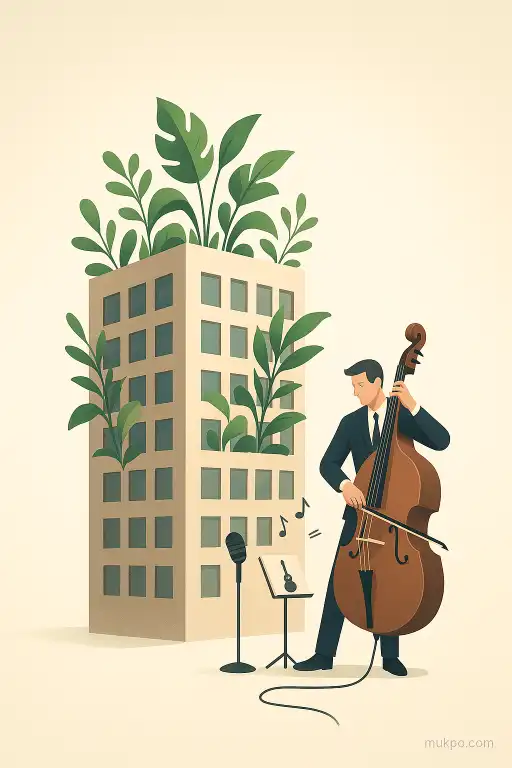
Live instruments can deliver vibration in a different way than a ceiling speaker. A cello on a wooden floor can transmit low-frequency vibration through the building structure. A drummer can do it even more. That doesn’t guarantee “better” growth. Mechanical stress can produce sturdier stems in some cases, but it can also stress a plant that’s already struggling with low light. So when an office says recorded music doesn’t work but live music does, vibration is one plausible difference, not a clean explanation.
Why the story sticks even when the cause is unclear
Office plants are already living on the edge. Light is inconsistent. Weekend temperatures swing. HVAC dries them out. Someone waters on Monday because they remembered, then forgets for ten days. In that setting, almost any change in routine can look like a secret key. Live music is perfect for that role because it’s memorable and social. People talk about it, so the correlation gets rehearsed out loud until it feels like a rule.
And sometimes it’s just one plant in one spot. A peace lily near a lobby performance might be close to a humidifier installed for human comfort, or near a window that gets different light when event signage is moved. Those are boring variables, so they fade into the background. The musician becomes the explanation people keep because it’s the only part of the scene anyone feels like they can point to.
Related reads
- How the 1755 Lisbon earthquake sent Enlightenment salons into philosophical panic
- How the 1778 Potato War over Bavarian fields turned Europe’s armies into crop thieves
- How tiny mineral magnets make sand dunes align
- How a distant volcano dimmed sunlight and chilled entire harvests
- A street where every doorstep displays a broken clock set to the same minute
- A bakery that refuses to bake any recipe printed in books