
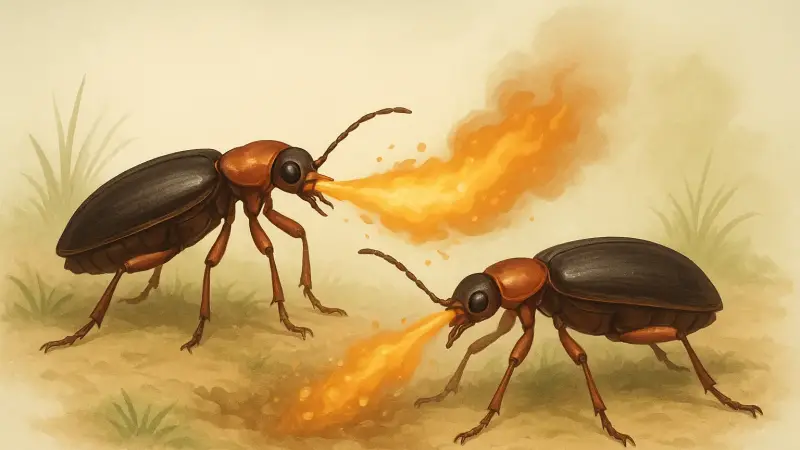
People hear “boiling chemical spray” and imagine a tiny flamethrower. It’s not one dramatic event in one place. It’s a defense that shows up in different habitats, from European woodlands to North American backyards and Japanese forests, depending on the species. A bombardier beetle keeps two sets of liquids in its abdomen, then mixes them only when it’s threatened. The mixing happens in a reinforced chamber. Heat and pressure build fast. The beetle fires a hot, irritating jet in short bursts, often aimed right at whatever grabbed it.
Where the chemicals sit before anything happens
The beetle doesn’t “store boiling liquid.” It stores ingredients. One reservoir holds hydroquinones. Another holds hydrogen peroxide. Kept apart, they’re relatively stable. When a predator closes in, muscles move measured amounts of both into a reaction chamber, along with enzymes that act like chemical switches.
That separation is the whole trick. If the beetle tried to keep the reactive mix pre-made, it would be dangerous all the time. By storing precursors, it stays safe during normal crawling, feeding, and mating, and only pays the cost of the reaction during an attack.
The reaction chamber is built like a pressure vessel
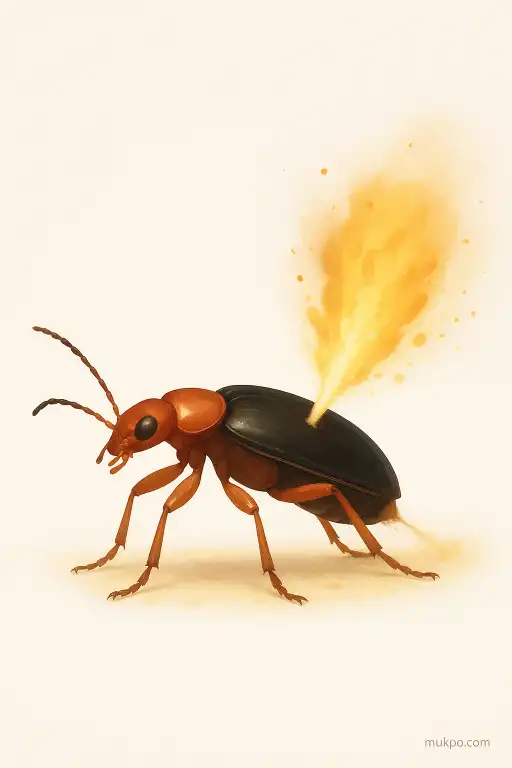
Inside the chamber, enzymes such as catalase and peroxidase speed up the breakdown of hydrogen peroxide and the oxidation of hydroquinones into quinones. Those reactions release heat and produce gas. The temperature can reach close to the boiling point of water, and pressure rises at the same time. The spray isn’t pure “chemical.” It’s a hot mixture of quinones, water, and oxygen-rich gas.
A detail people usually overlook is the chamber wall. It’s thickened and specially structured compared with surrounding tissue. That helps it tolerate repeated rapid heating without rupturing. Without that physical reinforcement, the chemistry alone wouldn’t be usable as a defense.
How it fires without cooking itself
The blast comes out as pulses, not one continuous stream. Pressure builds, a valve opens, fluid jets out, the chamber pressure drops, then the valve closes again. That cycling can happen many times per second. The “popping” or rapid clicking that some people report when handling these beetles comes from those repeated micro-explosions.
There’s also a basic safety benefit to pulsing. Each burst ejects hot material and pulls in cooler stored fluid for the next cycle. That helps keep the chamber from overheating. It also lets the beetle adjust how much it spends, since making the mix costs chemicals that have to be replaced over time.
Aim, timing, and a real-world encounter
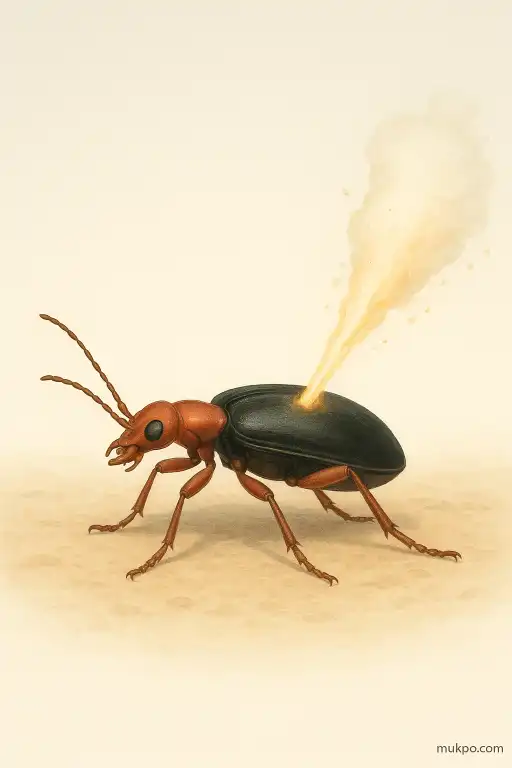
The nozzle is at the tip of the abdomen, but the beetle can bend and swivel it. Many species can direct the spray over their backs or to the side, which matters if the attacker is a toad’s tongue, a bird’s beak, or an ant climbing on from behind. The targeting isn’t perfect like a laser. It varies by species and posture. But it’s good enough to hit sensitive areas up close.
A concrete example is what tends to happen when a frog snaps up a beetle on a forest floor. The beetle is small and easily swallowed. Then the frog suddenly gapes and spits. It isn’t always clear which predators learn and avoid them long-term, but the immediate effect is often a rapid release. The heat and quinones irritate mouth tissue, and the surprise matters as much as the burn.
Why this defense works on more than one kind of enemy
Quinones are chemically aggressive. They can irritate membranes and interfere with proteins on contact. That gives the spray a broad effect across very different predators, from arthropods to small vertebrates. Heat adds an extra layer: it makes the liquid spread and sting more, and it can intensify the sensation on soft tissues.
It also works at close range, which fits how predators actually attack beetles. Most threats are grabby and fast: a lizard bite, an ant swarm, a bird peck. The beetle doesn’t need distance. It needs a fast reaction, a tough chamber that can take repeated blasts, and enough control to put the spray where contact will be most unpleasant.
Related reads
- Earworms explained: why a fragment of a song repeats in your head
- A cave where bats abruptly changed their songs and left scientists baffled
- How Jupiter keeps its Great Red Spot from fading
- Why your stomach growls louder at the worst possible moments
- A mailbox that filled up with letters addressed to fictional people
- Why strong emotions can sharpen some memories and erase others