
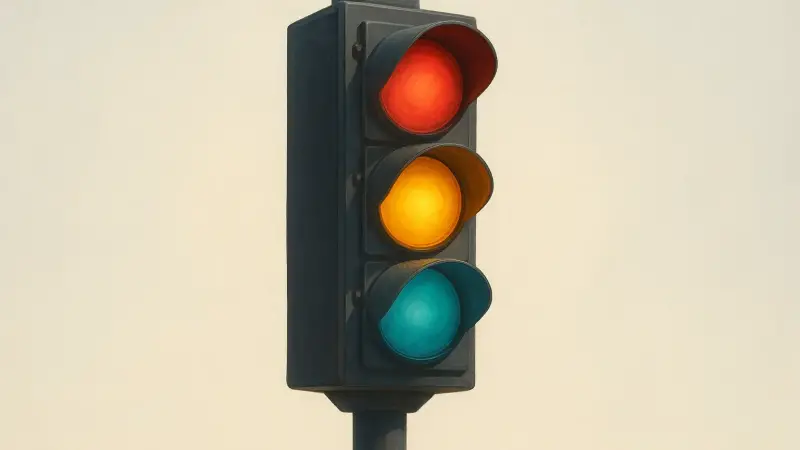
You’re waiting at a red light and it suddenly starts doing something it shouldn’t: a quick flash of yellow, a steady red again, then a strange-looking green pulse that feels out of place. This isn’t one single “storm light” phenomenon tied to one town. It shows up in a few different ways, depending on the system. In parts of Florida, Texas, and the Midwest, people notice odd signal behavior right before a thunderstorm line hits. The core mechanism usually isn’t prediction built into the signal. It’s the weather pushing on the electrical and communications systems that tell the light what to do, plus the way signals fail safely when inputs get weird.
Why the colors can look random
Most modern intersections aren’t three bulbs on a timer. They’re a controller cabinet running plans, taking inputs, and talking to nearby intersections. When something goes wrong, the controller often drops into a fallback mode that’s designed to be unambiguous to drivers. That’s why the “random” pattern so often resolves into a familiar one: flashing yellow on the main road and flashing red on the side street, or all-way flash, or an all-red hold.
The confusing part is the transition. If power sags, a detector drops out, or communications hiccup, the controller can briefly display an intermediate state while it decides what it’s allowed to show next. Those short blips can look like the light is “choosing” colors. To a person at the stop line, it can feel like a code. To the controller, it’s just switching to the safest legal configuration it can guarantee.
Storms push the grid in very specific ways
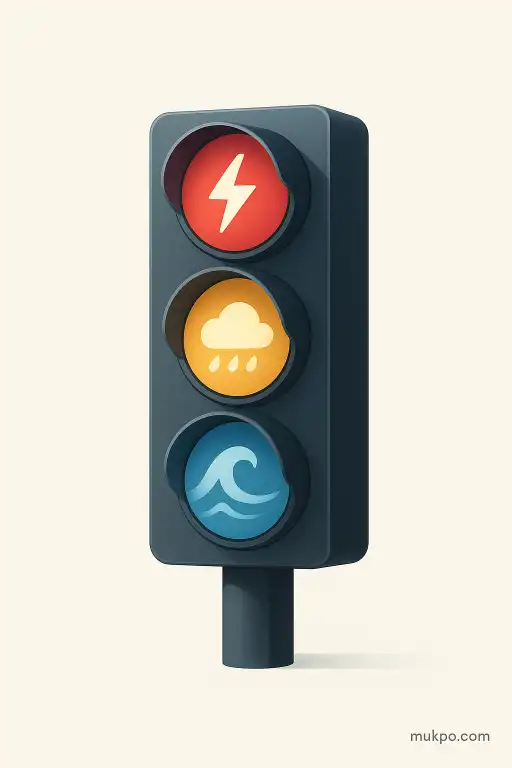
Thunderstorms don’t just bring rain and wind. They bring voltage dips, momentary outages, and abrupt frequency and load changes as branches hit lines and protective equipment reacts. Traffic signals are sensitive to that because they sit at the edge of the distribution network, often on the same feeders as street lighting and small commercial loads. A brief dip might not black out a building, but it can still reset a controller or confuse a detector interface.
Lightning adds a separate problem: fast transients. A strike nearby can induce a surge on long conductors, including the cable runs that connect signal heads, pedestrian pushbuttons, and loop detectors. Surge protection helps, but it doesn’t make the system invisible to the storm. So the intersection can start “acting odd” minutes before the rain arrives, because the electrical stress arrives with the storm’s leading edge, not with the first drop of water.
Detection systems can misread the road when the air changes
Signals decide who gets a green partly by sensing vehicles. Older intersections often use inductive loops cut into the pavement. Those are pretty stable, but water intrusion, temperature swings, and damaged insulation can make them flaky. When a storm front rolls in, the pavement and the loop’s electrical properties can change just enough to create “phantom calls” or missed vehicles, and the light starts serving movements that no one thinks are there.
Video detection and radar have their own storm quirks. Rain streaks, wind-shaken camera poles, and low contrast can cause missed detections. Heavy cloud cover can change exposure settings. Radar can see blowing debris. One overlooked detail is the visor and lens on the signal head itself: when water films over a lens or grime refracts light, the color can look wrong from certain angles, especially with bright lightning flashes in the background.
Communication dropouts change timing, not just colors
In coordinated corridors, intersections share timing so platoons of cars hit greens in sequence. That coordination often depends on fiber, copper, or wireless links. Storms can knock out a single link and leave one intersection running its own plan. To drivers, that can look like “the light is getting nervous” right before weather hits, because the usual rhythm breaks. The colors aren’t random, but the timing feels wrong because it no longer matches nearby signals.
This is also where the “predicts storms” idea gains traction. People notice the odd cycle, then the wind picks up and the sky opens. In reality, the storm caused the network to degrade first. The visible part at the intersection is just earlier than the visible part in the clouds overhead, especially at night when lightning can be miles away and still stress the system.
Why it feels like a forecast instead of a failure
Brains are good at pairing events that happen close together. Traffic lights are also one of the few pieces of infrastructure people stare at for long stretches, with nothing else to do. So a small glitch becomes memorable, and the storm that follows feels like confirmation. It doesn’t help that signal faults often cluster: the same front that causes a voltage dip can also trigger a cabinet door alarm, a detector error, and a brief reboot, creating a multi-step “sequence” that looks intentional.
There are specialized systems that do respond to weather, but they’re usually about road conditions and safety, not forecasting. Some places use preemption and priority for emergency vehicles, rail crossings, and drawbridges. Some agencies adjust plans for heavy rain or evacuation routes, but that depends on policy and hardware and varies by jurisdiction. The intersection itself usually isn’t sensing the future. It’s reacting to a storm that has already started affecting the wires, the sensors, and the communication lines upstream.
Related reads
- The confident memory that never happened: how false memories form
- Why yawns spread: what contagious yawning says about empathy
- A library that loans bottled rain collected during historic festivals
- A diner that serves one dish only on nights without moonlight
- How tiny pauses in speech reveal honesty and bluffing
- A market that sells jars labeled with the exact hour they were opened