
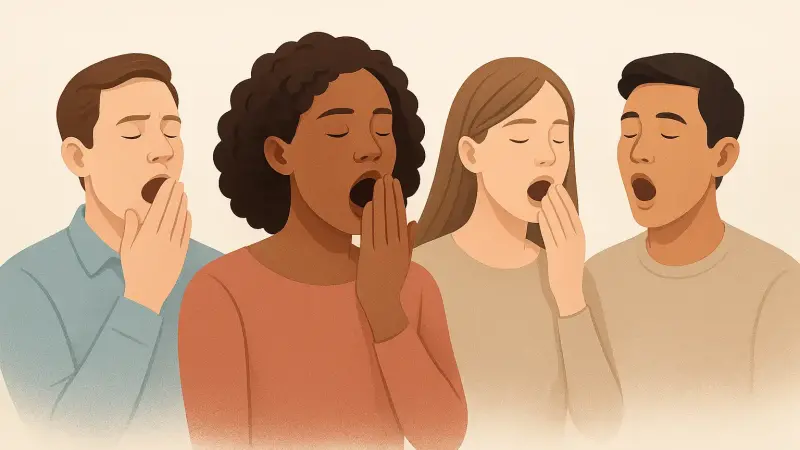
You notice it before you think about it
Someone yawns in a meeting, and two desks away a second mouth opens a few seconds later. It’s not one famous event in one place. It shows up in office rooms in New York, classrooms in London, and on crowded trains in Tokyo. The basic mechanism isn’t mysterious in the spooky sense. The brain is good at copying other people’s actions fast, especially faces. When it sees a yawn, it often prepares the same motor pattern, and sometimes that preparation tips into a real yawn. People also miss a key detail: the “trigger” can be tiny. A quick jaw stretch or even just the word “yawn” can be enough for some people.
Contagious yawning isn’t the same as being tired
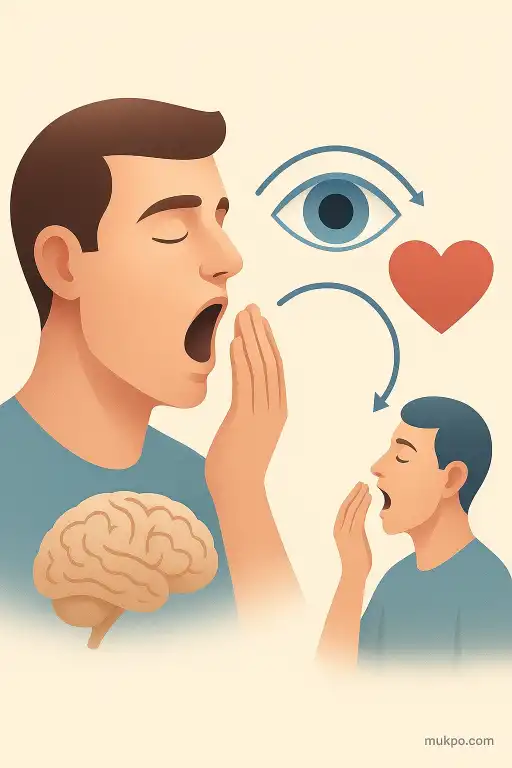
Yawning by itself happens for lots of reasons, and scientists still argue about the main one. Contagious yawning is a narrower thing: it’s tied to noticing another person’s yawn, not to how much sleep you got. The timing is usually quick, often within seconds to a couple of minutes. It’s also selective. A person might yawn after a friend does, but not after a stranger on a screen. And plenty of people never catch yawns at all. That matters, because it hints that the spread is not just “a yawn causes a yawn,” but “a yawn plus attention and social processing sometimes causes a yawn.”
Empathy is part of the story, but not the whole story
Researchers often bring up empathy because contagious yawning seems stronger when people feel socially close. There are studies where people are more likely to yawn after family or friends than after unfamiliar faces. That pattern fits with the idea that some brains automatically mirror signals from people they care about. But it’s messy. Empathy is hard to measure, and different studies use different tests. Some find links between self-reported empathy and yawn contagion. Others find weak or inconsistent links once attention and context are controlled.
One overlooked point is that empathy isn’t a single dial. There’s emotional sharing, perspective-taking, and just being tuned in to someone’s face. Contagious yawning may line up more with that last piece: rapid, low-effort social tracking. A person can be kind and caring and still not catch yawns. Another person can be very susceptible without being especially warm. That’s why many scientists treat it as a clue about social mirroring, not a clean “empathy test.”
What the brain may be copying
Faces are a high-priority signal. When the brain sees a familiar action, it tends to run a matching “template” of that action internally. Yawning is unusually readable. It’s slow, wide, and involves the whole lower face. That makes it a strong candidate for automatic mimicry. But mimicry alone doesn’t guarantee a yawn. People also need to register the cue. If someone looks away at the exact moment the mouth opens, the chain often breaks. That is one reason contagious yawning drops when attention is pulled elsewhere.
There are also competing ideas about why yawning exists at all, which complicates the story. Some researchers have proposed links to arousal changes, state transitions, and even brain temperature regulation. Contagious yawning might piggyback on whatever yawning is “for,” using social information to synchronize state in a group. That idea is plausible, but it’s not settled. What is clearer is that the social cue can activate the yawn program even when the body didn’t “ask” for it first.
When it spreads most, and when it doesn’t
Situationally, the spread is strongest when faces are easy to read. A small conference room is a classic setup: someone sits across the table, no masks, no phone in hand, and the yawn unfolds slowly. It tends to be weaker through text or when only the sound is heard. Video can work, but results vary depending on how close-up the face is and whether the viewer is engaged. Even lighting matters, because the brain needs a clean view of the mouth and eyes to classify what it’s seeing.
Age also seems to matter. Young children often don’t show reliable contagious yawning until later in development, and not everyone agrees on the exact age. That’s another reason researchers link it to maturing social processing rather than simple reflex. There are also differences between people and contexts that are still unclear, including how stress, sleepiness, and social anxiety affect susceptibility. In a room where everyone is trying not to look bored, a single suppressed yawn can still set it off, because the suppression itself changes the face in a recognizable way.
Related reads
- A library that loans bottled rain collected during historic festivals
- A diner that serves one dish only on nights without moonlight
- How tiny pauses in speech reveal honesty and bluffing
- A market that sells jars labeled with the exact hour they were opened
- Methane-eating microbes that slow greenhouse emissions in thawing Arctic ponds
- Why deep-sea squid flash lopsided bioluminescence to disappear from predators