
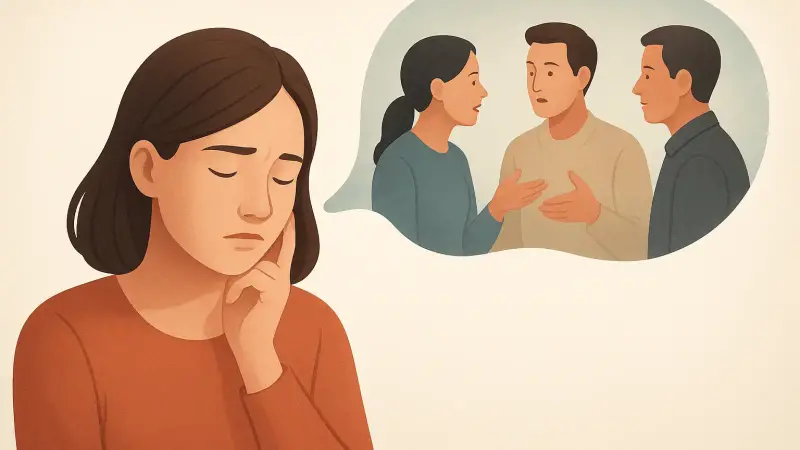
You leave a meeting and the conversation follows you home. Not the whole thing. One sentence. A pause. The look someone gave when you said “sure.” This isn’t one single place or event. It happens after a performance review in a New York office, after a family dinner in Mumbai, or after a first date in Berlin. The basic mechanism is pretty plain: the brain treats social moments as high-stakes, then keeps running them like simulations to check for mistakes and predict what comes next. It can feel like “thinking,” but it often behaves more like an automatic replay button.
Why the brain replays talk
Conversation is fast. You pick words, track tone, read faces, and monitor status all at once. When it ends, the brain finally has time to process the parts it couldn’t fully evaluate in real time. That’s when replay shows up. It’s a delayed quality-control pass, especially for moments that carry social risk: being misunderstood, sounding rude, losing credibility, or missing a cue.
Memory isn’t stored like a recording, so the replay isn’t neutral. It’s reconstructed from fragments. That reconstruction is shaped by emotion. If the moment felt tense, the mind tends to grab the tense pieces first, then rebuild the rest around them.
Which moments get stuck on loop
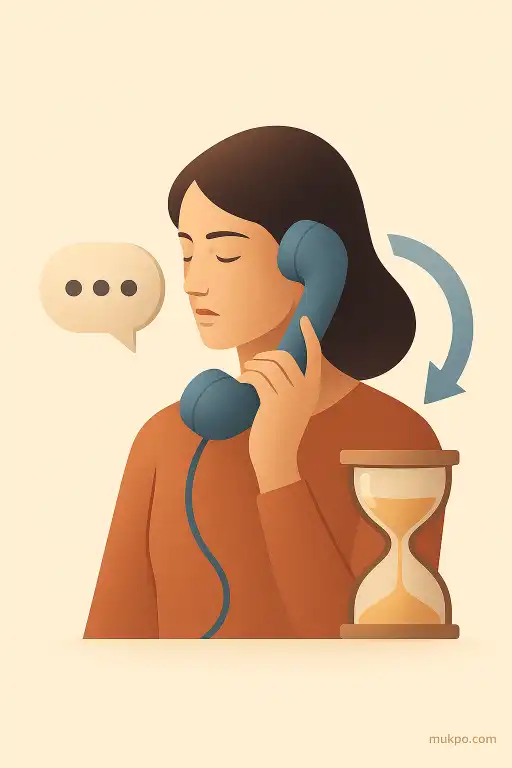
The loops usually form around ambiguity. Clear wins and clear losses end cleanly. But a vague reaction—someone saying “interesting” with a flat voice, or a long beat before “okay”—leaves an open question. The mind keeps replaying to try to close that gap. It’s less about the words and more about the unknown meaning behind them.
A concrete example: a manager ends a call with “Let’s circle back” and the line goes dead. Later, the replay focuses on the last ten seconds. The overlooked detail is often the transition point: the moment you started wrapping up. People tend to remember the end of an interaction more sharply than the middle, so the brain keeps checking that final stretch for evidence of how it “really” went.
What the replay is trying to solve
These replays behave like forecasting. The brain is building a model of other people: what they think, what they’ll do next, what they now believe about you. The conversation becomes raw data for predicting the next meeting, the next text, the next social consequence. That’s why the same scene can keep returning even when it’s unpleasant. It feels unfinished because the prediction still feels uncertain.
There’s also a fairness angle. People replay talk to check if they were treated properly or if they treated someone else properly. That can include moral details that didn’t feel obvious in the moment. A tiny interruption, a joke that landed oddly, a compliment that sounded strategic—small social “rule” violations invite review.
How replay changes the memory itself
Each replay is not just recalling. It’s editing. When someone re-runs a conversation, the brain strengthens certain parts and lets others fade. If the replay always starts at the same awkward sentence, that sentence becomes the anchor. Other neutral details—like the earlier friendly tone or the shared laugh—can blur, even if they mattered at the time.
This is why two people can remember the same exchange differently without anyone lying. They rewatched different “clips.” They emphasized different cues. Over time, the version that gets replayed most becomes the version that feels most true.
Why some people replay more than others
Replaying past talk is common, but its intensity varies. It tends to ramp up when someone is under stress, short on sleep, or navigating status uncertainty—new job, new group, a relationship that hasn’t settled. Personality also matters. People who are more sensitive to social evaluation or who prefer high precision in communication often notice more “loose ends” to tie up.
Culture and setting shape it too. In places where indirectness is normal, more meaning is carried by pauses and context, so there’s more to interpret later. In settings like Slack-heavy workplaces or formal academic environments, a single phrasing can feel permanently searchable, and that can feed the urge to re-check what was said and how it might be read.
Related reads
- Why kitchen lemons grow tiny roots when left in jars
- The town that heard a mysterious low hum no engineer could trace
- Why people stick to familiar routes even when a shortcut is obvious
- How sleep inertia turns you into a slow thinker after naps
- Storms that have actually dropped fish from the sky
- How biological soil crusts glue desert sand into living mats