
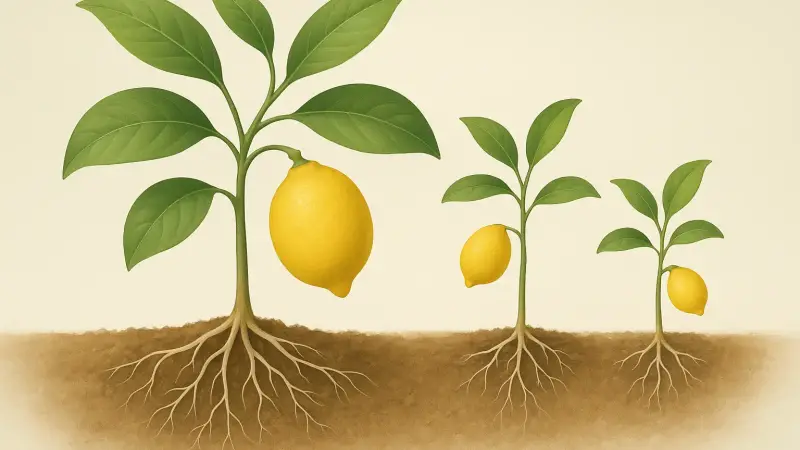
You rinse a lemon, drop it in a glass jar, and forget it on the counter. A week later it looks wrong. The peel is dull, the pulp has slumped, and there are thin white threads clinging to the rind like tiny roots. This isn’t one famous incident in one place. People report it in home kitchens in the U.S., the U.K., and India, and the timing varies with temperature and how wet the jar stays. The core mechanism is simple: trapped moisture plus sugar and acid create a good habitat for microbes, and a few of those microbes grow long, ropey structures that look like plant roots.
What those “roots” usually are
Most of the time the strands are fungal growth, not anything the lemon is sprouting. Molds and some yeasts send out filament-like structures (hyphae or chains of cells) that spread across a surface looking for food. On citrus, they often start where the peel is nicked, where the stem end dried out, or where pulp is exposed. The color can stay bright white at first, especially in low light inside a jar, and only later turn gray, green, or blue as spores form.
A detail people overlook is that the “root” look can come from how the strands attach. They often anchor in tiny oil-gland pits on the peel. Citrus rind is dotted with those glands. Under moisture, those pits hold microscopic droplets and residues that let filaments grip and branch.
Why a jar changes everything
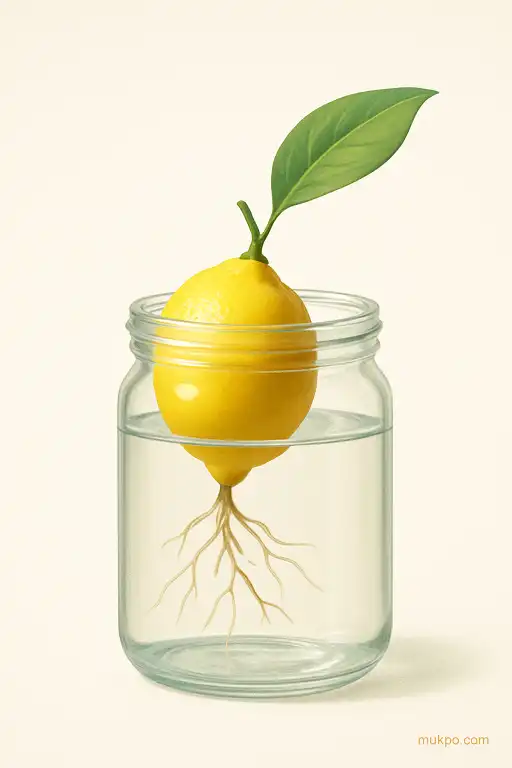
On an open counter, a lemon slowly dries. In a jar, water can’t escape. Condensation forms, runs down the glass, and keeps the peel wet for long stretches. That constant surface dampness matters more than the lemon’s acidity. The acid is inside the fruit, but microbes live on the surface first. A closed container also traps carbon dioxide and other gases from fermentation or decay. That can shift which microbes win the competition.
Even when the lemon looks intact, it is still “breathing.” It releases water vapor and small amounts of carbon dioxide as it ages. The jar turns that normal moisture loss into a humid microclimate. That’s why the same lemon might only wrinkle in a bowl, but grow visible filaments in a sealed container.
How microbes get a foothold on citrus
The peel is a barrier, but it isn’t sterile. Lemons pick up microbes from orchards, packing lines, grocery bins, hands, and cutting boards. Many of those microbes do nothing until conditions change. A tiny bruise, a puncture from a stem, or a hairline crack from drying gives them a doorway into sugary tissue. Once juice leaks out, the surface stops being just waxy rind and becomes a thin film of food.
Temperature swings also help. A jar that warms in daylight and cools at night will “breathe” a little as pressure changes, pulling in and pushing out air through imperfect seals. That can add new spores. It can also move moisture around, repeatedly wetting the same spots where filaments are already established.
Why it can look like plant roots instead of mold
People expect mold to look fuzzy. The early stage often doesn’t. Some molds and yeasts grow smooth, stringy, or webby before they start making the powdery spore layer people recognize. In a jar, the growth can also get stretched by gravity and condensation. Threads form on the upper peel, then get dragged downward as droplets slide, leaving lines that look like root trails.
There’s also a common confusion with the lemon’s own tissues. When citrus breaks down, parts of the inner membrane can detach and curl into pale strands. That material is usually thicker, more translucent, and breaks like wet paper. Microbial filaments tend to be finer and can form branching patterns that repeat across the surface.
What’s happening inside the lemon at the same time
While the surface is growing those threads, the inside is changing texture. Enzymes keep working after harvest. Cell walls soften, and juice pockets collapse. If microbes get inside, they produce enzymes too, and the fruit can turn mushy faster. The smell shifts first, because volatile compounds from peel oils and fermentation build up in the sealed airspace.
The timing varies a lot. A dry, cool kitchen might show only wrinkling for quite a while. A warm room with a little water trapped at the bottom of the jar can show visible filaments quickly. When people notice “roots,” they’re usually seeing the moment the growth becomes organized enough to be seen without looking closely, not the moment it began.
Related reads
- The town that heard a mysterious low hum no engineer could trace
- Why people stick to familiar routes even when a shortcut is obvious
- How sleep inertia turns you into a slow thinker after naps
- Storms that have actually dropped fish from the sky
- How biological soil crusts glue desert sand into living mats
- Why spinning ice slabs can flip and launch during a thaw