

It’s easy to forget how cramped a wooden warship was until you picture trying to run a medical test inside one. In 1747, on HMS Salisbury, the naval surgeon James Lind did something that looks a lot like a trial: he split sick sailors into small groups and changed one thing in their daily routine. The “thing” was food. Scurvy wasn’t a mysterious plague so much as a slow breakdown caused by missing vitamin C, though Lind didn’t know that mechanism yet. He only knew what the body looked like when it started to fail, and he tried to pin the failure to something you could carry in a crate.
Life onboard made scurvy hard to ignore
Scurvy was the kind of illness that turned a ship into its own grim laboratory. Sailors might start with fatigue and sore legs, then swollen gums, loose teeth, bruising, and wounds that refused to close. On long voyages, it could become the main thing limiting how far a fleet could travel without stopping. The diet explains why. Salt meat, dried peas, ship’s biscuit, and beer kept for weeks. Fresh greens and fruit didn’t. Even when a ship had “antiscorbutics” on board, they were often in forms that didn’t survive storage well.
A detail that’s easy to miss is that the ship’s constraints didn’t just shape what sailors ate. They shaped what counted as evidence. If a cure required constant resupply, or spoiled quickly, it wasn’t just medically awkward. It was operationally useless. Naval medicine was always tied to logistics, and that pressure sits behind almost every scurvy “cure” that got tried and abandoned.
The trial on HMS Salisbury was small and improvised
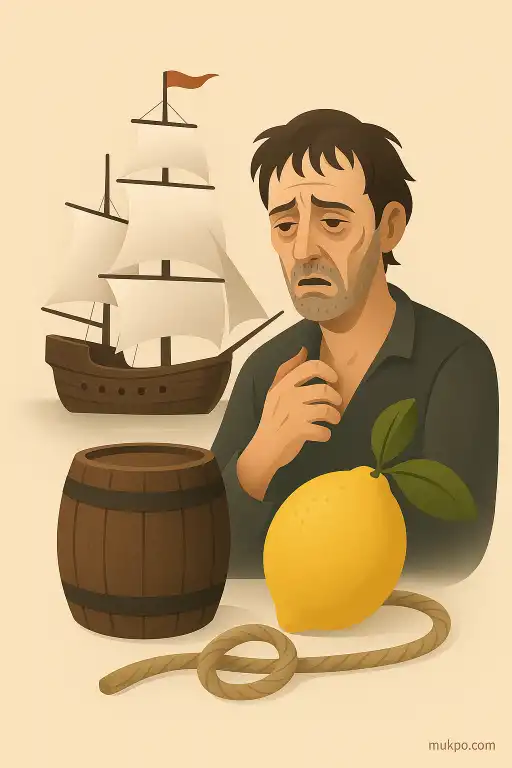
Lind’s experiment is often remembered as neat and modern. It wasn’t. It happened at sea, with a limited number of men already sick. He tried to keep their basic diet the same and then added different supplements. One pair got oranges and lemons. Other pairs got things like cider, vinegar, seawater, or an acidic “elixir of vitriol” (diluted sulfuric acid), based on popular theories of the time about putrefaction and “acidity” in the body. The citrus group improved fast, in a way that stood out even with messy conditions.
Another overlooked detail is the trial’s built-in weakness: citrus ran out. The improvement was dramatic, but it was also brief because the supply was small. That makes the episode feel less like a victory lap and more like a sketch of an idea that still had to fight its way through procurement and doctrine.
Why citrus wasn’t adopted right away
The Royal Navy did not immediately pivot to lemons and oranges for everyone. Part of that was ordinary institutional drag. Part was genuine confusion. Lind himself later recommended “rob” of lemon or orange, a boiled-down concentrate that seemed practical for storage. But heating destroys a lot of vitamin C, so the concentrate could fail in real use. That kind of near-miss is important. It helps explain why people could read about citrus helping and still come away unsure, especially when different ships tried different preparations.
There was also competition from other explanations. Some officers believed scurvy came from damp air, hard work, bad water, or general filth. Those factors did affect health, so the story felt plausible onboard. A food-based cause was harder to accept when the “food” solution might be absent on a given voyage, or when it appeared to work in one form and not another.
Supplying a fleet changed the kind of citrus that mattered
Once the Navy started treating citrus as standard issue, the question stopped being “does it help?” and became “which citrus, and how do we move it?” Lemons were used early on, but limes became common later because they were easier to source in bulk from British Caribbean supply lines. That shift helped the Navy build a routine system, but it introduced a quiet vulnerability. Many limes have less vitamin C than many lemons, and storage practices could chip away at potency. Success depended on getting enough of the right juice, kept in a way that preserved what made it work.
Citrus also fit the shipboard world in a way other proposals didn’t. It could be rationed. It could be measured. It could be written into orders. On a crowded deck, that mattered as much as theory. A cure that can be counted is easier to defend in paperwork than one that depends on a stopover that may or may not happen.
What the cramped trial did that a tidy theory couldn’t
The power of Lind’s shipboard test wasn’t its size. It was the contrast. Same setting, same sick men, different add-ons. In the middle of a floating routine built around standard rations, citrus created a visible change quickly enough for other people to notice. The trial didn’t tell the Navy about vitamins, and it didn’t settle every argument. But it created a kind of evidence that could survive shipboard gossip and officer skepticism because it was tied to bodies improving on a schedule.
It also forced the Navy to confront a practical point that sounds mundane: scurvy wasn’t beaten by discovering a secret ingredient. It was beaten when the fleet could reliably carry that ingredient, issue it, and keep it active long enough to matter.

Related reads
- The lichen that drinks rock vapor to survive deserts
- How a single brief apology can dissolve social tension
- The plankton that weaves glass armor from seawater silica
- Why a familiar name sometimes won’t come to mind
- A town that kept a cat as an honorary mayor for decades
- The skin bacterium that converts body odor into floral notes