
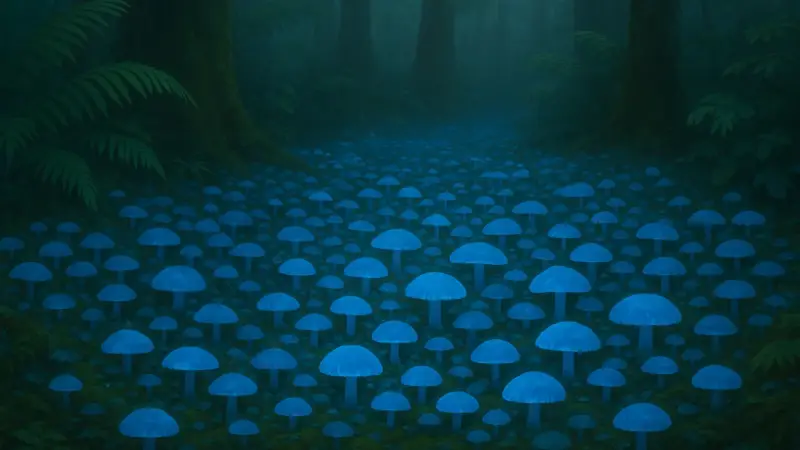
A glow that only shows up when the forest is dark enough
If you walk a rainforest trail at night, there’s a moment when your eyes adjust and the ground starts to look wrong. Not reflective. Not dusty. Just faintly, steadily blue. This isn’t one single place or one single species, either. People have reported it in parts of Brazil’s Atlantic Forest, in Malaysia’s rainforests, and in Japan’s subtropical forests on Yakushima. The effect comes from bioluminescent fungi: living cells running a chemical reaction that produces visible light, often strongest on the threadlike mycelium spread through leaf litter and rotting wood.
The fungi most often involved

The best-known “glowing mushroom” images usually show a cap and stem, but the carpeting look usually points to something else: glowing mycelium. Several species can do it. In the Americas, Neonothopanus gardneri (often described from Brazil) is one of the famous examples. In Asia and the Pacific, species in the Mycena group and relatives get mentioned a lot. Identification in the wild can be uncertain because different species can look similar in daylight, and glow intensity varies with humidity, age, and what the fungus is growing on.
One overlooked detail is that the brightest glow is often not the mushroom at all. It’s the network under it. The mycelium can spread into a wide, thin sheet through decaying plant material, so the light appears “painted” across the forest floor. The fruiting bodies can be tiny, short-lived, or hidden under leaves. Sometimes they never appear where you’re standing, even though the glow does.
How living tissue makes blue-green light
Fungal bioluminescence is chemical, not electrical. The basic setup is a light-emitting molecule (a luciferin) and an enzyme (a luciferase) that helps it react with oxygen. In fungi, researchers have described a pathway built around compounds related to caffeic acid, which is common in plants. The reaction ends with an excited molecule that relaxes by releasing a photon. That photon lands in the blue-green range, which is where human night vision is relatively sensitive.
The glow can look stronger after rain. That’s partly because the fungus is metabolically active when it has enough moisture, and partly because wet surfaces reduce dusty scattering and let light travel through thin films in the litter. The light is usually constant rather than blinking. If someone sees “pulsing,” it’s often their eyes and movement interacting with very low light, not the fungus switching on and off.
Why a fungus would spend energy on glowing
There isn’t a single settled answer. One idea is that light attracts insects or other small animals that then help spread spores. This has been tested in some systems, with mixed results depending on the species and the local insect community. Another idea is that glowing is a side effect of chemistry the fungus is already using to manage oxidative stress while breaking down wood and leaves. Fungi are essentially running a controlled burn at the molecular level, and dealing with reactive oxygen is part of the job.
Those two explanations don’t have to compete. A pathway can start as metabolic housekeeping and later become useful for interactions with animals. What’s clear is that glow intensity is not “for humans.” It’s tuned to a forest where the background is very dark, and where even a weak signal can stand out to a night-active insect a few centimeters away.
What people usually miss when they see it in person
The first miss is scale. Photos often make it look like a neon carpet stretching for meters. In reality, patches can be small and broken, shaped by where wood is rotting under the leaf litter. A fallen branch buried under leaves can glow along its length, while the surrounding soil stays black. The second miss is color. Cameras tend to exaggerate saturation in long exposures, and the “blue” can be closer to blue-green in person, sometimes almost gray-green until your eyes fully adapt.
The third miss is that it can be easy to confuse bioluminescence with other night glows. Some insects glow, some fungi reflect stray light, and human gear (watch faces, phone screens, even whitening agents in fabric) can throw off impressions. When the light is truly from the fungus, it stays steady, it comes from the decaying material itself, and it often traces the hidden map of what’s decomposing under your feet.
Related reads
- An elevator that stops for no passengers and opens to reveal a single folded note on the floor
- The microbes living on commuter shoes
- A shoemaker who found a child’s drawing hand-stitched inside a pair of century old boots
- How micrometeorites alter planetary atmospheres
- How quantum coherence helps plants harvest light
- The Tambora eruption that turned 1816 into a year without a summer and sparked food riots across Europe