

Dust that arrives already moving fast
People notice meteors because they flare. The steady rain that matters for atmospheres is smaller than a grain of sand. There isn’t one single place where this happens. It’s global. NASA has even flown high-altitude collectors over Antarctica to gather tiny spherules believed to be micrometeorites, and researchers have also found them in deep-sea sediments and in rooftop dust in cities like Oslo. The basic mechanism is simple. These particles hit the upper atmosphere at orbital speeds, heat violently, and either vaporize or melt into glassy droplets. That energy and new material change the chemistry and electrical behavior of the air they pass through.
What a micrometeorite actually does on entry

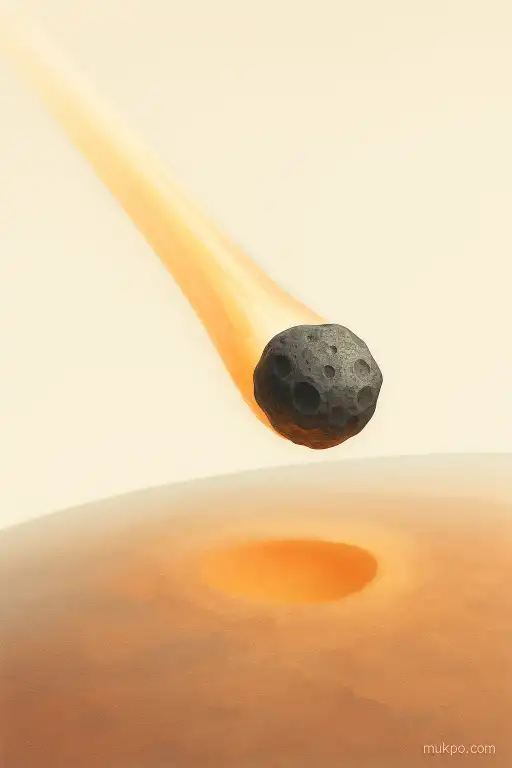
Most micrometeorites never reach the ground intact. Frictional heating isn’t like a campfire. It comes from compressing air in front of the particle at tens of kilometers per second. The particle’s surface can melt, then boil. Metals and silicates evaporate and recondense as nanoscale “smoke” particles, while tougher grains survive as molten spherules that cool quickly. A specific detail people overlook is altitude. The deposition happens high up, often in the mesosphere and lower thermosphere, where the air is thin but chemistry is extremely sensitive to new surfaces and ions.
Metal atoms, ion layers, and strange night clouds
When a micrometeorite ablates, it releases metal atoms like iron, magnesium, and sodium. Those atoms don’t just “mix in.” They form thin metal layers that can be detected by lidar and radar, and they can become ions that affect the conductivity of the upper atmosphere. This is tied to sporadic E layers—patchy, dense sheets of ionization in the ionosphere that can reflect radio waves. The chemistry also matters. Meteoric smoke particles provide surfaces where molecules can stick and react, which changes how quickly certain compounds form or get removed at those heights.
Those tiny particles also appear to be involved in noctilucent clouds, the high, icy clouds seen at high latitudes on summer nights. The ice needs something to nucleate on in very cold, very dry air near the mesopause. Meteoric smoke is one candidate for those nuclei. The exact balance is still studied because temperature, water vapor transport, and atmospheric waves also control whether the clouds show up, but micrometeorite debris is part of the recipe scientists keep testing.
Aerosols and chemistry lower down
Not all the injected material stays high. Some smoke particles and oxidized fragments drift downward over time and become part of the broader aerosol population. That gives the atmosphere new surfaces, and surfaces are where a lot of “quiet” chemistry happens. For example, heterogeneous reactions on particles can shift nitrogen and chlorine compounds between forms that are more or less reactive. How large this effect is varies with altitude, particle composition, and season, and it’s harder to pin down than the dramatic physics of a bright meteor.
Micrometeorites also deliver oxygen-hungry metals that quickly oxidize. That changes local chemical budgets in the upper atmosphere, even if only briefly. Some studies focus on iron because it’s abundant in cosmic dust and because iron-containing particles have distinct optical and magnetic signatures that are easier to track than many other components.
Why this matters for other planets, too
Earth is just the easiest place to measure these effects. Mars gets micrometeorite input too, but its atmosphere is thin, dusty, and chemically different, so ablation products and smoke formation don’t play out the same way. Venus has a dense CO₂ atmosphere that can slow and heat particles differently, changing how much ablates and where. Even airless bodies nearby still matter indirectly. The Moon’s surface is constantly micrometeoroid-bombarded, kicking up ejecta and a tenuous exosphere that has to be understood alongside whatever dust is passing through near-Earth space.
The tricky part is scale. The total mass added by micrometeorites is small compared to an atmosphere’s mass, but the effects are concentrated high up, where a tiny number of particles can change charging, light scattering, and reaction rates. That’s why scientists keep flying collectors, pointing lidars at faint metal layers, and using radar to watch ionized trails—because the smallest impacts can leave the most measurable fingerprints.
Related reads
- How quantum coherence helps plants harvest light
- The Tambora eruption that turned 1816 into a year without a summer and sparked food riots across Europe
- A lost photograph that appeared framed in different homes with a new person’s face each week
- Jellyfish that revert to adolescence when stressed
- Sleep fog and the slow brain: what causes those first groggy minutes
- How volcanic ash once cooled climates and shrank harvests