
Hearing one by accident
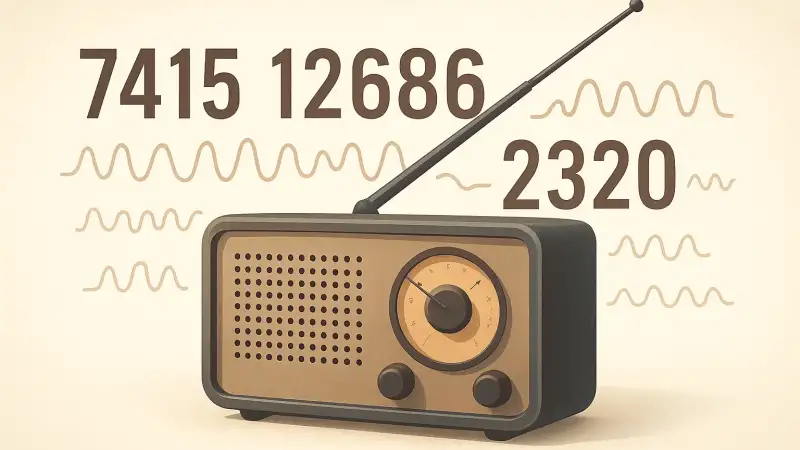
Sometimes you spin the shortwave dial looking for music or weather and land on something that feels wrong for radio. A flat voice reads groups of numbers. Or a few notes repeat, then silence, then more notes. This isn’t one single “station” tied to one place. It’s a pattern that’s shown up across regions for decades, including the UK-linked “Lincolnshire Poacher” broadcasts, Cuba’s “Atención” transmission known as HM01, and the Russian-language “Buzzer” (UVB-76). The mechanism is simple on the surface: a transmitter puts coded text on the air, and anyone can hear it, but only the intended listener can make sense of it.
What “coded messages” means on shortwave

Most classic number stations use voice (male or female), a steady cadence, and number groups, often in blocks of five. Others send Morse code, or digital bursts that sound like chirps. The reason shortwave fits this is physics. HF signals can travel far by bouncing off the ionosphere, and coverage changes with time of day and season. That’s why a broadcast aimed at one region can end up audible in another. It also means the sender doesn’t need a network of towers, phone lines, or local infrastructure to reach someone a continent away.
The part people often overlook is how “public” the whole thing is by design. These transmissions usually don’t try to hide that they exist. They just assume the content stays secret because of the cipher, not because the signal is hard to find. A one-time pad is the famous example: the message can be perfectly readable to anyone with the right pad, and useless to everyone else, even if it’s recorded and studied for years.
Examples that are still heard
Cuba’s HM01 is a well-known case that has been logged repeatedly by hobbyists. It mixes a Spanish voice (“Atención”) with digital data segments, which is unusual compared to older voice-only formats. Russia’s UVB-76, nicknamed “the Buzzer,” is different again. It’s mostly a monotonous buzzing tone, interrupted occasionally by short spoken Russian messages. It doesn’t behave like a tidy schedule of number groups, but it’s still widely treated as part of the same world: strange, structured transmissions that aren’t meant for general listeners.
There are also famous examples that stopped but help explain what “normal” can look like. The “Lincolnshire Poacher” station, often associated with UK intelligence in public discussion, used a snippet of an English folk song as an interval signal before reading numbers. It went off the air in 2008. The details of who ran many of these stations are unclear, and attribution often rests on patterns, timing, language, and where signals seem strongest, not on official confirmation.
How listeners and analysts make sense of them
Because the content is encrypted (or assumed to be), analysis tends to focus on everything around the message. People log frequencies, times, languages, the length of call-ups, and whether there’s an interval signal. Those little “radio” details can be consistent for years. If a station always starts on the hour, always uses the same intro phrase, or always transmits in two back-to-back frequencies, that stability becomes part of its fingerprint.
Another overlooked detail is the role of interference and redundancy. Some transmissions repeat the same groups multiple times, which sounds pointless until you remember fading and noise. Shortwave reception can drop out for seconds at a time. Repetition can make the message recoverable even with a bad signal, without needing the receiver to transmit anything back. That one-way design is a key feature, whether the audience is one person or many.
Why they persist in a world with the internet
It’s tempting to assume they’re relics, but shortwave has properties modern networks don’t. A receiver can be passive and hard to detect. No login. No packet trail. No local service provider to subpoena. A cheap radio can be enough. That doesn’t prove any specific station is tied to espionage today, but it explains why the method remains attractive to anyone who wants one-way messaging across borders without relying on third-party infrastructure.
Shortwave also ages well. Transmitters and antennas are blunt tools, but they’re durable, and HF propagation doesn’t care what year it is. So these broadcasts can sit alongside satellites and fiber without competing with them. On a quiet night, you can still hear a rigid voice counting into the noise, as if radio never moved on.

Related reads
- The 1970 Oregon operation that detonated a beached whale and scattered blubber across the beach
- Why people scramble to break awkward silence
- How a meteorite can seed new minerals in desert soils
- An island where cats outnumber people by the dozens
- The Italian town that banned high heels to stop tourists chipping its ancient stones
- How short routines calm decision anxiety