
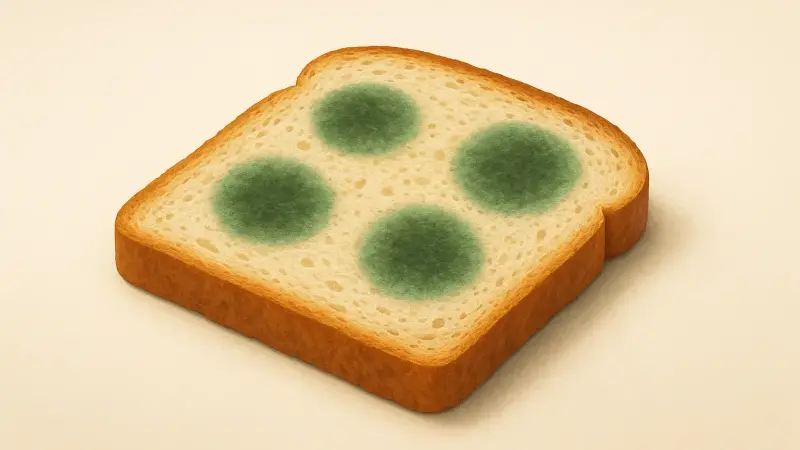
Not one place, but it’s a common kitchen pattern
You cut into a loaf and notice something oddly neat: a round, greenish spot that looks like it was stamped on. This isn’t tied to one town or one famous incident. People see it in homes in the U.S., the U.K., and Japan, and it can happen with supermarket sandwich bread or a bakery boule. The core mechanism is simple. Mold doesn’t spread as a smooth “fuzz wave.” It starts from a single spore that lands in one tiny wet-friendly spot, then grows outward in all directions. That radial growth is why the first visible patch often looks close to a circle.
A circle is what you get from one starting point
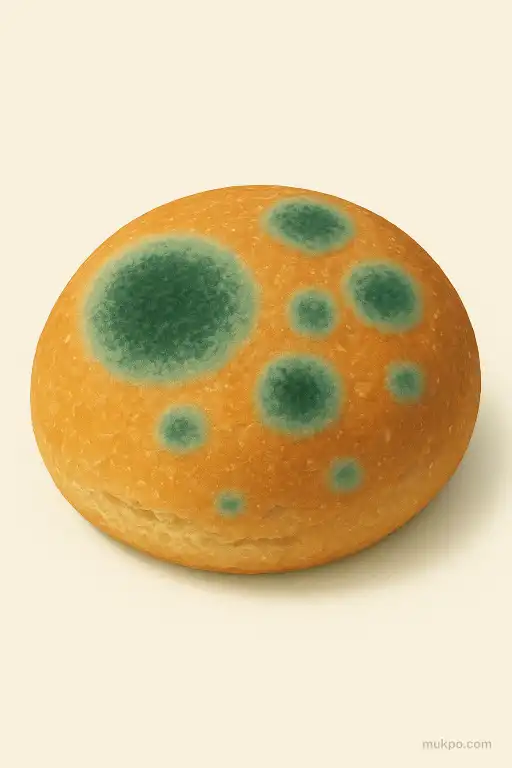
If one spore germinates, the mold body expands outward roughly evenly, like ripples. At the scale of a bread slice, there usually isn’t a strong “left to right” force pushing it. So the colony edge advances at a similar speed in every direction. Early on, that makes a clean round boundary.
The neat edge is also partly an illusion created by visibility. A colony can be larger than it looks. The center sporulates first, so it colors up first. The outer ring may still be pale, flat, and easy to miss. People often overlook that the circle they see is defined by pigment and spores, not the true reach of the organism.
Moisture isn’t uniform, and bread has micro‑landscapes
Bread looks uniform, but it isn’t. There are tiny air pockets, denser “walls,” and cracks from slicing. Water migrates through this structure. A slightly wetter pocket can form where the crumb is denser or where a slice was compressed in the bag. That small wet zone becomes the best launchpad, so growth starts there and radiates out.
One specific detail people miss is condensation from temperature swings. If a bagged loaf cools after being warm—say it sat in a car, then went into a cooler kitchen—water can condense on the inside of the bag. The droplets don’t coat everything evenly. They touch in a few spots, soaking small areas of crust or crumb. Those spots are exactly where a circular patch tends to appear first.
One spore can be enough, but the environment decides the shape
Air is full of spores from common bread molds like Rhizopus (“black bread mold”) and Penicillium (often green or blue-green). A loaf doesn’t need to be “contaminated all over” to show mold. A single viable spore in a favorable micro-spot can create one tidy colony, while nearby spores fail because the surface is drier or saltier.
The colony stops looking circular when the bread stops being uniform for it. It may hit a dry crust, a seam, or a region with less available water and slow down on that side. That’s when circles turn into ovals, lobes, or patches that follow cracks. The earliest stage looks the neatest because the mold hasn’t yet run into those boundaries.
Why “perfect” patches show up as separate dots
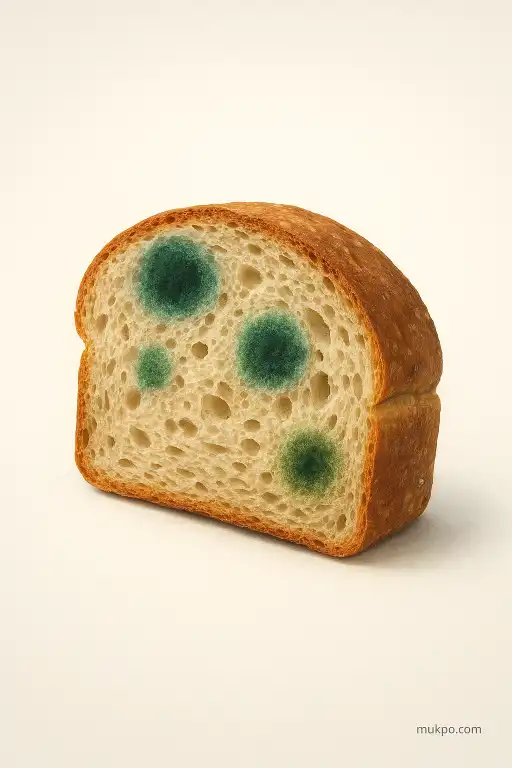
Sometimes there are several circles on one slice, each separated by clean-looking bread. That usually means several spores germinated in separate micro-spots at roughly the same time. Each colony expands outward. They don’t instantly merge into a sheet because the bread between them may be a little drier, or simply because the colonies haven’t reached each other yet.
Even when colonies get close, they can keep distinct edges for a while. Different species, or even different strains of the same species, can compete chemically. The boundary where they meet can stay sharp, which makes the patches look even more deliberate. On a kitchen counter, it’s easy to read that as “mold chose a circle,” when it’s mostly geometry plus a few invisible differences in moisture and structure.
Related reads
- An elevator that refuses to open on floors with odd birthdays
- How volcanic ash shapes global weather patterns
- How a tiny meteorite impact changes local soil chemistry
- The bench that always held a single lost glove belonging to the same person
- Why ordinary noises seem louder and creepier at night
- The mushroom that smells like rotting meat to lure flies