
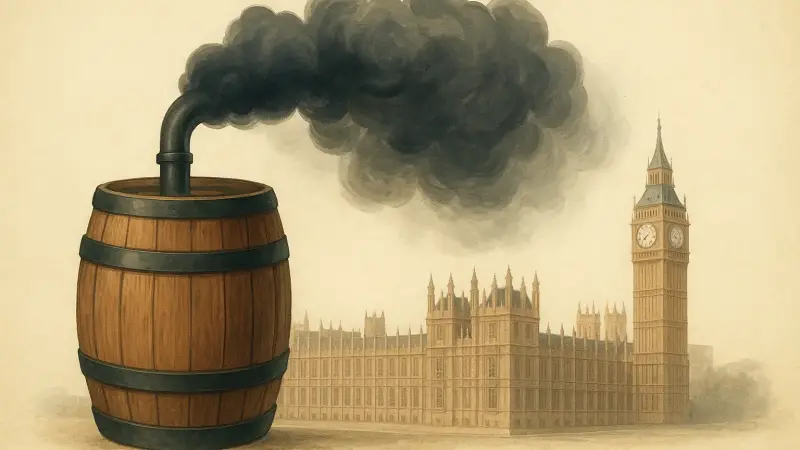
A smell that shut the windows at Westminster
Most bad smells can be escaped by stepping outside or opening a window. In London in the summer of 1858, the opposite was true. The River Thames, running past the Palace of Westminster, became so foul that members of Parliament struggled to work at all. It wasn’t just an unpleasant backdrop. Heat baked the river into a slow-moving stew of human waste and industrial runoff, and the stink pushed straight into the building. Curtains soaked in chloride of lime were hung at windows. Attempts were made to block the air. But the source was right there, and it wasn’t going anywhere.
Why the Thames was so bad by 1858

London had been growing fast for decades. More people meant more sewage, and most of it ended up in the Thames. New water-flushed toilets made the problem worse in an unexpected way. They were convenient indoors, but they pushed far more waste into drains and cesspits, and then into the river, faster than old systems ever had. Meanwhile, industries along the banks dumped chemicals and organic waste. The Thames was also a working river. Tide and low flow could leave pollutants lingering near the city instead of carrying them away.
A specific, overlooked detail is how much the temperature mattered. The “Great Stink” wasn’t a sudden new invention of filth. The river had been dirty for years. The summer heat in 1858 intensified decay and released more gas from the water. That changed the experience from “bad river” to “air you can’t ignore,” especially inside rooms facing the embankment.
How it disrupted Parliament day to day
The Palace of Westminster sits close to the Thames, and that proximity turned into a practical problem. Members tried to carry on, but the smell seeped into committee rooms and chambers. Reports from the time describe efforts to keep windows shut despite the heat, which made rooms stuffier and debates harder. The chloride-of-lime curtains are the famous image, because they show the situation wasn’t treated as a minor nuisance. People were actively trying to chemically fight the air coming in.
It’s easy to imagine officials simply being dramatic, but the building was effectively stuck between two bad options: open windows and take the full blast from the river, or close them and sit in hot, stagnant air during long sittings. Either way, the stench was baked into the work environment, and that changed what was politically tolerable to postpone.
What people thought was dangerous (and what was)
Victorians often linked disease to “miasma,” the idea that bad air itself caused illness. So the smell wasn’t only disgusting. It felt threatening. Cholera outbreaks had hit London earlier in the century, and many people believed foul odors were the driver. That belief shaped the urgency, even though the real danger was contaminated water carrying pathogens. The same sewage that made the river unbearable also helped spread waterborne disease, especially where drinking water and waste mixed through flawed intakes, pumps, and pipes.
This mismatch mattered. Fear focused on the nose, but the fix that was needed involved engineering. A city could deodorize rooms and still drink polluted water. The Great Stink made the river impossible to ignore, but the underlying problem was a sanitation system that treated the Thames as a convenient drain.
The engineering response that followed
The crisis helped force action toward a large-scale sewer solution associated with Joseph Bazalgette, chief engineer at the Metropolitan Board of Works. The basic idea was to intercept sewage before it reached central London’s riverfront, then carry it eastward through major sewers. This wasn’t a small patch. It required coordinated construction, new embankments in places, and a willingness to spend public money on infrastructure that would mostly be invisible when it worked.
One reason the episode is remembered is that it shows how political will can hinge on proximity. Londoners upstream and downstream had suffered the river for years, but when the smell invaded the heart of government at Westminster, delay stopped being comfortable. The Thames was no longer a distant municipal problem. It was inside the room.
Related reads
- The silent chemistry that paints autumn leaves in reds and golds
- What makes lightning behave differently over oceans and mountains
- The desert dunes that sing when you walk on them
- Why songs get stuck in your head
- How termite mounds regulate temperature with clever architecture
- The road that drowns twice a day and returns with the tide