

That moment a chorus won’t leave
It’s not one single event or place. It happens on commutes in London, in school hallways in Mumbai, and in grocery aisles in Chicago. A song plays once—maybe a few seconds of a chorus—and later it loops on its own, even when the room is quiet. The core mechanism is plain: the brain is good at predicting patterns, and music is built out of patterns that beg to be completed. When the brain keeps “finishing” the pattern, the feeling is that the song is still playing. It’s often strongest with short, catchy phrases because they’re easy to rehearse without trying.
Earworms are a memory loop, not a full replay
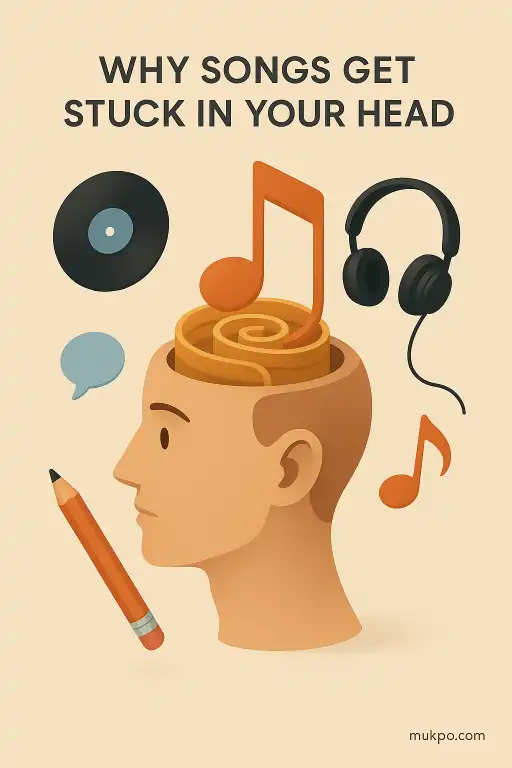
People usually imagine they’re re-hearing a whole track. More often it’s a tiny slice: a hook, a single lyric, a rhythm that fits in a few seconds. That matters because short sequences can cycle in working memory, the mental “scratch space” used for holding sounds long enough to compare and predict them. Music also links sound to motor planning. Even sitting still, the brain areas involved in timing and imagined movement can keep the beat running, which makes the loop feel stubborn.
It also isn’t always about liking the song. Familiarity helps, but novelty can, too. When something is almost known—half-remembered lyrics, a melody recognized but not fully placed—the mind keeps probing for the missing piece. That probing can resemble rehearsal, even when nobody intends to rehearse.
Why certain songs “stick” better than others
Catchiness is partly engineering. Many sticky hooks use small pitch jumps, repeated notes, and a narrow range, so they’re easy to generate internally. Simple rhythmic shapes help as well. A chorus that lands hard on the beat is easier for the brain to predict, and prediction is the habit that keeps the loop turning. Repetition inside the song matters too: if the hook repeats several times, the brain gets extra chances to encode it with very little effort.
A detail people overlook is where the hook starts and ends. Loops often form around a phrase that resolves almost, but not completely, in a satisfying way. It can end on a note that feels like it should move somewhere else, or it can cut off mid-thought in the lyric. That slight “open” ending gives the mind a reason to run it again, because completion is the brain’s default mode for familiar patterns.
Attention, stress, and the “spare bandwidth” problem
Earworms show up most when attention is partly occupied but not fully engaged. Think of washing dishes, waiting for an elevator, or walking from a parking lot to an office. The mind has enough bandwidth to generate internal sound, but not enough external demand to crowd it out. That’s why a song can appear in the gap between tasks, even if nothing musical is happening in the environment.
Stress can amplify it, but not in a simple way. Some people report more looping when they’re tense because repetitive thoughts in general become easier to trigger. Others notice it when they finally relax, because the brain stops tracking urgent details and slips back into automatic prediction and rehearsal. The direction varies, but the common thread is mental load: the loop has room to run, or it fights for space.
How the world around you sneaks the song back in
Often the trigger isn’t “hearing the song.” It’s hearing something shaped like it. A cashier’s scanner beep can match a rhythm. A phrase in conversation can share the same syllable pattern as a lyric. Even a single word can act like a cue if it’s strongly tied to a chorus. Advertising and short-form video make this easier because they repeat the same snippet with the same timing, over and over, so the brain learns a very specific loop rather than a full piece of music.
There’s also the social layer. When a tune is connected to a recent moment—someone singing it in the car, a stadium chant, a clip everyone quoted that week—memory pulls in the context along with the sound. The loop can be less about melody and more about the brain revisiting a fresh association, with the hook acting like the handle it grabs first.
Related reads
- How termite mounds regulate temperature with clever architecture
- The road that drowns twice a day and returns with the tide
- The lake that turns birds into stone
- Why peat bogs are such effective time capsules for pollen
- Why some rocks end up glazed with natural mineral polish
- The Alaskan town where night stretches for 65 days and residents throw sunrise parties